

Yes, gutter guards work, with real limits. Independent long-term testing shows fine-mesh systems block most leaves and large debris, cutting how often you need to clean your gutters, but no system is maintenance-free. They deliver the most value for multi-story homes, properties with heavy tree canopy, and anyone who dreads the ladder. If any of that describes your home, the next move is to check your debris type and access risk, then decide whether to compare products yourself or get a professional assessment.
TL;DR:
- Choose fine mesh for pine needles, pollen, and shingle grit; coarse screens suit large leaves, but even fine mesh needs occasional surface cleaning.
- Single story homes with little nearby tree cover may find twice yearly cleaning simpler and cheaper than buying and maintaining guards.
- DIY materials often cost under $100 to a few hundred dollars, while professional systems can run several hundred to several thousand.
- Inspect guards after major storms and seasonally in fall and spring; rinse surface buildup and clear downspouts, which can clog despite an effective guard.
- Heavy rain can overwhelm guards, especially on steep roofs or with undersized downspouts, so assess drainage capacity and roof conditions before installation.
Table of Contents
- How different gutter guard designs work and why that matters
- Independent tests and expert observations on real-world performance
- Pros and cons, and homeowner profiles that get the most value
- Selection criteria: which guard type to prefer for common debris and roof conditions
- Typical costs and how to think about return on investment
- What maintenance remains and a short inspection checklist
- How a professional installer evaluates and installs guards
- Impact of gutter guards on water flow and drainage efficiency
- Comparison of gutter guards versus regular gutter cleaning in long term
- Environmental considerations and impact of gutter guard materials
- Warranty and lifespan details for different types of gutter guards
- How gutter guards affect roof and gutter system warranties
- What I’d tell a friend asking about gutter guards
- Get a professional gutter guard assessment
- FAQ
- Sources
How different gutter guard designs work and why that matters
Every gutter guard tries to solve the same problem in a different way: let water in, keep everything else out. The design determines how well that trade-off actually holds up once leaves, pollen, and grit get involved.
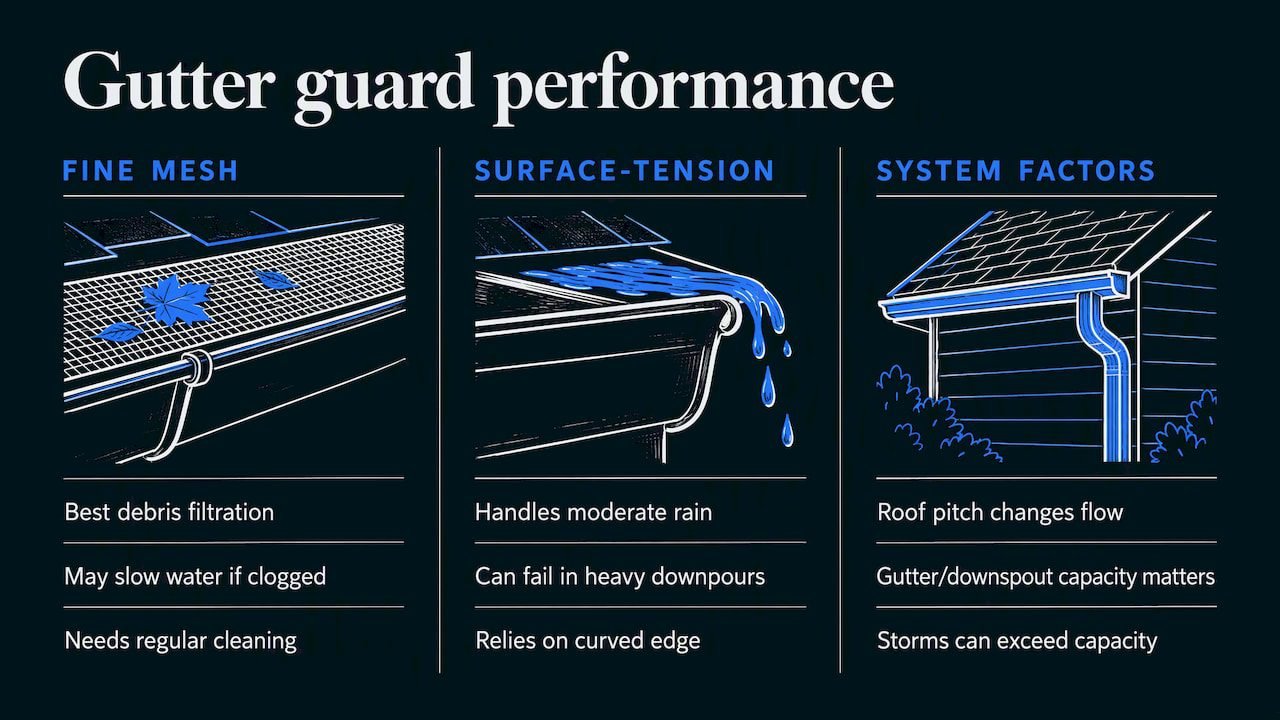
- Surface-tension and edge systems use a curved hood that lets water cling and flow around a sharp edge while debris drops off the front.
- Fine-mesh and micro-mesh screens sit over the gutter opening and physically filter out particles, including small ones like pine needles and shingle grit.
- Foam and brush inserts fill the gutter channel, blocking debris at the surface while water seeps through.
- Louvered and reverse-curve guards angle debris away using a sloped surface rather than a mesh barrier.
Water does not always follow the path a manufacturer promises. Shingle grit and fine pollen can still slip through coarser screens or settle on top of surface-tension hoods, and heavy rain can overshoot a guard entirely if the slope or flow rate exceeds what the design handles. Compatibility matters as much as the guard itself: a steep roof pitch sends water downhill fast, a low-pitch roof lets debris sit longer, and your existing gutter profile (K-style versus half-round) affects how securely any guard fastens.
Independent tests and expert observations on real-world performance
Marketing claims and lab results do not always line up, which is why long-term outdoor testing matters more than a product’s packaging. Controlled testing summarized by Consumer Reports found that fine-mesh screens generally block more debris, while some professionally installed surface-tension systems performed worse once rainfall intensity was pushed to simulate severe downpours. That same testing found that several homeowner-installed screens scored well for debris blocking at a fraction of the cost of integrated pro systems.
Fine-mesh designs tend to outperform coarse screens on fine debris, according to long-term testing of gutter guard systems, which found micro-mesh blocked needles and small particles that coarser guards let through. That protection comes with a small catch: debris that collects on top of fine mesh still needs an occasional rinse or brush pass.
Reporting on homeowner experience backs this up with a practical caveat. Gutter guards reduce the frequency of cleanings but are not maintenance-free, since even strong performers still need periodic inspection and surface cleaning, especially where pollen or shingle grit accumulates. Common failure points show up in predictable places:
- Pollen and shingle grit that cakes onto mesh surfaces over a season.
- Pine needles that wedge into coarse screens or louvered gaps.
- Overflow during intense storms that exceed a guard’s water-handling capacity.
- Downspouts and elbows that clog even when the guard itself performs well.
The pattern across tests and reporting is consistent: guards change the maintenance burden, they do not erase it.
Pros and cons, and homeowner profiles that get the most value
Gutter guards are not a universal upgrade. They are a strong fit for some homes and a marginal one for others, so it helps to weigh both sides against your own property before you decide.
- Fewer ladder climbs, which matters most for multi-story homes or steep rooflines where access is genuinely risky.
- Lower clog risk, reducing the chance of overflow that damages fascia, soffits, or foundation landscaping.
- Pest deterrence, since standing debris and trapped water in open gutters attract mosquitoes and nesting pests.
- Potential long-term savings by avoiding water damage repairs, though this depends heavily on your home’s exposure.
On the cost side, guards carry an upfront price that takes years to offset through avoided cleanings, cheap products can warp or sag within a few seasons, and even quality systems can overflow in extreme downpours that exceed their design capacity.
Professional roofing experts note that guards deliver the most value for homes with mature tree canopies, multi-story layouts, or rooflines that make ladder access genuinely dangerous. A single-story home with few nearby trees may find that routine cleaning twice a year is simpler and cheaper than any guard system.
Pro Tip: If climbing a ladder to your gutters makes you nervous, that safety factor alone can justify guards even when the pure cleaning-cost math looks marginal.
Selection criteria: which guard type to prefer for common debris and roof conditions
Choosing the right guard starts with your debris, not the product reviews. Pine needles, oak leaves, and pollen each behave differently once they hit a gutter, and the guard that handles one poorly might handle another well.
- Match mesh fineness to your worst debris: fine mesh for pollen, pine needles, and shingle grit; coarser screens are fine for homes that mostly deal with large leaves.
- Favor durable metals like aluminum or stainless steel over plastic or vinyl guards that can become brittle under sun exposure over several seasons.
- Weigh DIY screens and inserts against micro-mesh or pro-installed systems based on your budget, your comfort on a ladder, and whether a warranty matters to you.
- Watch for red flags: systems sold purely on surface-tension claims without independent testing behind them, guards installed in a way that voids a roof shingle warranty, and fastening methods that rely on adhesive alone rather than mechanical attachment.
If your biggest debris problem is fine particulate rather than whole leaves, a coarse guard will give you a false sense of security. If your home sits under heavy tree cover, the fine-mesh category is worth the extra cost over basic screens.
Typical costs and how to think about return on investment
Gutter guard pricing spans a wide range, and the gap between a DIY project and a professional installation is significant. DIY guard materials typically run under $100 to a few hundred dollars for an average home, while professionally installed systems, especially micro-mesh or integrated gutter-and-guard combinations, commonly run several hundred to several thousand dollars depending on linear footage and installation complexity.
Several factors drive where you land in that range:
- Linear footage of gutter being covered, since pricing scales with the length of your home’s perimeter.
- Roof complexity, including multiple stories, steep pitches, or dormers that require custom cuts and extra labor.
- Warranty and service terms, where a longer warranty or a no-clog guarantee typically adds to the upfront price.
A simple way to judge ROI: add up what you currently spend on annual gutter cleaning plus any realistic risk of water damage from a missed cleaning, then compare that figure against the installation cost and what the warranty covers. For homes with frequent cleanings and difficult access, guards often pay for themselves within a few years. For low-debris, single-story homes, the payback period stretches much longer.
What maintenance remains and a short inspection checklist
Guards change your maintenance schedule, they do not eliminate it. Most homes do well with a visual check after any major storm, plus a seasonal inspection in fall and spring when debris loads peak.
- Look at the guard surface for caked-on pollen, grit, or needle buildup after storms or seasonal changes.
- Hose or brush the guard from the ground when possible rather than climbing, since most buildup sits on top and rinses off easily.
- Clear downspouts and elbows, which can clog even when the guard itself is working exactly as intended.
- Call a professional if you notice persistent overflow, sagging gutters, or signs of water damage on fascia or siding.
A partner resource on safely cleaning gutter guards twice a year outlines a lift, clean, and flush approach that works well for homeowners who want to handle routine upkeep themselves between professional inspections.
Pro Tip: Keep a simple log of when you last checked your gutters after a storm. It takes thirty seconds and saves you from guessing whether it’s been one season or three.
How a professional installer evaluates and installs guards
When we assess a home for gutter guards, the process starts well before any product gets chosen. We measure total gutter length, check pitch and how the existing gutters attach to the fascia, and inspect the fascia and roofline for signs of wear or prior water damage. We identify the dominant debris type, whether that’s pine needles, oak leaves, or shingle grit, and note any access risks that make safe installation or future maintenance harder.
That groundwork shapes which guard gets recommended and how it gets installed.
- Custom fit to your actual gutter profile rather than a one-size screen that leaves gaps.
- Proper mechanical fastening instead of adhesive-only attachment that tends to fail over time.
- Warranty coverage, including our Lifetime No-Clog Guarantee, so you know what’s protected after installation.
- Safer execution, since a trained installer carries the ladder risk instead of you.
You can see how this plays out on local jobs through our gutter installation services in Lakewood Ranch.
Impact of gutter guards on water flow and drainage efficiency
A gutter guard’s whole job is to let water through while keeping debris out, and how well it does that depends on design and storm intensity. Fine-mesh guards filter the most debris but can slow water entry slightly if pollen or grit builds up on the surface between cleanings. Surface-tension systems handle moderate rain well by design, since water clings to the curved edge, but testing has shown some of these systems struggle to keep pace once rainfall intensity spikes during a severe downpour.
Roof pitch plays a bigger role than most homeowners expect. A steep roof sends water downhill fast, which can push water past a guard’s intended capture point during a heavy storm. A low-pitch roof gives water more time to settle into the gutter, but it also gives debris more time to collect on the guard surface. Gutter size and downspout capacity matter just as much as the guard itself, since even a perfectly functioning guard cannot compensate for undersized downspouts or an elbow that’s already clogged.
The practical takeaway: a guard changes how debris interacts with your gutter, but it does not rewrite the basic physics of water volume versus drainage capacity. Oversized storms will always test the limits of any system, guarded or not.
Comparison of gutter guards versus regular gutter cleaning in long term
Regular cleaning without guards means climbing a ladder two to four times a year, scooping out wet debris, and checking downspouts each time. It costs little in materials but demands consistent time, physical effort, and acceptance of ladder risk every single season.
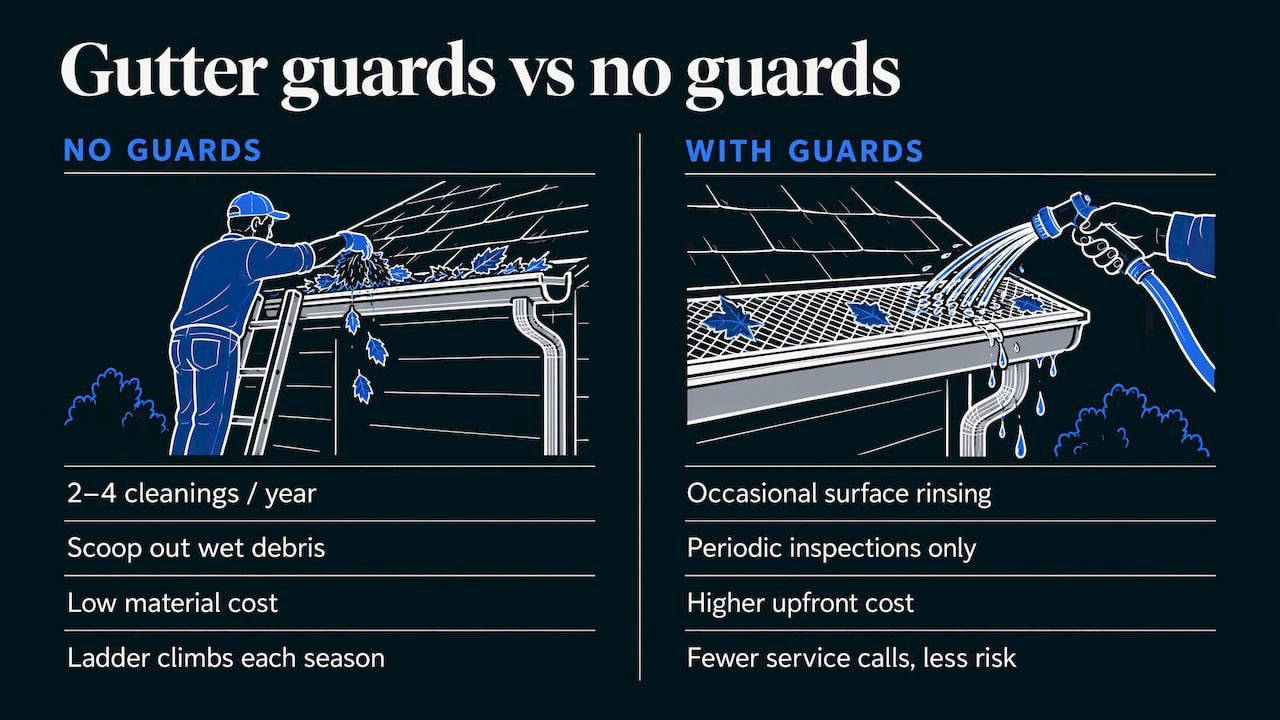
Gutter guards shift that equation. The upfront cost is higher, as reporting on gutter guard pricing shows, but the ongoing task shrinks to occasional surface rinsing and periodic inspection rather than full debris removal. Over several years, homes with heavy tree cover or difficult access often find the guard investment pays off through fewer service calls and less risk of missed cleanings that lead to overflow damage.
For low-debris homes, the comparison tilts the other way. Twice-yearly cleaning without guards can remain the simpler, cheaper choice when there’s little to block in the first place. The long-term winner depends less on the product and more on how much debris your roof actually sheds each year, and how much that ladder climb is worth to you in time, safety, or peace of mind.
Environmental considerations and impact of gutter guard materials
Material choice affects both durability and environmental footprint, and the two often move together. Aluminum and stainless steel guards resist corrosion, hold up for years, and can be recycled at the end of their service life, which keeps them out of landfills longer than plastic alternatives.
Vinyl and plastic guards cost less upfront but tend to become brittle under prolonged sun exposure, leading to cracking and replacement within a shorter span than metal options. That shorter lifespan means more frequent manufacturing and disposal, which adds up over time even if each individual unit seems inexpensive.
Foam inserts raise a different concern: they can degrade and shed material into the gutter channel over time, which partially defeats their purpose and adds small amounts of debris back into a system meant to stay clear. For homeowners weighing environmental impact alongside performance, durable metal systems generally offer the better long-term footprint, since replacing a guard every few years carries its own material and labor cost.
Warranty and lifespan details for different types of gutter guards
Lifespan varies widely by material and installation quality, which makes warranty terms worth reading closely before you commit to any system. Aluminum and stainless steel micro-mesh guards typically hold up the longest, often matching or outlasting the gutters they’re installed on when properly fastened and maintained. Vinyl and plastic guards tend to have shorter practical lifespans, since sun exposure and temperature swings cause brittleness faster than with metal.
Warranty coverage tracks that same divide. Premium metal and micro-mesh systems more often come with multi-year or lifetime coverage against clogging or material failure, while basic plastic inserts and foam products typically carry shorter or more limited warranties, if any.
The installation itself matters as much as the product. A guard that’s improperly fastened can fail well before its rated lifespan, regardless of what the warranty promises. That’s part of why warranty terms on professionally installed systems, like our Lifetime No-Clog Guarantee, tend to cover both the product and the workmanship rather than materials alone.
How gutter guards affect roof and gutter system warranties
Adding a gutter guard can interact with existing warranties in ways homeowners do not always expect. Some roofing manufacturers specify how fasteners can attach to shingles or roof edges, and a guard installed with screws driven into the wrong spot can technically void a roof warranty, even if the guard itself works perfectly.
Gutter warranties carry their own conditions. A gutter manufacturer’s warranty may require that attachments, including guards, not interfere with the gutter’s designed water flow or pitch. Installing a guard that changes how water sits in the channel, or one that adds excess weight the original gutter system wasn’t rated for, can create a gap between what’s covered and what actually happened on your roof.
This is one of the stronger arguments for professional installation over a weekend DIY project. A trained installer knows how to attach a guard without compromising roof shingle warranties or gutter manufacturer terms, and can tell you up front if a particular guard and roofline combination carries any warranty risk worth avoiding.
What I’d tell a friend asking about gutter guards
Most of the debate around gutter guards misses the real question. It’s not whether they work. It’s whether your home’s debris load and access risk justify the cost, because the honest answer changes from house to house.
If you’re dealing with heavy pine needle drop or live under mature oaks, fine-mesh is worth the premium over basic screens every time. If your main motivation is staying off a ladder on a two-story or three-story home, that safety value alone can justify guards even when the cleaning-cost math looks marginal. For anyone with a complex roofline or multiple stories, a professional assessment beats guessing from a product aisle.
— Brian
Get a professional gutter guard assessment
If a ladder climb feels like a bigger risk than it used to, or your gutters clog faster than you can keep up with, we can take that off your plate. Our team inspects your gutter length, roofline, and debris patterns, then installs a custom-fit guard system backed by our Lifetime No-Clog Guarantee, so you get protection built for your home rather than a generic fit.

Have your approximate gutter length, a few photos of problem areas, and any known trouble spots ready when you reach out. Request a quote through our gutter installation and guard services page and we’ll handle the rest.
FAQ
What are the downsides of gutter guards?
The main downsides are upfront cost, the fact that they still require periodic inspection and surface cleaning, and the possibility of overflow during extremely heavy storms that exceed a guard’s water-handling capacity. Cheaper plastic or foam products can also degrade faster than metal systems, requiring earlier replacement.
Do you still have to clean gutters if you have gutter guards?
Yes, though much less often. Reporting confirms that gutter guards reduce cleaning frequency but are not maintenance-free, since surfaces still need occasional rinsing and downspouts can clog even when the guard itself works well.
Is there a gutter guard that really works?
Long-term testing shows fine-mesh and micro-mesh systems generally perform best against a wide range of debris, including pine needles and shingle grit, while some surface-tension systems can struggle during severe downpours. No system is foolproof, but controlled testing points to fine mesh as the most consistent performer across different debris types.
How do I know if gutter guards are worth it for my home?
Guards tend to deliver the most value for multi-story homes, properties with heavy tree canopy, or rooflines where ladder access is genuinely risky, according to roofing professionals weighing in on gutter guard value. For single-story homes with little nearby tree cover, routine cleaning without guards often remains the simpler and cheaper option.
What maintenance do gutter guards still require?
Most homes need a visual check after major storms plus a seasonal inspection in fall and spring, along with occasional rinsing of the guard surface and clearing of downspouts. Extension service guidance recommends adding a guard or strainer as part of a broader moisture-control strategy rather than treating it as a standalone, maintenance-free fix.
Sources
- Do gutter guards work? What homeowners should know before buying
- Consumer Reports — Gutter guards (archived test summary)
- Moisture control and prevention: gutter management — NC State Extension