

Gutters should sit with their back edge tucked under or behind the drip edge’s lower flange, so every drop of runoff lands inside the trough instead of sneaking behind it. Checking this means looking at your eaves for dark streaks or soft, swollen wood along the fascia. That staining is called water tracking, and it is the clearest early sign that your drip edge and gutter are not working as a team.
TL;DR:
- At eaves, underlayment laps over the drip edge, while at rakes the drip edge sits above it; ice dam membranes sandwich eave flashing.
- IRC requires drip edge at eaves and rakes, with overlaps of at least 2 inches; industry guidance recommends fasteners every 8 to 10 inches.
- A properly hung gutter drops about a quarter inch per 10 feet; clean gutters at least twice yearly, more often beneath trees.
- Water tracking can cause fascia rot within 5 to 10 years; inspect stained wood early, before moisture damage requires board replacement.
- Adjust or reseal small gaps yourself, but call a licensed contractor for soft or rotted fascia, sagging gutters, or major roof edge realignment.
Table of Contents
- How drip edge, underlayment, and gutters fit together at eaves and rakes
- What building codes and industry standards require
- Why the gutter to drip edge connection matters so much
- Choosing drip edge materials and profiles that pair well with gutters
- Why gaps open up and how to repair them by size
- Keeping drip edge and gutters aligned over time
- What professional installation gets right that DIY often misses
- Our take on getting this right
- How we can help with drip edge and gutter problems
- FAQ
- Sources
How drip edge, underlayment, and gutters fit together at eaves and rakes
The order of installation changes depending on which edge of the roof you’re looking at, and that difference matters when you’re inspecting an existing roof.
At the eaves, the drip edge goes down first, directly on the roof deck, and the underlayment laps over the top of it. This sequence lets water that gets under the shingles drain onto the drip edge and off into the gutter rather than soaking into the fascia board. At the rakes (the sloped side edges of the roof), the order flips: the drip edge goes on top of the underlayment. Building-science guidance explains that this reversal exists because wind-driven rain at the rakes behaves differently than runoff at the eaves, and the drip edge needs to shed that water outward rather than let it track under the edge.
For the gutter to catch water correctly, a few measurements matter:
- The drip edge should extend a minimum of half an inch below the roof sheathing and overlap the sheathing by at least 2 inches.
- The gutter’s back lip should sit tight against the fascia, directly behind or under that lower drip-edge flange, with no visible gap.
- Drip-edge segments should overlap each other by at least 2 inches where one piece ends and the next begins.
Fastener spacing matters more than most homeowners realize. Code allows up to 12 inches on center, but tighter spacing holds up better against wind uplift, which is why many installers tighten that pattern considerably in storm-prone areas.
What building codes and industry standards require
Homeowners don’t need to memorize a code book, but knowing the basic numbers helps you tell a solid installation from a shortcut.
IRC Section R905.2.8.5 requires drip edge on every asphalt shingle roof, at both eaves and rakes, not just at the eave line. Installation guidance also addresses overlap and fastener spacing. On top of the baseline code, the Asphalt Roofing Manufacturers Association recommends tighter fastening for better wind performance.
| Requirement | Code minimum | Industry recommendation |
|---|---|---|
| Fastener spacing | 12 inches on center (IRC R905.2.8.5) | 8 to 10 inches on center (ARMA) |
| Overlap between segments | 2 inches minimum (IRC R905.2.8.5) | 2 inches minimum |
| Extension onto deck | Not separately specified | 2 inches minimum (ARMA bulletin) |
| Flange drop below sheathing | 1/2 inch minimum (building science) | Follow manufacturer guidance |
One nuance worth knowing: when a roof uses a self-adhering ice-dam membrane instead of standard felt, the drip edge at the eave gets sandwiched between two layers of that membrane rather than sitting under a single layer of felt. This keeps the eave watertight in freeze-thaw climates and is a detail worth asking your IRC change summary notes about if you’re reviewing a contractor’s proposal.
Why the gutter to drip edge connection matters so much
A gutter that’s slightly out of position behind the drip edge doesn’t fail all at once. It fails slowly, and that’s what makes it dangerous.
Water tracking, sometimes called wicking, happens when runoff misses the trough and instead clings to the underside of the drip edge and rolls backward onto the fascia board. Left alone, this steady exposure to moisture can cause meaningful fascia rot within 5 to 10 years, long before most homeowners would otherwise think about replacing that wood.
It’s worth being clear about what each part actually does, because gutters and drip edges are often confused for performing the same job:
- Drip edge controls water at the roof deck level, keeping it from curling under shingles and soaking into the sheathing or fascia.
- Gutters collect and channel water once it has already left the roof surface, directing it toward downspouts and away from the foundation.
- Neither one replaces the other. A roof with gutters but no drip edge still lets water wick back under the shingles at the edge.
A few mistakes cause most of the drainage failures we see:
- Gutters installed too far from the fascia, leaving a visible gap behind the back edge.
- Drip edge with too short a flange, so it doesn’t extend far enough over the gutter.
- Gutters hung with the wrong pitch, pulling the back edge away from the roof edge over time.
If you suspect a problem, run a hose over the roof edge for a minute and watch where the water actually lands. If it skips the trough and runs down the fascia, you’ve found your answer. For a deeper look at how fascia damage shows up and what it takes to repair, see our soffit and fascia homeowner checklist.
Choosing drip edge materials and profiles that pair well with gutters
Not every drip edge integrates with a gutter the same way, and material choice affects how long that connection stays tight.
Aluminum is the most common choice for residential roofs because it resists corrosion well and holds its shape without adding much weight. Galvanized steel offers more rigidity in high-wind areas, though it can rust at cut edges over time if the coating is compromised. Copper is more expensive but resists salt air exceptionally well, which makes it a durable option in coastal climates. Some vinyl and plastic profiles exist, but they tend to become brittle with UV exposure over the years.
Profile shape matters too:
- Type C (90-degree L-shape) is the simplest profile and works well on most eaves with standard gutters.
- Type D (T-shape or kickout) extends further over the gutter’s outer lip, which helps on steeper roofs where water moves faster.
- A wider flange generally gives the gutter a more secure seat and reduces the odds of a gap opening up later.
Pro Tip: If you live near salt water, ask your installer whether the drip edge and gutter hangers are both rated for coastal exposure, mismatched metals can cause galvanic corrosion where they touch.
Why gaps open up and how to repair them by size
Gaps between drip edge and gutter usually trace back to one of a handful of causes: the original installer got the eave or rake sequence backward, the drip edge flange was cut too short, the fascia behind it has shrunk or started to rot, the gutter itself has sagged out of its proper slope, or something simply knocked the assembly out of alignment, like a ladder or storm debris.
For small gaps:
- Clear debris from the area so you can see the actual gap.
- Gently bend the drip edge flange back toward the gutter using pliers, taking care not to crack old, brittle metal.
- Re-nail any loose drip-edge sections with roofing nails spaced every 8 to 10 inches.
- Apply a bead of roofing sealant along the seam where the drip edge meets the gutter back.
- Check that gutter brackets are still snug against the fascia, not pulled outward.
Tools for this job are simple: a stable ladder, pliers, roofing nails, a caulk gun with exterior-grade sealant, and gutter screws if a bracket has worked loose.
For medium gaps: a standalone drip edge repair often isn’t enough. This is where a gutter apron, a separate flashing piece that bridges the space between roof edge and gutter, becomes useful. Steps look like this:
- Remove the damaged drip-edge segment.
- Inspect the fascia underneath for soft spots before installing anything new.
- Install a gutter apron so its lower edge extends into the gutter trough.
- Fasten at 8 to 10 inch intervals and reseal all seams.
Pro Tip: Never fasten new flashing over fascia that flexes or feels soft when you press on it, that’s a sign of rot underneath, and nails won’t hold.
For large gaps or visible rot, this is where DIY repair stops making sense. Replacing fascia, re-cutting drip edge, and realigning an entire gutter run involves ladder work at height, precise slope calculations, and often warranty considerations that a homeowner repair could void. That’s the point to call a licensed contractor.
Keeping drip edge and gutters aligned over time
A short seasonal routine catches most problems before they become fascia rot.
Walk your property after major storms and at regular intervals. Look along the fascia line for dark streaks, peeling paint, or sagging gutter sections, and take photos of anything questionable before calling a contractor. Our guide to quick yard tests for roof runoff walks through a few more checks you can do without climbing a ladder.
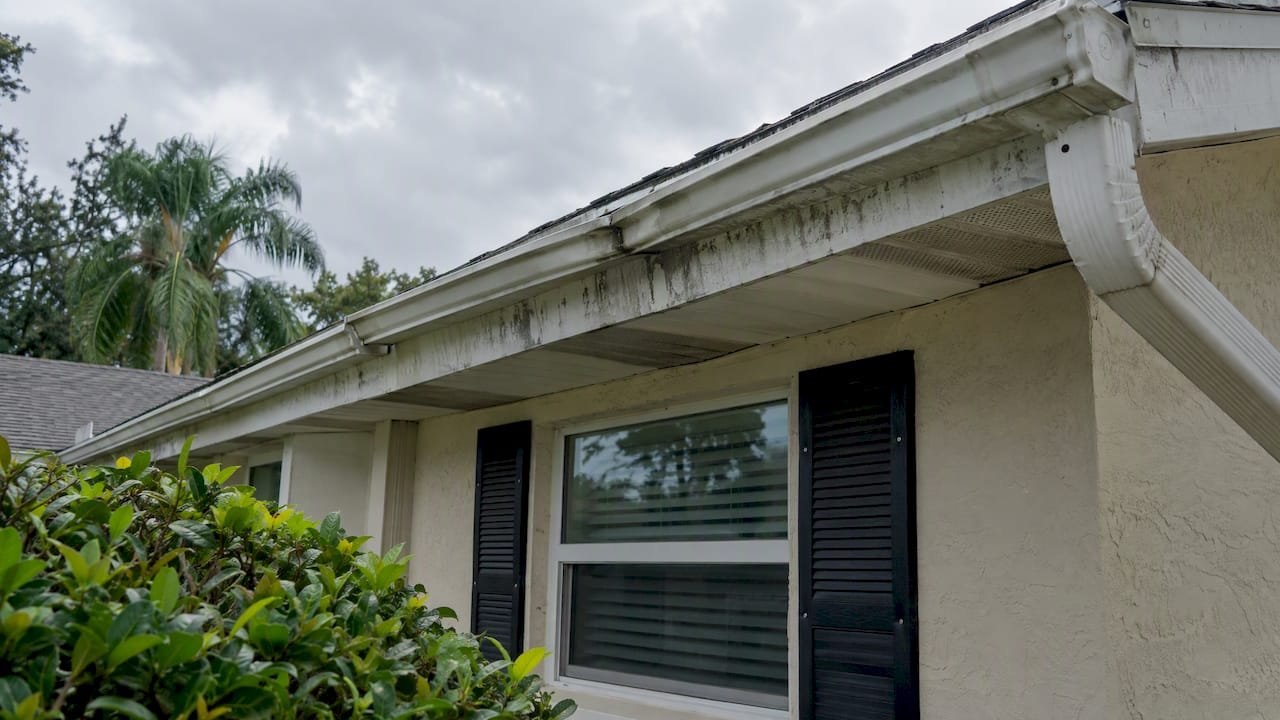
Gutter slope matters more than most people expect. A properly hung gutter should drop about a quarter inch for every 10 feet of run, enough to keep water moving toward the downspout without pulling the back edge away from the drip edge.
A short maintenance checklist:
- Clean gutters at least twice a year, more often under trees.
- Check brackets and fasteners for looseness during each cleaning.
- Re-seal any seam where you see dried, cracked caulk.
- Consider gutter guards if debris buildup is a recurring issue, though they still need periodic checks.
Pro Tip: Keep a simple log with dates and photos each time you inspect, it makes it much easier for a contractor to spot a pattern if a problem keeps coming back. For a fuller maintenance routine, see our seamless gutter maintenance guide.
What professional installation gets right that DIY often misses
Professional installations follow the eave and rake sequencing exactly, account for local wind exposure and salt air, and tie the work to a warranty that holds up if a seam fails later. We’ve installed and repaired enough gutter systems to know that the jobs most likely to cause repeat problems are the ones where drip edge and gutter positioning were never verified in the first place, especially on homes that have had multiple owners and multiple roofing contractors over the years.
Our take on getting this right
Most advice about gutters treats the gutter as the whole system, and that’s the mistake. The gutter is only doing its job correctly if the drip edge handed it clean, controlled water in the first place. We’d rather see a homeowner take time to check the fascia for staining than spend a weekend adjusting gutter brackets that were never the actual problem.
The conventional wisdom that “gutters replace the need for drip edge” is simply wrong, and it’s probably the single most expensive misunderstanding in this whole topic. They do different jobs at different points in the water’s path off the roof.
If we had to prioritize one thing for a homeowner to check this weekend, it’s the gap itself: look behind the gutter at the fascia line, in good light, after a dry week. Staining there means water has already been tracking for a while, and the sooner it’s addressed, the smaller the repair.
— Brian
How we can help with drip edge and gutter problems
When a gap between drip edge and gutter has already led to fascia staining or softness, we handle gutter installation, gutter repair, and soffit and fascia repair as connected jobs, not separate ones, so the whole edge works together again.

Simple sequencing fixes and small resealing jobs are reasonable to try yourself. Once you’re looking at soft or rotted fascia, a sagging gutter run, or a roof edge where the original installation sequence looks backward, that’s a job for a licensed crew that can verify code compliance while the work is open.
Before you call, it helps to have a few things ready:
- Photos of the stained or gapped area in daylight.
- An estimate of how many feet of gutter or fascia are affected.
- Any measurements you’ve already taken of the gap itself.
If water damage has already reached your fascia or interior walls, leak detection and repair may be needed for the parts of a water problem that go beyond the roofline. For the exterior work itself, downspout installation and soffit and fascia installation are available alongside gutter repair, and we won’t leave a job site until you’re satisfied with the result.
FAQ
Does the drip edge go over or under the underlayment?
It depends on the edge: at eaves, the underlayment laps over the drip edge, while at rakes the drip edge goes on top of the underlayment. This reversed sequence is described in IRC guidance to manage water differently at each edge.
How much does it cost to install a drip edge on an existing roof?
Published pricing varies too widely by region and roof size to state a single reliable figure here. A contractor can give you an exact quote once they’ve measured your roof’s eave and rake length and assessed the condition of the existing fascia.
Do gutters go on before or after the roof?
Drip edge goes on first, as part of the roofing process at the eaves and rakes, and gutters are installed afterward so their back edge can seat correctly behind the drip edge’s lower flange. Installing gutters first risks the drip edge not sitting in the right position relative to the trough.
Can you install drip edge without removing the gutters?
In many cases yes, especially for short sections or repairs, since a contractor can often work behind or around an existing gutter run. Larger replacements or full re-sequencing of the eave, however, usually require temporarily detaching the gutter section involved.
Do you need drip edge if you already have gutters?
Yes, because drip edge and gutters perform different jobs: drip edge keeps water from wicking under shingles and into the fascia at the roof deck level, while gutters only collect water after it leaves the roof. Skipping drip edge, even with gutters installed, leaves the fascia exposed to the kind of water tracking that leads to rot.