

Gutters overflow in heavy rain when peak roof runoff outruns a clean channel or its downspouts, usually because of clogs, undersized parts, poor slope or support, or a faulty roof-edge handoff. Your first move is to watch the gutters during a storm, or run a garden hose to reproduce the spill, then clear the outlets and attach a temporary downspout extension that carries water away from the foundation.
TL;DR:
- Watch the system during rain or run a hose from the far end toward the outlet; a low spot signals sagging or poor pitch.
- Clear outlet blockages and use an extension or splash block to send water away; these temporary measures reduce foundation exposure but do not fix capacity.
- When a clean system still overflows in intense storms, add capacity or outlets based on roof area, rainfall, pitch, and outlet layout.
- Route downspouts at least 5 feet from the foundation, or use a properly designed underground catchment at least 10 feet away.
- Gutter guards can keep leaves out, but they do not increase peak flow capacity; call a contractor if overflow persists or gutters sag.
Table of Contents
- What causes gutters to overflow in heavy storms?
- How do you diagnose where and why your gutters overflow?
- What can you do right now to protect your foundation?
- Which long-term repairs stop overflow for good?
- What damage does unchecked gutter overflow cause?
- How do you keep gutters from overflowing year after year?
- When should you call a gutter contractor?
- An installer’s view: diagnose in a real storm
- How we fix overflow for good
- FAQ
- Sources
What causes gutters to overflow in heavy storms?
Overflow almost always traces back to one of a few mechanical or design problems. Northern Virginia Soil and Water Conservation District says gutters overflow when they are clogged, undersized, poorly supported, or unable to discharge through downspouts fast enough. Matching your symptom to the cause saves you from cleaning the same gutter again and again.
- Clogged troughs or outlets: Leaves, shingle grit, and debris block the opening to the downspout, so water has nowhere to go and spills over the front edge.
- Undersized gutters or downspouts: A channel that works in a light shower can be overwhelmed at peak rainfall, even when it is perfectly clean.
- Sagging gutters or wrong pitch: Loose hangers let water pool in low spots instead of moving to an outlet. Inspectapedia notes that sagging gutters overflow.
- Roof-to-gutter handoff problems: Water can shoot past the gutter or flow behind it when the drip edge or flashing is wrong, or when a roof valley concentrates runoff into one short stretch.
A clean gutter can still overflow because the roof-to-gutter handoff, the capacity, or the attachment strength falls short. That is why a quick cleaning sometimes changes nothing.
How do you diagnose where and why your gutters overflow?
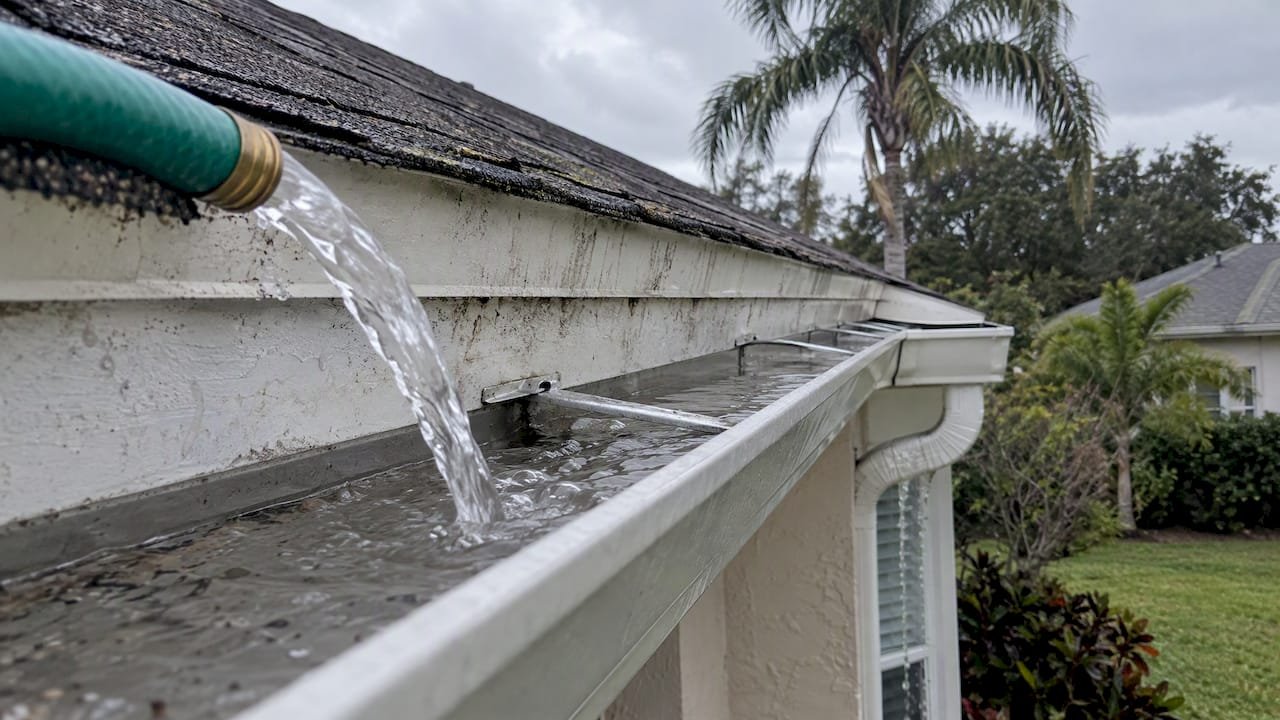
Watching your system work is the most informative test you can run. A dry gutter hides the very behavior you need to see, so inspect during a real rain or use a garden hose on the roof to mimic a downpour.
- Stand safely at ground level, or use binoculars, and note exactly where water spills over.
- Check whether each downspout is actually discharging, and how much water is coming out.
- Compare the spill pattern to the guide below.
- Look at the ground and fascia for evidence of repeat overflow.
Here is how to read what you see. Overflow near a valley or an outlet points to a blockage. Overflow only in intense storms, with a clear channel, suggests the system is too small. Water that spills repeatedly at one low spot means a sag or incorrect pitch, according to the Northern Virginia district’s guidance. Also look for watermarks on the fascia and soil washed out under the drip line.
Pro Tip: Start the hose at the far end of the longest gutter run and work toward the downspout, so you can watch where the flow slows or backs up.
What can you do right now to protect your foundation?
While you plan a permanent repair, a few interim steps cut your risk. These do not cure the underlying problem, but they keep water off the foundation today. Building America guidance points out that temporary extensions and splash blocks reduce immediate exposure without fixing the restriction behind it.
- Clear debris from the outlets and downspout openings. Use a stable ladder on level ground, and call a professional if heights make you uneasy.
- Attach a downspout extension or splash block so water lands well clear of the house.
- Rerun the hose to confirm the flow now heads away from the foundation.
- Calm bare soil with gravel, a shallow temporary channel, or by steering runoff toward planted areas, as MU Extension suggests.
Pro Tip: See our roof runoff solutions.
Which long-term repairs stop overflow for good?
If overflow returns after cleaning, the system probably needs a design change rather than another rinse. Building America recommends increasing gutter and rain-leader capacity in heavy-rain regions. Sizing depends on roof area, rainfall intensity, roof pitch, and outlet layout, which is why Washington State University Extension points to whole-roof drainage rather than one-size-fits-all rules.
- Upsize gutters and downspouts when overflow keeps coming back after cleaning.
- Add downspouts or shorten long gutter runs so water travels a shorter distance.
- Install kick-out diverter flashing where concentrated runoff meets a wall.
- Send downspouts to daylight at least 5 feet from the foundation, or to a properly designed underground catchment at least 10 feet away.
- Repair sagging hangers and restore the correct pitch.
Our downspout installation work often starts with exactly these routing questions.
What damage does unchecked gutter overflow cause?
The stakes go beyond a messy driveway. Repeated runoff saturates the soil first, and moisture then migrates through the foundation, a pattern building-science guidance explains when damage shows up long after the storms.
- Saturated soil that wicks moisture into the foundation, feeding mold, rot, and indoor air-quality problems.
- Erosion and washout under the drip line, which can cut trenches and destabilize landscaping.
- Stained or rotting soffit, fascia, and siding.
Roof water that is not drained away can rapidly saturate the soil around a building and wick through the foundation, according to Building America, contributing to mold, rot, and reduced durability.
If chronic wetness has already led to mold, a licensed specialist such as Ready 2 Inspect handles assessment and remediation. Fixing the water source first keeps it from coming back.
How do you keep gutters from overflowing year after year?
Overflow prevention is mostly routine. A short checklist, repeated each season, catches most problems before a storm does.
- Clean the gutters and outlets on a seasonal schedule. Our seasonal gutter checklist explains when to do it yourself and when to call a pro.
- Remember that gutter guards keep leaves out but do not add capacity for heavy-rain peak flows. We cover this in do gutter guards work.
- Check hanger spacing and pitch once a year, and consider extra outlets on long roof edges.
- Protect soil along the drip line with vegetation, rock, or a rain garden while permanent routing is put in place.
- Confirm the ground near each downspout slopes away from the house. The Northern Virginia district recommends roughly a 5% grade away from the foundation for 10 feet where site conditions allow.
When should you call a gutter contractor?
Bring in a professional when overflow continues after cleaning, when gutters sag or pull away, when the foundation stays wet, or when you want water routed to a drywell or underground system. Our guide to signs your gutters need replacing can help you decide.
During an inspection, a pro should look at:
- The whole-roof drainage area and how it splits among outlets.
- Gutter and downspout sizing and spacing.
- Hanger strength and roof-to-gutter flashing.
- Where the water finally goes.
Ask about the proposed discharge distance from the foundation, the materials, the warranty, and whether kick-out flashing or added outlets make sense for your roof.
An installer’s view: diagnose in a real storm
I work with Five Star Aluminum, and the pattern we see most is simple: homeowners keep cleaning a gutter that was never built to carry a storm’s peak flow. We work to solve recurring overflow in heavy-rain and salt-air conditions, and we stand behind our work. Ask us about the terms that apply to your project. Watch your gutters in a real downpour, and put routing away from the foundation first.
— Brian
How we fix overflow for good
If overflow keeps returning, we can put in a lasting fix. Our team handles gutter installation and replacement, downspout routing, gutter guards, soffit and fascia repair, and storm-damage restoration. A visit includes an inspection, a sizing recommendation, and routing options. Request an inspection or estimate through our gutter repair page, and we will help you stop the overflow before the next storm.

FAQ
How can you stop gutters from overflowing in heavy rain?
Start by clearing the outlets and downspouts, then confirm the gutters slope toward them. If overflow continues after cleaning, the system likely needs more capacity or more downspouts, as Building America recommends for heavy-rain regions.
How do you stop rain from overshooting your gutters?
Overshoot usually comes from fast runoff off a steep roof or a valley that concentrates water. Correct roof-edge flashing, added outlets, or a larger gutter can catch the flow. A contractor can check the roof-to-gutter handoff for you.
What happens when a gutter overflows?
Water falls beside the house and can saturate the soil, erode landscaping, and stain or rot fascia, soffit, and siding. Over time, building-science guidance says moisture can pass through the foundation and raise mold risk.
How do you fix a gutter that overflows?
Match the spill to the cause: clear a blockage, re-hang a sagging section, or upsize the system if a clean channel still spills in storms. Route every downspout well away from the foundation to finish the job.
Sources
- Gutters and Downspouts | Building America Solution Center
- Gutters and Downspouts: Wetness or Erosion Problems | Northern Virginia Soil and Water Conservation District
- Managing Roof Runoff | Clark County | Washington State University