Yes, your metal roof should have gutters, and they need to be sized and hung with more care than gutters on a shingle roof. Metal sheds water fast. A hard Florida downpour running off a smooth panel can overshoot a thin or poorly pitched gutter and land right at your foundation. For most homes, the best setup is seamless aluminum in a wide profile, hung on hidden hangers or brackets with stainless fasteners, with the drip edge set correctly and a micro-mesh guard if trees overhang the roof.
Below you will find how to choose the material, size and style, where installations fail, what gutter guards actually work on metal, and what to expect to pay.
TL;DR
- Metal roofs shed water quickly, so gutters help protect the fascia, soffits and foundation from concentrated runoff.
- Seamless aluminum is the most practical choice for most Florida homes: rust-resistant, cost-effective and custom-formed on site.
- The most common failure is at the drip edge, not the gutter itself. Water that runs behind the gutter rots the fascia.
- Micro-mesh gutter guards are widely considered the best fit for metal roofs, but they must be anchored correctly.
- Use compatible fasteners and avoid mixing metals, or galvanic corrosion will eat the system from the inside.
Table of Contents
- Do you need gutters on a metal roof?
- Choosing the gutter material
- Size and shape: where metal roofs ask for more
- Slope, hangers and fasteners
- The drip edge: where most installations go wrong
- Mounting height and position
- Gutter guards on a metal roof
- What new gutters on a metal roof cost
- Our view: what we tell Sarasota homeowners with metal roofs
- Maintenance that keeps the system working
- Gutters for your metal roof, installed the right way
- FAQ
- Sources
Do you need gutters on a metal roof?
In most cases, yes. A metal roof has no granules, no texture and almost no absorption, so rain leaves the surface quickly and in volume. Without a gutter, that water falls in a concentrated line along the eave. It splashes up onto siding, erodes landscaping, pools beside the slab and soaks the fascia and soffit from below.
There are exceptions. A home with deep overhangs, a stone or gravel drip strip, and ground that slopes cleanly away can sometimes go without. But in Sarasota and the surrounding counties, where summer storms can drop heavy rain in minutes and sandy soil erodes easily, we rarely recommend skipping them. If you are not sure, run a simple hose test to see how your roof runoff behaves before deciding.
There is also a second reason to keep the system in good order. Building scientists reviewing hurricane damage in Florida have noted that a gutter or soffit pulling away from the fascia can be an early sign of stronger wind forces acting on the building. Checking the drainage components after a storm is a quick way to spot trouble before it reaches the roof itself.
Choosing the gutter material
Material is the first decision, and the answer is shaped by two things: what your roof is made of and how much salt and humidity your home sees.
| Material | Strengths | Watch out for |
|---|---|---|
| Aluminum | Rust-resistant, lightweight, widely used, cost-effective | Soft, so it can dent or scratch from debris or ladders |
| Galvanized or heavier-gauge steel | Stronger against impact, snow and ice loads | Heavier, and coatings can fail over time, especially near salt air |
| Copper | Very long life, over 50 years by some estimates | Cost, specialist installation, and galvanic risk next to other metals |
| Vinyl | Low price | Not as well suited to heat and sun exposure, and not a match for metal roof runoff |
According to Angi’s guide to gutters for metal roofs, aluminum is the most popular option and typically runs about $7 to $13 per linear foot, while copper is significantly more expensive and needs professional installation. Heavier-gauge steel tends to be preferred in areas with high winds or heavy snow load. Snow is not our concern in Southwest Florida, which is one more reason aluminum fits so well here.
For a deeper look at why we lean toward aluminum over vinyl for the long term, see our comparison of aluminum and vinyl gutters.
Why seamless matters on metal
Seamless gutters are formed from a single piece on your property, cut to the exact length of each run. That removes the joints that leak first when water arrives with force. Metal roofs push more water than most systems are used to, so fewer joints means fewer places to fail. The only seams left are at corners and end caps, and how those are made matters. We cover the options in our guide to seamless gutter corner methods, and our page on seamless versus regular gutters explains the difference in more detail.
Size and shape: where metal roofs ask for more
Two gutters can look the same from the street and perform very differently in a storm. The difference is capacity.
Profile
K-style gutters hold more water than a half-round of the same width and sit flush against the fascia. That is why K-style is commonly recommended for metal roofs and heavy rainfall areas. Half-round profiles look classic and suit some architectural styles, but they carry less water for the same width. Our breakdown of K-style versus half-round gutters covers when each makes sense.
Width
Five-inch gutters are common on shingle roofs. On a metal roof, especially a large or steeply pitched one, moving up to a 6-inch gutter and larger downspouts is a sensible way to add margin. Water coming off a long, smooth panel arrives with speed, and extra width gives it room instead of letting it jump the front lip.
Downspouts
More capacity in the trough means nothing if the water cannot leave. A long run with a single downspout is a common reason for overflow. Adding downspouts, or upsizing them, spreads the load and keeps water from backing up. Where the outlet lands matters too: it should discharge well away from the foundation. Our downspout installation service covers placement and sizing.
Slope, hangers and fasteners
Good material still fails when it is hung badly. Three details matter most.
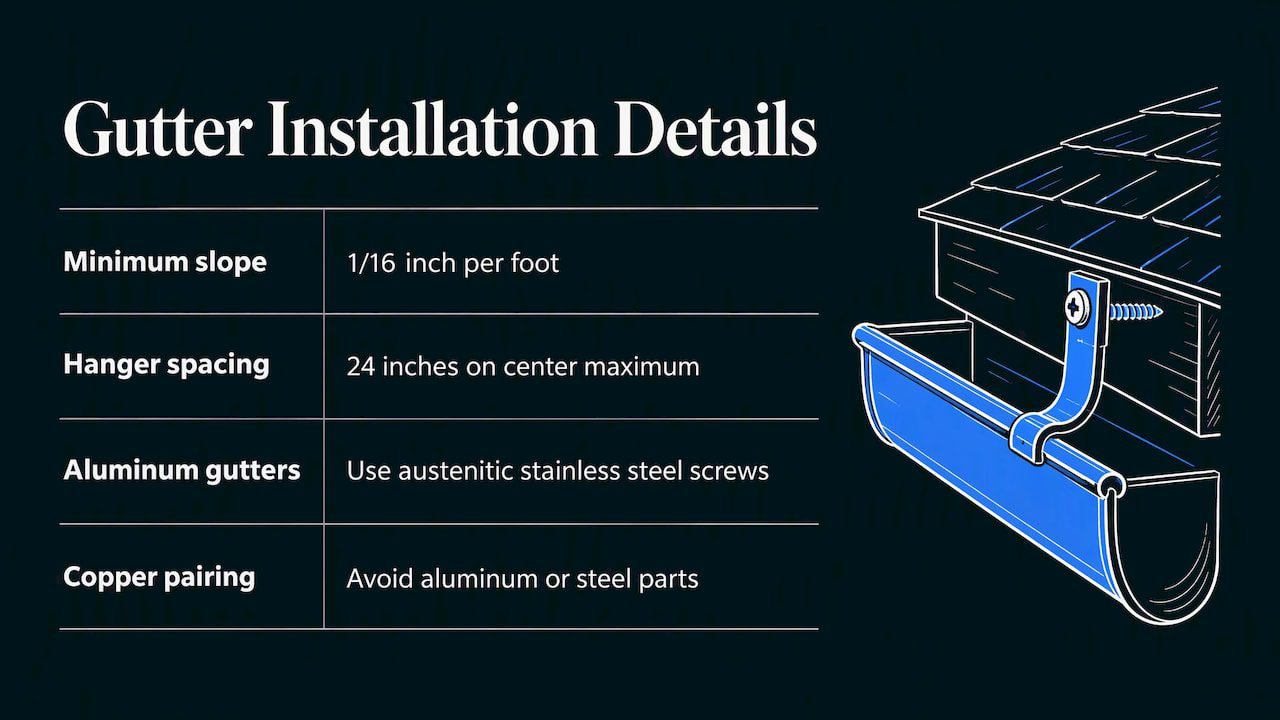
Slope. Gutters need a slight pitch toward the downspouts. Professional installers note that even a small loss of pitch over time, from settling or distorted supports, can leave standing water that speeds corrosion and invites debris. A manufacturer’s guide for one commercial gutter line specifies a minimum slope of 1/16 inch per foot and hangers spaced at 24 inches on center at most. Your installer should follow the specification for the product being used.
Hangers. Hidden hangers screwed into solid backing hold better than old-style spikes and ferrules, which work loose over time. On a metal roof, where the system takes heavy flow, closer hanger spacing is cheap insurance.
Fasteners. This is the detail homeowners rarely hear about. Architectural metal specialists insist on austenitic stainless steel screws with aluminum gutters to avoid galvanic corrosion, which happens when dissimilar metals touch in the presence of moisture. In Florida’s humid, salty air, that reaction runs faster. The same caution applies to copper: pairing copper gutters with aluminum or steel parts can cause fast deterioration. If your roof panels are steel or aluminum, ask what touches what before you approve a material.
The drip edge: where most installations go wrong
The most common failure on a metal roof is not the gutter. It is the handoff between the roof edge and the gutter. If the eave trim or drip edge does not reach far enough into the trough, water runs down behind the gutter instead of into it. It then soaks the fascia and stains the soffit. The product guide we reviewed says the drip edge should project about 1/2 inch into the gutter so water drops in cleanly.
You can check this yourself on a dry day:
- Look at the eave from a ladder or with binoculars. Does the metal edge stop short of the gutter, or sit above its back lip?
- Check the fascia directly behind the gutter for dark streaks, peeling paint or soft wood.
- Look at the soffit below for stains or bubbling.
- Run a hose along the roof edge and watch whether water enters the gutter or slips behind it.
If you find staining or soft spots, fix the cause before the new gutters go up. Our guide on drip edge and gutter overlap shows what to measure, and if the wood is already damaged, our soffit and fascia repair service covers it. Understanding the difference between soffit and fascia helps you read what you are seeing.
Mounting height and position
Metal roofs can send water, and in cold climates sliding snow, past the gutter. In Florida the concern is mainly water, but the same logic applies: the gutter should sit where the roof edge delivers flow into it. One expert source notes that gutters should be mounted as high as possible with a positive slope in line with the roof system’s design, though every metal roofing system differs. Standing seam, exposed fastener panels and metal shingles each have different eave details, and your installer should look at yours before choosing hangers and position.
If your panels have a notable overhang, or there is a snow or ice factor if you are shopping for a second home elsewhere, ask whether a different mounting method suits the roof better. A good contractor explains the reasoning and does not fit one method to every house.
Gutter guards on a metal roof
Many homeowners with metal roofs ask about guards because pine needles, oak debris and palm fronds are a fact of life here. The catch is that fast-moving water behaves differently from a gentle shingle roof flow, and some guards cause overflow.
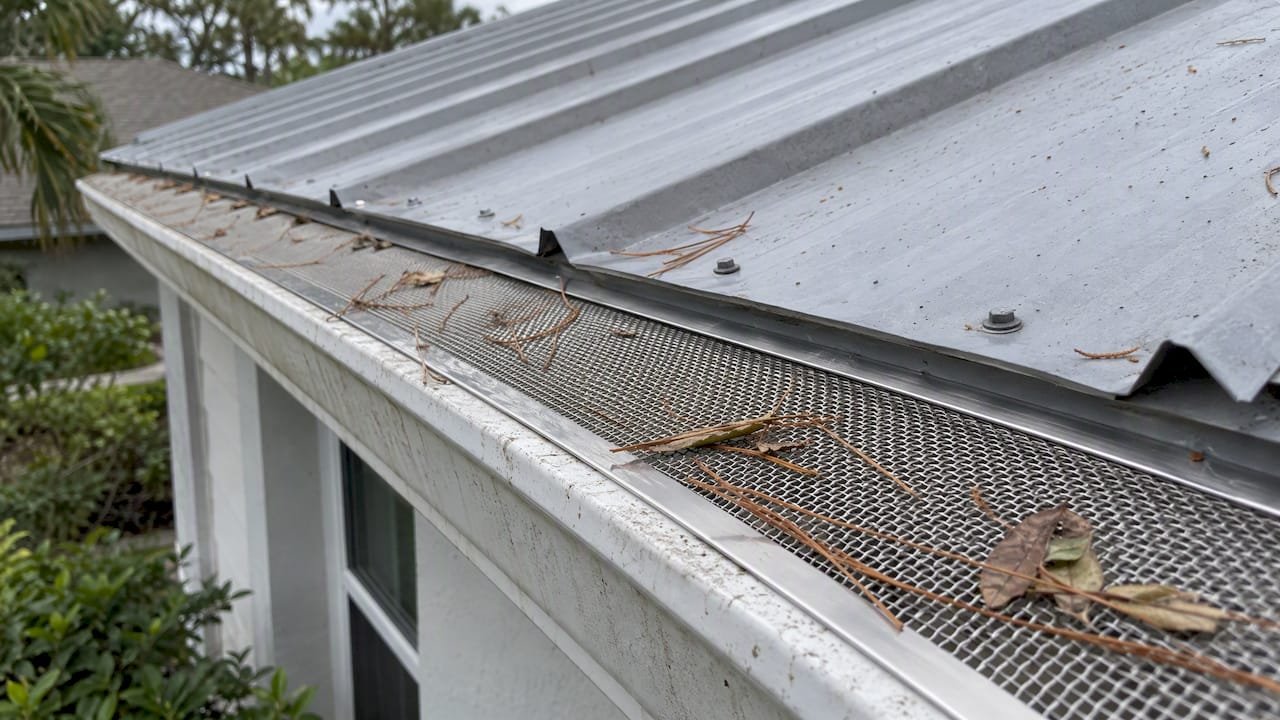
According to This Old House’s testing and research, micro-mesh stainless steel designs are widely considered the most effective for metal roofs because they handle heavy flow while blocking fine debris. Bob Vila’s review agrees that guards help prevent leaves, sticks and pine needles from entering the system. Anchoring matters too. Guards that tuck under shingles do not suit every metal roof, so the anchoring method should match your edge detail.
Cost is worth knowing. This Old House reports that gutter guards on a 2,000-square-foot home average $6,414 to $9,468 installed, with individual projects varying by material and labor. Actual quotes depend on your roof and run length.
Guards do not eliminate maintenance. They reduce it. Our article on whether gutter guards work looks at how much cleaning they can save, and the seasonal gutter checklist lays out what to inspect and when.
What new gutters on a metal roof cost
Prices move with your home’s size, the roofline, the number of corners and downspouts, and the height of the work. For a rough national benchmark, Angi puts aluminum gutters at about $7 to $13 per linear foot, or an average of about $1,150 for professional installation of a typical job. Copper sits well above that.
We do not publish set prices, because a Sarasota ranch with a simple roofline is a different job from a two-story home with several valleys and a lanai. The way to get a real number is to have someone measure your roof edge and look at the fascia. If you want to know when replacement is due rather than repair, our list of signs your gutters need replacing is a good starting point.
Our view: what we tell Sarasota homeowners with metal roofs
We have worked on Florida homes for more than 20 years, and metal roofs have a pattern. The roof is usually the most expensive and best-built part of the house. The drainage is often an afterthought. Here is what we tell homeowners.
First, we start at the eave, not the gutter. If the drip edge is wrong or the fascia is soft, a new gutter hides the problem for a season and then fails. We would rather correct the root cause once.
Second, we choose salt-air-resistant aluminum, formed seamlessly on site and sized up for the volume your roof produces. We prefer stainless fasteners and hidden hangers because they last in coastal humidity. That choice is why we stand behind our Lifetime No-Clog Guarantee and our promise not to leave a job site until you are satisfied.
Third, we are honest about guards. Not every homeowner needs them, and a bad guard on a metal roof can cause more trouble than none. If your yard has heavy tree cover, a fine-mesh guard properly anchored makes sense. If it does not, regular cleaning may be enough.
Finally, we encourage homeowners to check their gutters after a big storm. A loose run is a cheap thing to fix. A loose run left alone can become a rotted fascia and a wet attic.
— Brian
Maintenance that keeps the system working
Metal roofs are low-maintenance, but the drainage is not. A short routine goes a long way:
- Clear debris from gutters and downspouts before the summer rainy season and after storms.
- Watch for standing water in the trough after rain, which suggests the pitch has changed.
- Look for loose hangers, gaps at corners and stains behind the gutter.
- Check the downspout outlets to confirm water flows away from the foundation.
- After a hurricane or major storm, inspect gutters, downspouts, soffits and fascia from the ground. A post-storm property checklist lists these as items to check, along with roofing materials and vents.
Our seamless gutter maintenance tips go further, and if water overshoots in heavy rain, try the hose test for gutter overflow before paying for repairs.
Gutters for your metal roof, installed the right way
If you own a home in Sarasota or a nearby county and want gutters sized for a metal roof, we handle the whole job: seamless aluminum gutter installation, downspouts, guards, and soffit and fascia work where the wood needs attention. We back our work with a Lifetime No-Clog Guarantee, and we do not leave until you are satisfied, or you do not pay. Contact Five Star Aluminum to schedule an estimate.
FAQ
Do you have to have gutters with a metal roof?
Not legally, but in most cases you should. Metal sheds water quickly and in volume, which can damage fascia, soffits, siding and the soil around the foundation. Homes with deep overhangs and well-sloped yards sometimes manage without, but few Florida homes fit that description.
What is the best gutter material for a metal roof?
For most Florida homes, seamless aluminum is the best balance of rust resistance, cost and ease of custom fitting. Heavier steel suits high-snow areas, and copper is a premium option with galvanic risks if mixed with other metals. Whichever you choose, use compatible fasteners.
What is better, vinyl or metal gutters?
Metal, in nearly every case on a metal roof. Aluminum handles fast runoff and heat better, and seamless runs reduce leak points. Vinyl costs less up front but is not the usual pick for a roof that sends this much water. See our aluminum versus vinyl comparison for details.
Which gutter guards work on a metal roof?
Micro-mesh stainless steel guards are widely considered the most effective because they pass heavy water flow and block fine debris like pine needles. They need to be anchored in a way that suits your eave. Cheaper guards can let water shoot over the edge.
What is the biggest problem with metal roofs and gutters?
The drip edge interface. If the roof edge does not reach into the gutter, water runs behind it and rots the fascia. Galvanic corrosion from mixed metals and incorrect fasteners is the second most common issue.
Sources
- Gutters for a Metal Roof: Types and Fit, Metal America
- Types of Gutters for Metal Roofs, Angi
- How to Choose the Right Gutters for a Metal Roof, This Old House
- Best Gutter Guards for Metal Roofs, This Old House
- Best Gutter Guards for Metal Roofs, Bob Vila
- EuroGutterUSA Product Guide, Ornametals
- Gutter Installation Guide, Marley Alutec
- Technical Note: Roofs, Queensland Government
- Minimizing Wind and Water Damage, Hurricane Michael, FEMA
- Florida Hurricane Property Damage Checklist, Everest Building Consulting Group