

A roof valley splash guard is a thin piece of metal that sits on the outer edge of a gutter, right where a roof valley empties into it. It slows and redirects the fast stream of water coming off the valley so it lands inside the gutter instead of shooting over the front edge. It is a small, inexpensive part, but it only solves one kind of overflow. This guide shows you how to tell whether that is your kind, how to choose and fit a guard, and what to fix when a guard is not enough.
TL;DR
- A valley splash guard deflects water at the inside corners of your roofline, where two slopes meet and funnel rain into one short stretch of gutter.
- It helps most on steep roofs, metal roofs and homes that see heavy rain. It does not fix clogs, sagging runs or too few downspouts.
- Rule out debris and undersized drainage first, then test with a hose before you buy anything.
- Installation is caulk, set, screw and reseal. Watch the result in a real downpour and adjust.
- If water still pours over the corner, the real fix is usually a larger gutter or an added downspout near the corner.
Table of Contents
- What a roof valley splash guard actually does
- Do you actually need one?
- When a guard is the wrong answer
- Choosing the right guard
- How a splash guard is installed
- Inspecting and maintaining a guard
- Our perspective
- Get the corner fixed properly
- FAQ
- Sources
What a roof valley splash guard actually does
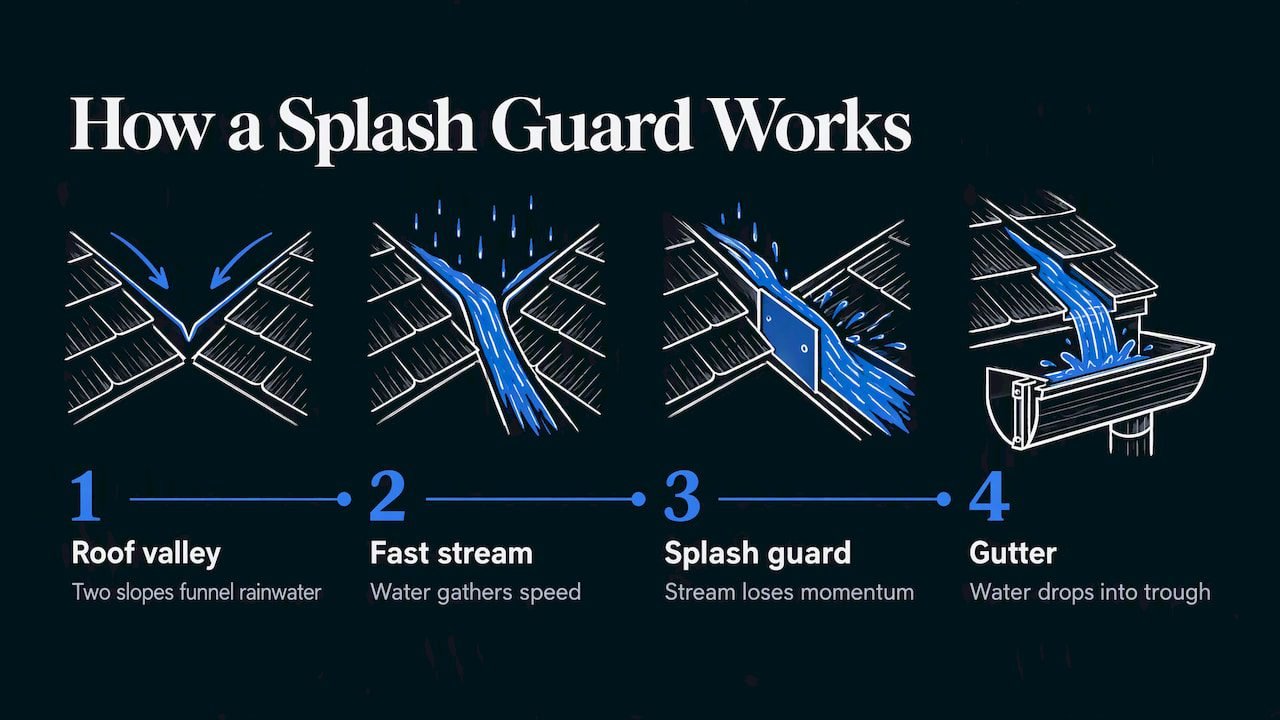
A roof valley is the V-shaped line where two roof slopes meet. Every drop that lands on both slopes runs down into that channel, gathers speed and exits in a single concentrated stream at the eave. Gutters are built to catch water that sheets off an edge. They are not built to catch a fire-hose stream arriving at an angle.
Gutter splash guards are thin pieces of metal installed along roof valleys, where the slopes funnel rainwater to one gutter section, and they help keep that water from spilling over during heavy rain, according to This Old House. The guard works like a small wall. The fast stream hits it, loses momentum and drops into the trough.
You will hear the same part called a valley diverter, a rain diverter, a corner guard or a splash shield. They are all variations on the same idea. The shapes you will see for sale are straight and bent versions. Straight guards suit a valley that meets a straight run of gutter. Bent guards wrap an inside corner.
Why the corner is the trouble spot
Overflow tends to happen beneath steep slopes or at inside corners, the places where roof water arrives with the most speed or volume. If you have ever watched a gutter during a storm and seen a bright arc of water leaping over at one spot while the rest of the gutter behaves, you have seen a valley at work.
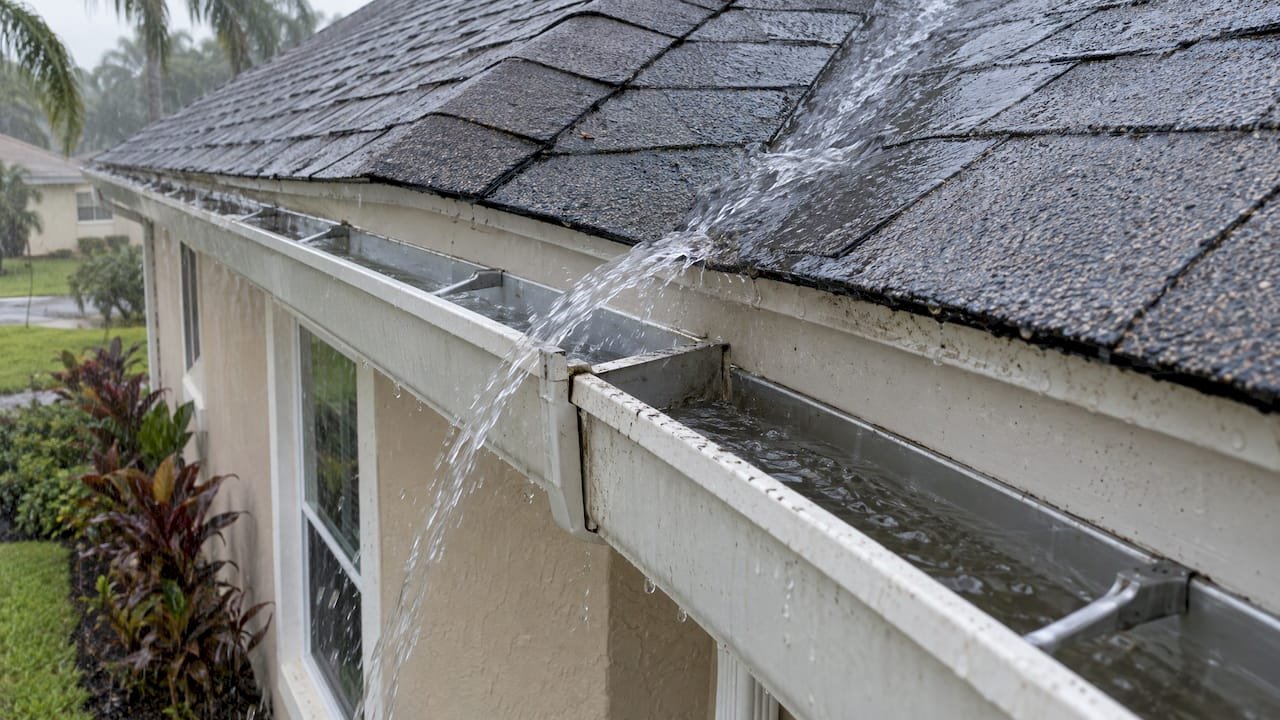
That same corner is where seams, miters and fasteners concentrate. Water that overshoots there also tends to soak the fascia and the siding below. Our guide to gutter corner leaks covers the leak side of the same problem, and our overview of four seamless gutter corner methods explains why the way a corner is built matters.
Do you actually need one?
Not every inside corner needs a guard. Splash guards may help homes with steep roof pitches, heavy rainfall or metal roofs, because water on those surfaces leaves the roof faster and carries more energy. Metal roofing in particular sheds water quickly, so the stream leaves the valley with little to slow it down.
Here is a quick way to think about it.
| Situation | Guard likely to help? | What else to check |
|---|---|---|
| Steep roof with a long valley feeding one short gutter run | Yes | Gutter size and downspout location |
| Metal roof with valleys | Yes | Fastener and seam condition at the corner |
| Water spills along the whole run, not only at the valley | Not on its own | Clogs, pitch, sagging, undersized gutter |
| Water runs behind the gutter, not over the front | No | Drip edge and fascia condition |
| Low-pitch roof, mild overshoot only in the hardest storms | Possibly | Test first, then decide |
Rule out the other causes first
Before installing splash guards, rule out other causes of overflow, such as debris buildup or inadequate downspouts. This is the step most homeowners skip, and it is where most wasted money goes. A guard bolted onto a gutter full of leaves and shingle grit will not stop it from overflowing. The water has nowhere to go no matter how well it is deflected.
Walk through this short check:
- Look for debris. Scoop out leaves, pine needles and shingle granules near the corner and at the downspout opening.
- Check the downspout. Run water into the outlet. If it backs up, the downspout is clogged or too small for the roof area feeding it.
- Look at the gutter line. Sags, loose hangers or a run that tilts away from the downspout will hold water and make corners overflow first.
- Check the gutter size. A narrow gutter under a big roof surface will overflow in every heavy storm, valley or not.
If you want a structured way to do this, our hose test for gutter overflow shows how to reproduce a heavy rain safely and see exactly where water escapes. Our 15-minute yard tests for roof runoff cover what happens to the water after it leaves the gutter.
When a guard is the wrong answer
A splash guard treats a symptom at one point. If the whole system is undersized, you will end up chasing overflow from corner to corner. Gutter expert Lantz, quoted by Family Handyman, suggests that for persistent overshoot, homeowners first assess whether their gutters are undersized for the roof area, and he points toward a larger gutter or more downspouts as a sturdier solution than relying only on guards.
We agree with that order of operations, and it matches what we see on Florida roofs. A large roof with several valleys that all empty into one corner needs more drainage capacity at that corner. In practice that means one or more of these:
- A larger gutter profile. Stepping up from 5-inch to 6-inch gutters carries more water per foot. Our comparison of 5-inch and 6-inch gutters walks through which size fits which roof.
- An extra outlet and downspout near the corner. Giving a heavy valley its own way down often stops the overflow at its source. We install downspouts sized and placed for exactly this.
- A different gutter shape. Some profiles move more water than others. See our guide to K-style versus half-round gutters.
Often the best result is a combination: a properly sized system with a downspout near the valley, and a guard as the finishing touch for the hardest storms.
Watch for water behind the gutter
Sometimes what looks like overflow is water tracking the wrong way. If the drip edge is not properly fed into the gutter, water can run behind the gutter and damage the fascia over time, as Family Handyman notes in the same guide. A splash guard does nothing for that. If you see stains, peeling paint or soft wood on the fascia board behind the corner, check the overlap. Our article on drip edge and gutters shows what a correct overlap looks like. If the wood is already compromised, soffit and fascia repair comes before anything else.
Choosing the right guard
Three choices matter: material, shape and fit.
Material
Most splash guards are made of aluminum or stainless steel. Aluminum is the common choice because it is light, easy to cut and does not rust. In Florida, where salt air reaches well inland from the Gulf, a corrosion-resistant metal and matching fasteners matter more than they would in a dry climate. Choose a finish that matches your gutters so the guard disappears from the street view.
Avoid mixing metals where you can. A steel screw in an aluminum gutter in a salty, humid environment is a recipe for staining and corrosion at the very spot you are trying to protect.
Shape and size
Straight guards go where a valley meets a straight section of gutter. Bent guards fit around an inside corner. Match the guard to the way your valley meets the gutter, not to whatever comes in the box. Take a photo of the valley from the ground and another of the gutter below it before you shop.
Fit with your gutter profile
Check product details carefully if you have a gutter type other than K-style. Many guards are shaped for K-style gutters and may not sit correctly on half-round or box profiles. Measure the gutter face height and the width of the stream you see during the hose test. A guard that is too short will be topped by the stream, and one that is too tall can trap water or look awkward.
How a splash guard is installed
The basic sequence is short. Apply caulk to the bottom edge of the gutter, set the guard on the outside edge, fasten it with gutter screws, and reseal its edges with caulk. In practice, there are a few details that decide whether it works.
- Clean and dry the spot. Caulk will not hold on grit or wet metal. Wipe the gutter edge and let it dry.
- Position by the stream, not by the corner. Run the hose down the valley and see where the water lands. Center the guard on that line.
- Run a bead of sealant, set, and screw. Use gutter-rated screws in a material compatible with the gutter.
- Seal the edges. Reseal the guard’s edges so water cannot creep underneath it.
- Test and adjust. Observe the system during heavy rain after installation to confirm the guard is positioned where it needs to be. If water still clears the guard, it may need to be taller, longer or moved a few inches along the run.
Working on a ladder at an eave is where most homeowner injuries in this job occur. If your roofline is two stories, steep or wet, have a professional do it.
Inspecting and maintaining a guard
A guard is a low-maintenance part, but it sits in the path of a lot of debris. A few checks twice a year keep it doing its job:
- Clear leaves and grit that pile up against the guard.
- Look at the caulk line for gaps or cracks, and reseal when it has pulled away.
- Check the screws for looseness or corrosion streaks.
- Confirm the downspout nearest the valley flows freely.
Where the water goes after the downspout matters just as much. The U.S. Department of Energy’s building science material stresses that roof water management protects the foundation, with gutters directing water to a discharge point at least 5 feet from the foundation, as described on Building Science Education. A guard that keeps water in the gutter only helps if the downspout then carries it well away from the house. For a full routine, see our maintenance tips for seamless gutters.
If you are also considering covers to cut down on cleaning, read whether gutter guards work. Splash guards and leaf guards are different products solving different problems, and the best setups often use both.
Our perspective
We install gutters on Sarasota-area homes in the kind of rain Florida delivers: short, violent downpours that dump a lot of water in minutes. Valleys are where that shows up first. A splash guard is a fair, honest fix when the gutter is properly sized and the only issue is a fast stream clearing one inside corner.
What we do not like is a guard used as a bandage over a gutter that was never right for the roof. When we look at an overflow problem, we start with the roof area feeding the gutter, the profile, the pitch and the downspout count. Often a seamless gutter fitted to the home, with an outlet near the valley, solves the problem for good and the guard becomes insurance.
Seamless aluminum has no joints along the run to leak, and it resists the salt air we live with. That is why our work is built around it. We stand behind it with a Lifetime No-Clog Guarantee, and we do not leave a job site until you are satisfied. If you have a corner that throws water every storm, we would rather look at it in person than guess.
Brian
Get the corner fixed properly
If your gutters overflow at a valley, we can look at the whole picture: gutter size, downspout placement, the corner construction, and whether a splash guard is the right finishing touch. Five Star Aluminum has more than 20 years of experience with seamless gutters, soffits and fascia built for Florida’s climate, and we serve homeowners in Sarasota and nearby counties. Our promise is satisfaction or no payment.

Start with our gutter repair and storm damage services if you have an existing system that needs correcting, or see our gutter installation options if the system is due for replacement. Not sure which? Our guide to signs your gutters need replacing helps you decide. You can reach us through fivestaraluminum.com.
FAQ
Where exactly does a roof valley splash guard go?
It mounts on the outer edge of the gutter directly below the point where the roof valley empties. Center it on the line the water takes during a hose test rather than on the geometric corner. That placement is what lets it catch the stream and drop it into the trough.
Can I install a gutter splash guard myself?
On a single-story home with a stable ladder, it is a manageable job: caulk the edge, set the guard, screw it down and reseal. The harder part is diagnosing the overflow correctly. Rule out clogs and undersized drainage first, and call a professional for two-story rooflines or steep eaves.
Will a splash guard stop my gutter from overflowing in every storm?
Not necessarily. It only addresses water overshooting at a specific point. If the gutters are clogged, sagging, too small for the roof or short on downspouts, overflow will continue elsewhere. In those cases a larger gutter or an added downspout near the corner is the stronger fix.
What are splash guards made of, and will they rust in Florida?
Most are aluminum or stainless steel. Aluminum does not rust, which suits coastal conditions, but you should still use compatible, corrosion-resistant fasteners so the screws do not stain or corrode around the guard.
How do I know if my gutter corner needs a guard or a repair?
If water arcs over the front edge at the valley during rain and the corner itself is tight and dry, a guard may be enough. If you see drips at the seam, stains below the corner or rotted fascia, the corner needs repair, and a guard alone will not help.
Sources
- Gutter Splash Guards Guide: Installation and Benefits, This Old House
- Easy Gutter Fixes You Can DIY, Family Handyman
- Stormwater, Gutters and Downspouts, Building Science Education