

A downspout is the more dependable way to move roof water away from your house, especially in heavy rain. A rain chain is a decorative option that can slow and show off the water, but it only works well with the right gutter setup and a planned landing spot at the bottom. Below, we compare how each one performs, what each needs, and how to choose for a home in Sarasota or anywhere with sudden downpours.
TL;DR
- Both rain chains and downspouts carry water from the gutter to the ground. Only a downspout is a closed channel, so it keeps more water under control in a big storm.
- Rain chains can slow runoff and look attractive, but link-style chains splatter, and any chain needs a basin, dish or rock bed below it.
- A rain chain does not strictly need a gutter, yet it works best when attached to one.
- Whatever you choose, discharge water well away from the foundation: generally at least 5 feet.
- Many homeowners get the best of both: downspouts on the main runs, a chain as an accent where the splash zone is safe.
Table of Contents
- How each one moves water
- Rain chains vs downspouts at a glance
- Rain chains in heavy rain
- Do rain chains need a gutter?
- What happens at the bottom matters more than the top
- Pros and cons, side by side
- Which should you choose?
- Installing and maintaining a chain
- Our perspective on rain chains vs downspouts
- Get the downspouts right first
- FAQ
- Sources
How each one moves water
A downspout is the vertical part of a gutter system. The U.S. Department of Energy’s Building America Solution Center describes a gutter system as two pieces: horizontal channels that collect runoff and downspouts that carry it to grade. So a downspout is not a gutter. It is the part of the gutter system that finishes the job.
A rain chain replaces that closed tube with a chain, or a string of cups, that hangs from the gutter outlet. According to Clemson’s Home & Garden Information Center, rain chains guide water down using surface tension, and the water follows the links to the ground. The same factsheet notes that they do the same basic job as a downspout: directing water off the roof to a place you choose.
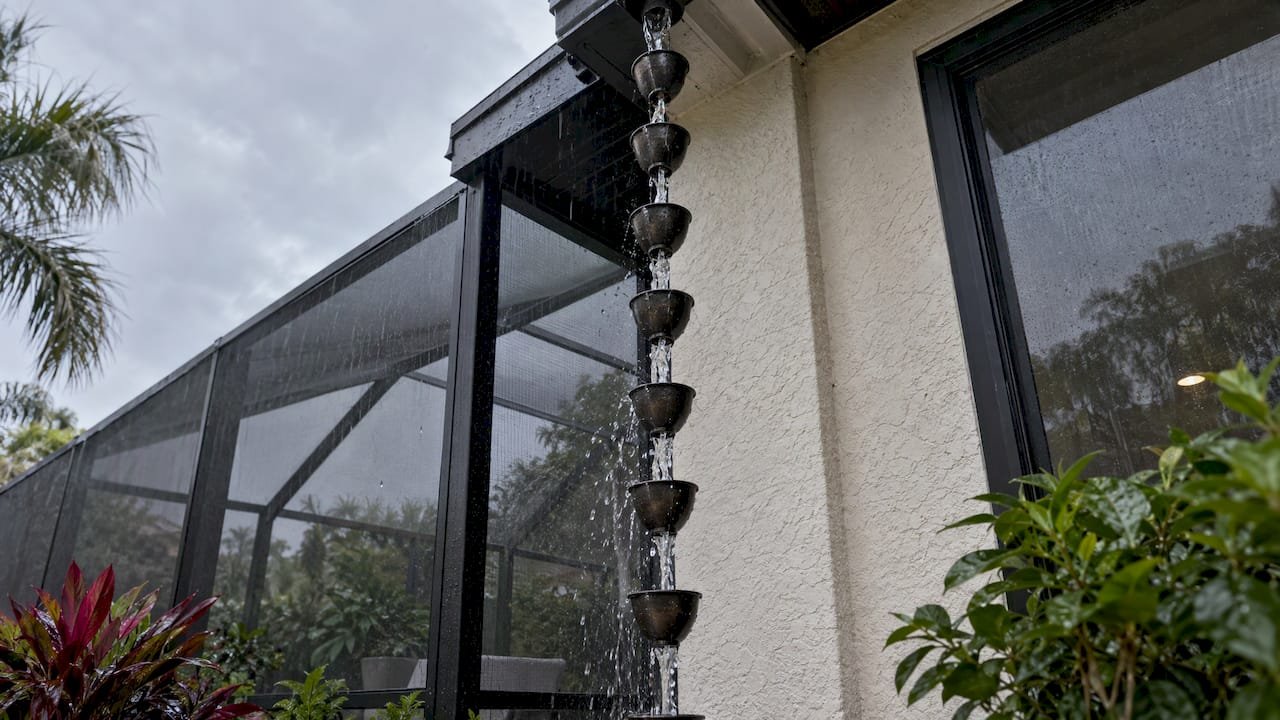
The difference you will notice most is visibility. Water in a downspout is hidden. Water on a rain chain is on display, and you can hear it. The University of Arizona Cooperative Extension calls a rain chain an attractive and audible alternative to closed downspouts. If you already have a noisy downspout, our guide on how to quiet gutter downspout noise covers the usual causes.
Rain chains vs downspouts at a glance
| Factor | Downspout | Rain chain |
|---|---|---|
| Water path | Enclosed, water stays inside the tube | Open, water runs along links or in cups |
| Splash | Minimal along the run, discharge at the bottom | Link chains commonly splatter; cupped chains reduce splashback |
| Heavy rain | Built to carry concentrated flow | Cupped styles do better; plain chains can throw water sideways |
| Weight on the eave | Light, fastened along the wall | Chain plus temporarily held water adds weight at the gutter |
| Wind | Fixed to the wall, stays put | Can swing unless anchored |
| Ground-level needs | Extension, splash block or underground drain | Basin, dish, pot, barrel or rock bed |
| Looks | Functional, can be color-matched | Decorative focal point |
| Installation | Standardized | Often needs a customized approach |
The weight and installation rows come from the research below. Clemson’s factsheet says rainwater adds a little over 8 pounds per gallon, so a chain that holds water in cups puts real load on the gutter and fascia. Dwell reports that some installations need a bespoke approach, unlike standardized downspouts.
Rain chains in heavy rain
This is where the decision usually gets made. Florida storms can drop a lot of water in a short time, and everything that falls on your roof ends up in one or two outlets.
The Arizona extension publication says link-style chains commonly splatter and are a problem near doors, windows and walkways. The same publication says cupped chains capture and direct water more efficiently than link chains and can be used where splashing matters, including heavy rainfall. The tradeoff is that cups temporarily hold water and add considerable weight to the gutter. Clemson reaches the same conclusion on splash: cupped chains reduce splashback compared with plain or loop chains.
In practice, that means:
- Plain or loop chain: pretty in a drizzle, messy in a downpour. Keep it away from entries and walkways.
- Cupped chain: the better choice for heavy rain, but check that your gutter and fascia can carry the added load.
- Closed downspout: the least drama in a storm, because the water stays contained until the bottom.
If your gutters already overflow during storms, no outlet change will fix that alone. Start by finding out why, using our hose test for gutter overflow in heavy rain. Overflow is often a clog, a pitch problem or an undersized gutter, and a chain does not cure any of those. Sometimes moving from 5-inch to 6-inch gutters is the real fix.
Do rain chains need a gutter?
No. Clemson notes that although rain chains typically attach to gutters, they can also be installed at roof valleys or eaves where water concentrates, and they are most effective when the flow is directed into them.
The key word is directed. A chain hanging off a bare roof edge catches only the water that happens to land on it. Dwell’s experts do not recommend installing a chain into a soffit. They suggest attaching it to a gutter so water flows from the gutter into the chain. In other words, even if a gutter is optional on paper, you will get the cleanest result with one.
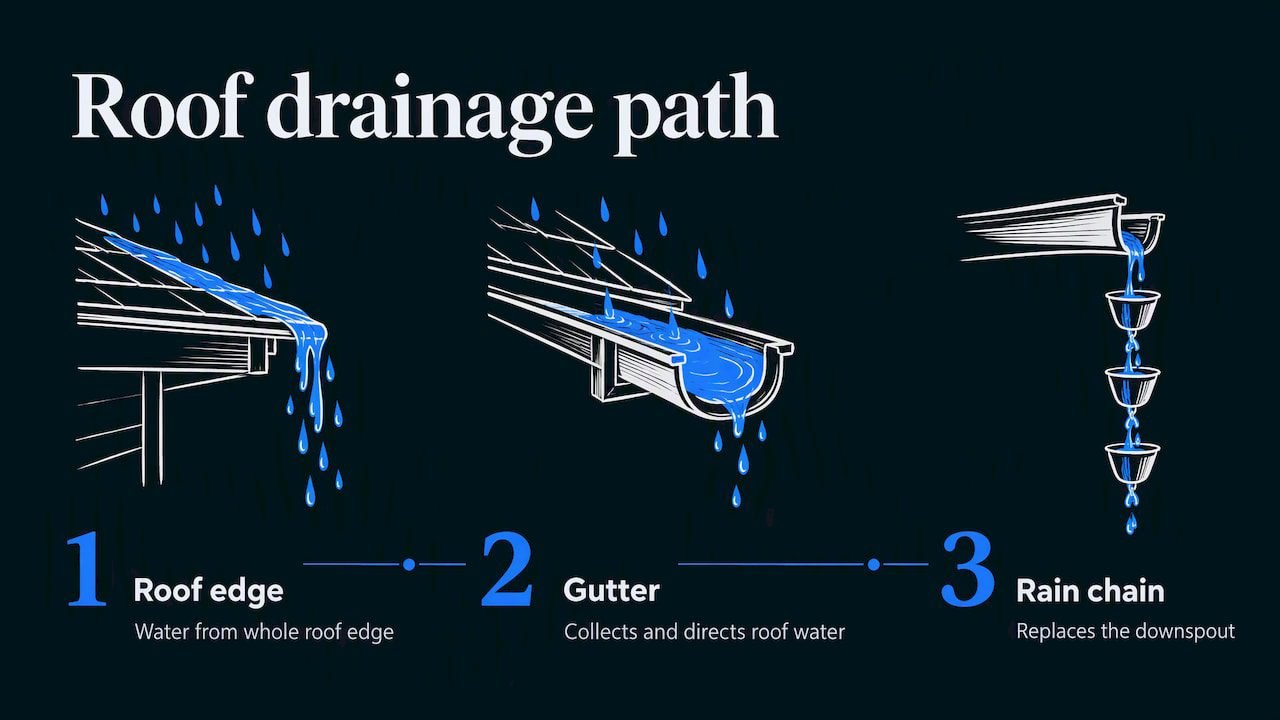
That also answers a common mix-up: rain chains are not really “versus gutters.” The chain replaces the downspout, not the gutter channel above it. The gutter still collects the water from the whole roof edge and feeds one point.
What happens at the bottom matters more than the top
The water has to go somewhere. The U.S. Department of Energy’s Building Science Education page warns that roof runoff that is not drained away can saturate the soil around a building and contribute to foundation seepage, mold, rot and durability damage.
For downspouts, the guidance is specific. Water should reach a sloping final grade farther than 5 feet from the foundation, or an underground catchment more than 10 feet away. The Building America Solution Center also recommends spacing downspouts 20 to 50 feet apart so peak rain can be carried off.
A rain chain has no built-in extension, so that distance becomes your job. Architect Alexander Zilberman, quoted by Dwell, says that with a chain you must solve for runoff just as you would for a downspout, with a catch basin or transfer system at the end. Designer Matthew Bowles adds that water should flow into a dissipator such as a pile of rocks to prevent erosion.
Clemson’s ground-level suggestions are practical:
- Anchor the chain in a dish, pot or rain barrel so it stays still and the water has a landing spot.
- Use ¾-inch drainage rock around the base to help prevent pooling and erosion.
- Choose a cupped chain where splashback would hit siding or a walkway.
- Make sure the final discharge point slopes away from the house, not toward it.
For a deeper look at where water goes once it leaves the roof, our 15-minute yard tests for roof runoff show you how to watch it in action.
Pros and cons, side by side
Where rain chains shine
Clemson lists the benefits: chains can slow runoff, reduce soil loss and erosion, and direct water to rain barrels, landscaped beds or other water features. Homes & Gardens’ Rachel Bull makes a similar point, that chains work like downpipes while slowing the flow of rainwater, which can ease pressure on a yard’s drainage. And visually, a chain can be a focal point at an entry, a courtyard or a garden corner.
Where they need care
- They must discharge away from the foundation, just like a downspout.
- They can swing in wind unless anchored.
- They add weight to the eave, more so with cups.
- Link chains splatter and are a poor match near doors, windows and walkways.
- The Arizona extension also warns that metals in rain chains can leach into rainwater, potentially making it toxic to wildlife, and that weathering changes their appearance unless treated or periodically cleaned. If the water feeds a garden or barrel, ask about the chain’s material.
Where downspouts shine
Downspouts are standardized, quiet in operation once installed correctly, and sized for the flow the gutter delivers. They can be color-matched to the trim, extended underground or tied into a drain. They are the lowest-maintenance way to protect your foundation, landscaping and siding, which is why most roofs in the neighborhood use them.
Which should you choose?
Use a downspout as your default when:
- The outlet sits above a walkway, entry, driveway or door.
- The ground at the base is flat or slopes toward the house.
- You want the lowest maintenance and no extra weight on the eave.
- The roof section is large and sends a lot of water to one corner.
Consider a rain chain, ideally cupped, when:
- The outlet falls over a planting bed, gravel area or courtyard with room to drain.
- You have or will add a basin, dish or rock bed below.
- The gutter and fascia are in sound condition and can carry the extra load.
- You want the sound and sight of water as part of the landscape design.
Many homes land in between. A common approach is to keep downspouts on the busiest runs and add a chain on one small, low-volume section where it can drain freely. Before hanging anything on the gutter, check it. Clemson recommends checking gutters for wear at least twice a year and checking eaves for stress from the chain and water weight. If you see sagging or pulling, remove the chain or reinforce the attachment. Our seasonal gutter checklist fits that routine, and the maintenance tips for seamless gutters explain what to look for.
Installing and maintaining a chain
If you go with a chain, treat it like part of the drainage system, not jewelry.
- Location: pick an outlet where splash and runoff will not reach siding, doors or walkways.
- Style and material: cupped for heavy rain, and a material you are comfortable with where the water ends up.
- Anchoring: secure the bottom so it does not swing in wind.
- Drainage: plan the landing zone before you hang the chain.
- Inspection: look at the ground for erosion and pooling after storms, and check the gutter attachment point regularly.
The gutter outlet matters too. A chain hangs from a hole or bracket in the gutter, so the gutter itself must be solid and well pitched. Leaks at seams and corners get worse when more weight and more concentrated flow pass through. Seamless runs reduce the number of joints, and our overview of seamless gutters vs regular gutters explains why. If you have a metal roof, see gutters for metal roofs in Florida, since fast-shedding roofs send water to the outlet quickly.
If leaves and debris clog the gutter above the chain, the water will spill over the edge instead of reaching it. Guards can help, and our look at whether gutter guards work covers what to expect.
Our perspective on rain chains vs downspouts
We like rain chains. We also like homes that stay dry, and in Florida those two goals do not always point the same way.
Our approach is to start with water volume. A gutter system is designed to collect everything your roof sheds and deliver it to a few points. A properly sized downspout is built for that job. For most homes, we recommend seamless gutters with correctly placed downspouts as the base of the system, because that is what keeps water away from fascia, soffits, siding and foundation through a summer storm.
If a homeowner wants the look of a chain, we are happy to talk it through. We start with the questions that decide whether it will work: where the water will land, what is underneath, how much weight the gutter and fascia can take, and whether the salt air will be kind to the finish. We use salt-air-resistant aluminum designed for Florida’s climate, and we fit each installation to the individual house.
Our goal is simple: a drainage system you never have to think about, whichever way it looks. That is why we stand behind our work with a Lifetime No-Clog Guarantee and do not leave a job site until you are satisfied.
Brian
Get the downspouts right first
Whether you want a clean, hidden downspout or a plan that leaves room for a decorative accent, the first step is a gutter system that moves water properly. We install seamless gutters, downspouts, gutter guards, and soffit and fascia for homeowners in Sarasota and nearby counties, and every project is custom-fitted to your home. Our satisfaction-or-no-payment promise applies to the work we do.

If you are replacing outlets or adding new ones, see our downspout installation service. If something is already leaking or sagging, start with gutter repair, or contact us through our site to schedule an estimate.
FAQ
Are rain chains effective?
They can be, when the setup is right. Chains slow runoff and can direct water to a barrel, planting bed or rock bed, and cupped chains handle splashing better than link chains. They are less forgiving than downspouts in heavy rain, so the landing area and gutter condition decide how well they perform.
Does a rain chain need a gutter?
Not strictly, but it works best with one. A chain can be used wherever water concentrates, such as a roof valley or eave, as long as the flow is directed into it. Attaching it to a gutter outlet is the more reliable method.
Are downspouts considered gutters?
No. A gutter system has two parts: the horizontal channels that collect runoff and the downspouts that carry it to the ground. The downspout belongs to the system, but it is not the gutter itself.
How far should water drain from the house?
The U.S. Department of Energy’s building science guidance says downspouts should carry water to a sloping grade more than 5 feet from the foundation, or to an underground catchment more than 10 feet away. The same applies to the base of a rain chain.
Can I swap my downspout for a rain chain myself?
You can, but check the gutter, the weight on the eave and the drainage below first. Chains plus held water add load, and the outlet connection has to be secure. If you are unsure about the gutter’s condition, have a gutter professional look at it before you hang anything.
Sources
- Rain Chain, Clemson Home & Garden Information Center
- Rain chains, University of Arizona Cooperative Extension (SmartScape)
- Gutters and Downspouts, Building America Solution Center
- Stormwater, Gutters, Downspouts, Building Science Education
- Foundation Drain, Gutters, Downspouts, Building Science Education
- Is a Rain Chain Right For You?, Dwell
- What is a rain chain and how does it work?, Homes & Gardens