

Gutter noise at night almost always comes from one of three places: water falling into a metal elbow, loose hangers rattling in the wind, or water that has nowhere to go because of a clog or poor slope. Each has a different fix, and the sound itself usually tells you which one you have. Below, we walk through how to read the noise, what you can safely try yourself, and when the noise points to a drainage problem worth a professional’s eyes.
TL;DR
- A steady drip or thump after rain is usually water free-falling inside a downspout and hitting an elbow. A rope or an extra bend in the water’s path can soften it.
- Rattling or clanging in wind or rain usually means loose hangers, brackets or screws. Inspect twice a year.
- Gurgling, overflow or water pooling at the foundation is not just noise. It points to a clog, bad pitch or short downspout that can damage your home.
- Never climb a ladder in wet weather. Wait for dry daylight, and call a pro if the job is high or the cause is unclear.
- Persistent noise after simple fixes is a good reason to have the system looked at by a gutter specialist.
Table of Contents
- What your gutters are telling you at 2 a.m.
- Why a downspout drips and thumps
- Rattling and clanging: loose hardware
- Simple ways to quiet a noisy downspout
- When noise is a drainage problem
- A safe weekend check
- Our perspective
- When to call a gutter professional
- How we can help
- FAQ
- Sources
What your gutters are telling you at 2 a.m.
At night, a house is quiet and a metal gutter system acts like a speaker. Rain hits the roof, runs into the trough, and drops through the downspout. Anything that is loose, tight, steep or blocked becomes audible. Start by naming the sound.
| What you hear | Most likely cause | First thing to check |
|---|---|---|
| Steady drip, tap or plink after the rain stops | Water falling from the gutter outlet into a downspout elbow | The first elbow under the outlet |
| Hollow thump or boom during rain | Long straight downspout with water dropping onto a bend | Downspout length and bends |
| Rattle, clang or knock in wind | Loose hangers, screws or brackets | Hangers along the run and the downspout straps |
| Gurgling or splashing at one spot | Partial clog or standing water | Outlet and the gutter section near it |
| Drip from the roof edge into the trough | Normal rain tapping on the metal | Usually no repair needed |
If you want a deeper walkthrough of each sound, our guide to gutter downspout noise and how to quiet it covers it in more detail.
Why a downspout drips and thumps
A downspout is a hollow metal tube. When water drops through it, the free fall ends against an elbow, and the metal amplifies the impact. Family Handyman notes that downspouts with elbows can amplify the sound of water dripping through them.
That is why the noise often continues after the rain has stopped. Water is still draining off the roof and out of the gutter in slow drops, and each drop lands in the same spot. In a quiet bedroom, a drop every few seconds is enough to keep you awake.
A few things make it worse:
- Second-story runs. More vertical drop means a harder landing.
- Several tight bends. Each bend is another place for water to strike metal.
- Downspouts on the wall next to a bedroom. Sound travels through the siding and framing.
- Thin or dented sections. They ring more than a smooth, well-secured run.
Rattling and clanging: loose hardware
If the noise comes mostly in wind, or sounds like a knock rather than a drip, look at the hardware. Today’s Homeowner recommends inspecting gutters twice a year for loose hangers, screws or brackets, because loose parts can rattle or clang in high winds or a rainstorm, sometimes loudly enough to be heard inside the house.
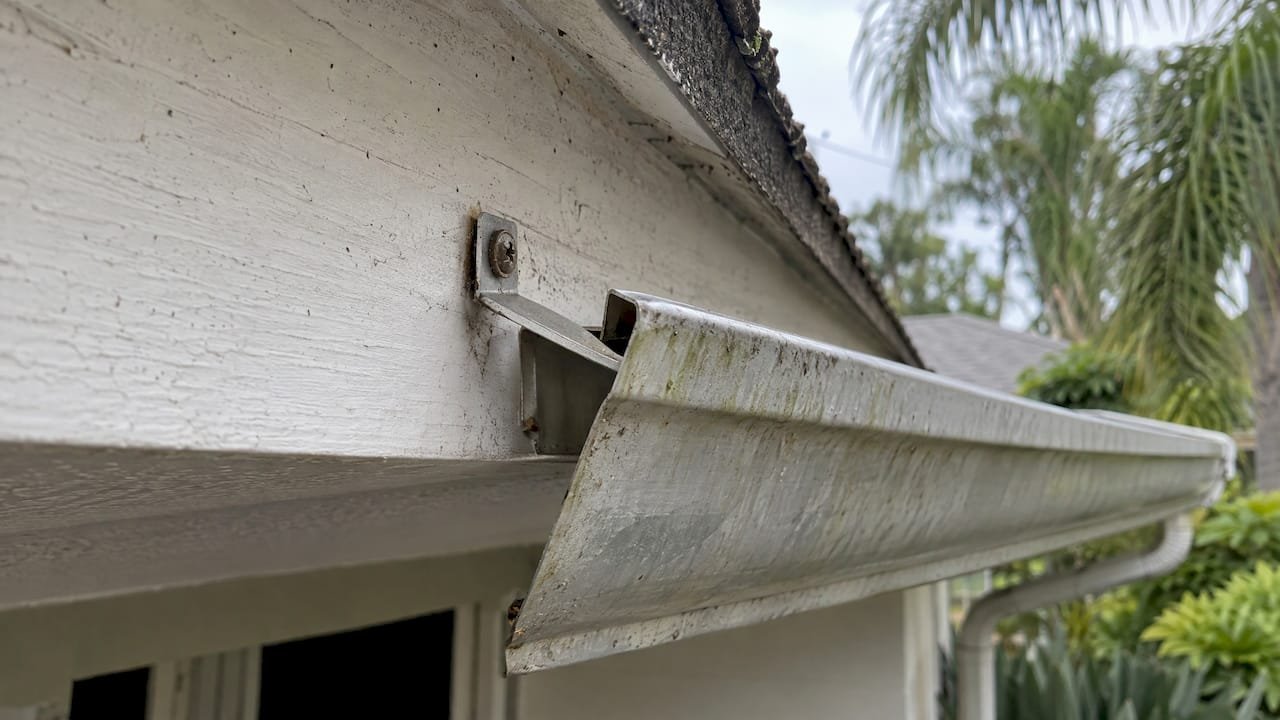
In Florida, this matters more than most places. Summer thunderstorms and tropical systems push wind and heavy rain against the gutter line, and fasteners that were snug years ago can work loose. Sagging sections, gaps at the fascia and downspout straps that no longer grip are all common culprits.
What to look for from the ground:
- Gutter sections that sag or pull away from the fascia.
- Gaps between the gutter and the board behind it.
- Downspouts that sway or sit away from the wall.
- Missing straps or screws.
A loose gutter does more than make noise. It can pitch water the wrong way and spill it along your wall. If the fascia behind it is soft or damaged, the hardware has nothing solid to hold. Our soffit and fascia repair service covers that side of the problem.
Simple ways to quiet a noisy downspout
The most widely recommended fix is a nylon rope. Family Handyman describes caulking a 3/8-inch-diameter nylon rope to the gutter drain opening, leaving a 1/4-inch gap, then gluing the rope to the bend in the elbow. Water then wicks down the rope instead of free-falling and hitting the metal. Today’s Homeowner describes the same approach with a 3/8-inch nylon rope and seaming caulk.
Other options people use:
- Plates or cushions in the elbow. Family Handyman notes that a lead plate or magnetic cushioned plate in the elbow usually changes the tone from a metallic drip to a thud rather than silencing it. It helps, but expect a softer sound, not silence.
- Rain chains. Today’s Homeowner points out that rain chains are common alternatives to downspouts in Japan because they are quiet and decorative. They are not built for exceptionally heavy rain, and the gutters must be free of clogs for them to work. In a Florida downpour, that limit is worth taking seriously.
- Tightening hardware. For rattles, this is the whole fix.
One caution if you use the rope trick. Today’s Homeowner warns that if water streaming down the rope pools underneath, you should add a rain system or ground gutter to redirect water away from the foundation. A quieter downspout that dumps water beside your slab is not a win.
Quiet should not mean slow
Water has to leave the gutter freely. Anything you add to a downspout or outlet must not restrict flow, or you trade a noise problem for an overflow problem. If you try a fix and the gutter starts to back up in heavy rain, stop and reassess. Our guide on testing gutter overflow with a hose shows how to check flow before you commit to repairs.
When noise is a drainage problem
A drip is annoying. Gurgling, splashing or a constant trickle in the wrong place can be a sign that water is not moving the way it should. That matters because your gutters protect the walls, the soil around the foundation and the roof edge.
FEMA states that well-maintained gutters and downspouts can double or triple the life of a roof drainage system, can keep water out of a structure, and can prevent ground saturation around the foundation. It also recommends an elbow or drain sleeve at the bottom of downspouts to divert water away from the structure. FEMA’s flood-protection guide adds that you should routinely clean gutters, downspouts and splashpads so rainwater from the roof flows easily away from the home.
Slope and downspout placement
Two setup details cause both noise and overflow:
- Pitch. InterNACHI states that gutters should slope toward the downspout at 1/16 inch per foot, or 1/4 inch per 5 to 10 feet. Less than that will not move water effectively, and much more can send it too fast, potentially causing overflow over end caps and corners. The Building America Solution Center gives the same minimum of 1/16 inch per foot.
- Spacing. The Building America Solution Center says downspouts should be installed every 20 to 50 feet along the gutter. This Old House puts it at one every 30 to 40 feet, or every 20 to 30 feet in areas with heavy rainfall. That is relevant in Florida.
A gutter that holds standing water away from the downspout is a gutter with a pitch problem. InterNACHI suggests looking for standing water in sections far from the downspout rather than measuring slope, which is a practical check you can do after a rain.
Where the water ends up
The Building America Solution Center says downspouts should end at least 5 feet from the foundation, or at an underground catchment at least 10 feet away, with lateral pipe pitched away from the foundation. This Old House warns that pooling near the foundation from too-short extensions can infiltrate the foundation and wick up the wall, causing mold, insects or rot. Telltale signs include a wet spot in the basement after rain or widening foundation cracks.

For how extension length is chosen in practice, this overview of downspout extension lengths contractors use is a handy reference. Our roof runoff yard tests show you how to see where water actually goes.
Clogs that make noise
Leaves, pine needles and shingle grit slow the flow and cause gurgling, splashing and overflow. NC State Extension advises inspecting gutters yearly and after major weather events to make sure they are clear, and considering a guard or strainer to keep debris out. Our seasonal gutter checklist breaks down timing, and our piece on whether gutter guards work helps you decide if a guard fits your trees.
A safe weekend check
Do the noisy-gutter inspection in daylight and dry weather. Most of it can be done from the ground.
- After the next rain, walk the perimeter. Look for overflow marks, water running down the siding and puddles near the foundation.
- Listen at the downspout. Run a garden hose into the gutter near the outlet and note where the sound is loudest.
- Look for loose hardware. From the ground, check for sagging, gaps and swaying downspouts.
- Check the discharge point. Make sure each downspout ends with an elbow, sleeve or extension that carries water away.
- Photograph what you find. It helps any contractor give you a clear answer.
Ladder safety
If you do go up, follow the safety rules from extension programs:
- West Virginia University Extension advises never working on a ladder or roof in any weather in which ice or precipitation is possible, and having another person stabilize the ladder if securing it with rope is not practical.
- UMass Amherst, citing U.S. Consumer Product Safety Commission precautions, says the ladder should extend at least 3 feet over the roof line, you should not stand on the top three rungs, and the ladder should sit at about a 75-degree angle. It also advises level, firm ground, a helper holding the base, keeping your body centered between the rails, and using a wooden or fiberglass ladder near power lines.
- This Old House suggests using a standoff to rest the ladder on the roof rather than the gutter, which prevents dents and adds stability, and staying on the ladder instead of working from the roof.
Never go up at night to chase a noise, and skip the ladder entirely on a two-story wall. That is exactly what a crew with the right equipment is for.
Our perspective
Most noise complaints we hear about come down to how the system was put together. Long straight drops, tight bends, hangers spaced too far apart and rushed downspout corners all make a gutter louder than it needs to be.
That is why we build seamless gutters custom-fitted to each home, in salt-air-resistant aluminum designed for Florida’s climate. Fewer seams and properly secured hardware mean fewer places for water to rattle, leak or hang up.
We also look past the sound. A drip at night can be the first hint that a gutter is pitched wrong, a downspout ends too close to the slab, or the fascia behind it is failing. Fixing the cause protects your home, and the quiet comes with it.
Our Lifetime No-Clog Guarantee and our promise not to leave a job site until you are satisfied are there for the same reason: we want the system to work every time it rains, not just on installation day.
Brian
When to call a gutter professional
A specialist is the right call when:
- The noise continues after you have tightened hardware and checked for clogs.
- Gutters sag, pull away from the fascia or hold standing water.
- Water spills over the edge in heavy rain or runs down the siding.
- The fascia or soffit behind the gutter looks soft, stained or cracked.
- Water pools near the foundation, or you see damp spots or widening cracks.
- The noisy downspout is on a second story or hard-to-reach wall.
- Your system is old enough that repairs keep coming. Our list of signs your gutters need replacing helps you judge.
A proper inspection looks at pitch, outlet size, downspout count and placement, hardware and where the water ends up, then fits a fix to the cause. That might be resecuring a run, reworking an elbow, adding a downspout or extension, or replacing the section.
How we can help
Five Star Aluminum serves homeowners in Sarasota and nearby counties with seamless gutter installation, repair and replacement, downspout installation, gutter guards and soffit and fascia work. If a noisy gutter is the symptom, we find the cause and fix it.

Start with gutter repair for loose, sagging or leaking runs, or downspout installation if the layout itself is the problem. If your system is beyond repair, see our seamless gutter installation options. We guarantee satisfaction or no payment. Contact us through fivestaraluminum.com to schedule an assessment.
FAQ
Why do my gutters drip at night after it stops raining?
Water keeps draining off the roof and out of the gutter for a while after rainfall ends. Each drop falls through the downspout and strikes an elbow, which amplifies the sound. A rope in the elbow or a reworked downspout path usually softens it.
How can I stop rain gutter noise?
Match the fix to the sound. Tighten loose hangers for rattles, clear clogs for gurgling, and use a nylon rope or elbow cushion for drips. If none of that works, a professional can check pitch, downspout placement and the condition of the system.
Is a noisy downspout a sign of damage?
Not always, since dripping is often just acoustics. But overflow, standing water in the gutter, or pooling at the foundation point to a drainage problem. Those are worth fixing soon because water near the foundation can lead to rot, mold or cracks.
Can I fix a noisy gutter myself?
Ground-level checks and small adjustments are reasonable on dry days. Work at height carries real fall risk, so for second-story runs, sagging sections or unclear causes, it is safer to have a crew handle it.
Sources
- How to Quiet Gutters and Downspouts, Family Handyman
- Guide to Quieting Gutters and Downspouts, Today’s Homeowner
- How to Make Your Home Safer and Stronger, FEMA
- Protect Your Home from Flooding, FEMA
- Inspecting Gutters and Downspouts, InterNACHI
- Gutters and Downspouts, Building America Solution Center
- Everything You Need to Know about Gutters and Downspouts, This Old House
- How To Drain Downspout Water Flow Away From a House, This Old House
- Moisture Control and Prevention: Gutter Management, NC State Extension
- Gutter Safety, West Virginia University Extension
- Fall Cleanup Hazards, UMass Amherst
- Downspout Extension Lengths Contractors Use