

Yes, many gutter runs need expansion joints, especially long runs, wide metal gutters, built-in box gutters, and some long seamless runs. Metal grows and shrinks with temperature, and a joint gives that movement somewhere to go. Without one, the gutter strains against its fasteners, buckles, or opens a leak at the seams.
TL;DR:
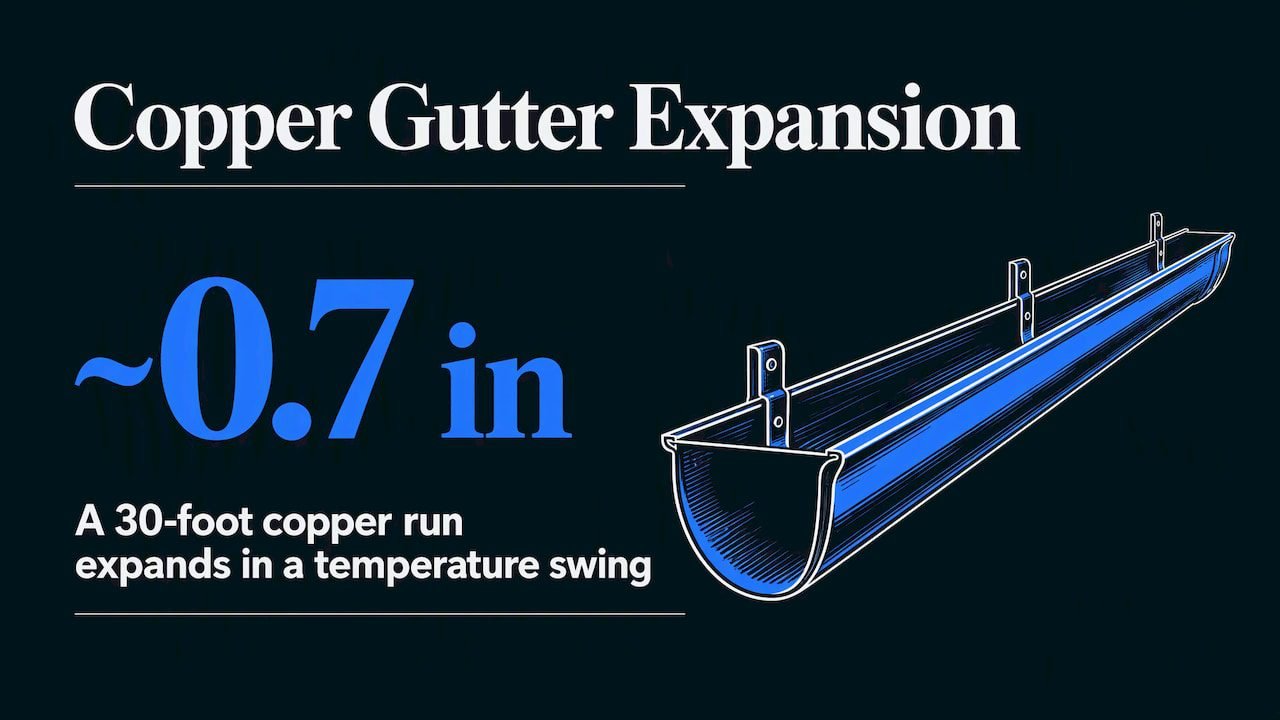
- A copper sheet spanning 30 feet can expand about 0.7056 inches over a 200°F temperature change; spacing depends on width, gauge, and run length.
- Treat corners and downspouts as fixed anchors; Amerimax recommends at least one downspout per 40 feet, but that is not a universal expansion joint spacing rule.
- Aluminum moves more than copper, so long aluminum runs need planned relief; coastal homes also need corrosion resistant fasteners and compatible joint materials.
- Never fasten through both sides of a slip joint, because locking the overlap prevents movement and can lead to buckling, failed seams, or leaks.
- Hire a qualified installer for long continuous runs, wide metal gutters, or box gutters, where movement calculations and inaccessible seams raise the stakes.
Table of Contents
- 1. What types of gutter expansion joints exist, and how does material affect the choice?
- 2. How far apart should expansion joints be, and where do they go?
- 3. How do you install a gutter expansion joint step by step?
- 4. Which gutter profiles need expansion joints?
- 5. When should you bring in a professional?
- 6. What problems do missing or failed expansion joints cause?
- 7. What signs point to an expansion joint problem?
- 8. How do you maintain gutter expansion joints?
- 9. What are the long-term benefits of using expansion joints?
- 10. Which expansion joint type works best in Florida’s climate?
- 11. Why expansion joints are not an extra worth skipping
- 12. How can we help you plan and install gutter expansion joints?
- FAQ
- Sources
1. What types of gutter expansion joints exist, and how does material affect the choice?
Not every joint suits every gutter. The right choice depends on the metal, the profile, and how the seams are made.
- Slip joints: Two sections overlap and slide against each other, so the run can lengthen or shorten without stressing the seam.
- Rubber or compression joints: A flexible gasket sits between sections and absorbs movement while keeping water in the trough.
- Mechanical cover plates: A plate bridges the gap and holds the sections in contact while still allowing movement.
- Cleated slip seams: Common in formed metal work, where a cleat anchors one side and the other side floats.
- Prefabricated joiners: Sized to the profile so the joiner matches the trough width.
Material changes everything. Aluminum moves more than copper for the same temperature swing, so aluminum runs need movement planned more deliberately. Copper can be soldered, which is why lapped, riveted, and soldered seams are standard for solderable metals. Zinc is also a metal that traditionally relies on soldered detailing. Vinyl behaves differently again, with its own snap-together joiners that are built to flex.
Duke University’s construction standards for flashing and sheet metal point to mechanical or interlocking joints that keep wide metal sections in contact, and they steer away from pop-riveted and caulked gutters for solderable metals. They also call for the same metal type across roofing accessories. Modern aluminum systems lean on mechanical or compression joints, while solderable metals lean on soldered seams. If you are still deciding on material, our comparison of aluminum and vinyl gutters covers the tradeoffs.
2. How far apart should expansion joints be, and where do they go?
Start with the fixed points. Downspouts and corners anchor the gutter in place, so movement builds up in the stretch between them. Joints belong where that stretch gets long enough that the metal cannot absorb the change on its own.
Spacing is not one number. It shifts with the metal’s expansion rate, the gutter width, the gauge or weight, and the total length. A wide, thin run needs closer attention than a narrow, heavy one.
The scale of the movement is bigger than most people expect. According to IIBEC’s guidance on built-in gutter design, a 30-foot copper sheet can expand roughly 0.7056 inches over a 200°F temperature change. That movement can be substantial on a single section, so seams and spacing have to be designed to accommodate it.
Here is how to plan placement in practice:
- Measure the full run and mark every downspout and corner, since those are your anchors.
- Mark the gap you need at each planned joint, sizing it to the gutter system and installation conditions.
- Use temperature marks at installation. Cut and set gaps tighter on a hot day and wider on a cold one, because the metal is already expanded or contracted when you work.
- Plan downspouts at a steady rhythm. The Amerimax installation guide calls for at least one downspout per 40 feet of gutter, which also gives you natural anchor points.
When a run is long, wide, or complicated, a pro can calculate the spacing for your exact material and gauge.
3. How do you install a gutter expansion joint step by step?
Good installation keeps the joint free to move while keeping water inside the trough.
- Measure the run and snap a chalk line along the fascia so the slope is consistent.
- Mark joint locations and use the temperature marks on the gutter to guide your cuts for the expansion gap.
- Cut the sections at the planned joint locations, keeping edges clean so the seal sits flat.
- Place the joiner or joint assembly and position the gutter past the seals, or against the center tabs when it is hot.
- Hang the gutter with hooks or dovetail hangers. The Amerimax guide gives hanger placement guidance.
- Fasten the joiner to the fascia where required, following the manufacturer’s instructions.
- Install end caps and drop outlets near the joints so water exits where you planned.
- Add straps around the gutter exterior at intervals. Duke’s standards recommend them to prevent blow-off in wind.
Pro Tip: Never drive a fastener through both sides of a slip joint. Pinning the overlap locks the metal in place and defeats the whole purpose of the joint.
Fastener choice matters. Use screws or rivets suited to the metal, and avoid rigid fastening that blocks movement. For sealing, solderable metals get lapped and soldered seams, while modern aluminum systems use mechanical covers and compatible sealants. Duke’s standards specifically caution against pop-riveted and caulked gutters for solderable metals, so match the method to the metal.
4. Which gutter profiles need expansion joints?
Profile changes both the stress and the detailing.
- K-style and half-round: Long runs benefit from planned movement, and a wider or lighter-gauge trough shifts more. Our guide to K-style versus half-round gutters shows how the shapes differ.
- Box and built-in gutters: These are the most likely to require joints. They sit inside the roof structure, so a failed seam is harder to reach and more costly to fix, and the detailing has to place joints close to fixed points. IIBEC treats this as a design issue, with spacing tables based on material thickness, width, and geometry.
- Seamless gutters: A long seamless run has no seams to relieve stress, so movement concentrates at the ends, downspouts, and any expansion fittings. Installers plan those points carefully, and how corners are handled matters too, as our look at seamless gutter corner methods explains.
5. When should you bring in a professional?
Brian here. In my experience, the gutters that fail early are the long, wide metal runs and the built-in box gutters where nobody planned for movement. The damage rarely shows up on day one. It shows up after a few hard seasons, as a popped seam or a sagging stretch.
For built-in or box gutters, and for any long continuous run, I recommend a qualified installer. At Five Star Aluminum, we handle gutter installation, repair, replacement, and related services.
6. What problems do missing or failed expansion joints cause?
When metal cannot move, the stress goes somewhere. It usually finds the weakest point.
- Buckling and waviness: The trough bows between fixed points as it pushes against itself.
- Open or cracked seams: Repeated movement fatigues sealant and breaks soldered or riveted joints, leading to leaks.
- Loosened fasteners: Screws and hangers work free as the gutter tugs against them, and sections start to sag or pull away.
- Misaligned slope: A shifting run loses its pitch, so water pools instead of draining.
- Water damage behind the gutter: Leaks at a failed joint run down the fascia and soffit, and that can mean rot and repairs well beyond the gutter itself.
Because aluminum moves more than copper, aluminum systems with too few relief points tend to show these symptoms sooner, especially on long, sun-exposed runs. Duke’s standards ask for an ample number of expansion joints for exactly this reason. If fascia has already taken damage, our team also handles soffit and fascia repair.
7. What signs point to an expansion joint problem?
You can often spot trouble from the ground, and a closer look from a ladder confirms it.
- Drips or stains at seams: Water marks on the fascia or a streak below a joint mean the seal has opened.
- Gaps or bulges at the joint: A visible crack, or a section pushed out of line, shows the metal has been fighting its restraints.
- Sagging between anchors: A dip in the middle of a run suggests hangers have loosened or the slope has shifted.
- Overflow in dry weather or light rain: Water spilling over the edge at one spot points to a pooling or misaligned section.
- Cracked or peeling sealant: Brittle, split material at a lap or cover plate means it has stopped doing its job.
- Loose or backed-out fasteners: Screws sticking out or hangers hanging free are an early warning.
- Seasonal changes: If a gutter looks tight in winter and wavy in summer, the movement is not being absorbed.
If you notice several of these at once, it may be bigger than a joint. Our list of signs your gutters need replacing can help you decide between repair and replacement.
8. How do you maintain gutter expansion joints?
Joints are low effort, but they need a look now and then.
- Inspect twice a year, ideally after the hottest and coldest stretches, when movement is at its extreme.
- Clear debris from the joint area. Leaves and grit packed into a slip joint can jam it and stop it from moving.
- Check sealant and gaskets for cracks, shrinkage, or gaps, and replace them before they fail.
- Tighten or replace loose hangers and straps, but never pin the joint itself.
- Flush the run with water and watch each joint for drips.
- Touch up soldered or lapped seams on solderable metals before small leaks spread.
General upkeep helps too, and our maintenance tips for seamless gutters cover cleaning and inspection habits that protect the joints as well. If cleaning is the sticking point, we also offer gutter cleaning and repair.
9. What are the long-term benefits of using expansion joints?
A well-placed joint is a small part that protects a larger investment.
- Longer seam life: Seams that are not constantly pulled apart keep their seal far longer.
- Fewer leaks: Movement is absorbed at a designed point instead of at a random weak spot.
- Less stress on fasteners and fascia: Hangers stay put and the fascia stays dry.
- Steadier slope and drainage: The run holds its pitch, so water keeps moving toward the downspouts.
- Better results on wide and built-in gutters: These profiles carry the most movement and gain the most from planned relief.
- Lower repair costs over time: Preventing a buckled run or a rotted fascia board is far cheaper than fixing them.
Metal will always expand and contract. The only choice is whether that movement is planned for or left to cause damage. Joints are how you plan for it.
10. Which expansion joint type works best in Florida’s climate?
Florida’s heat, strong sun, humidity, and salt air all shape the choice, because daily temperature swings, UV, and corrosion work on every joint.
- Slip joints: Reliable on aluminum because they allow free movement, and there is little to degrade. Keep the overlap clean so grit does not jam it.
- Rubber or compression joints: Good at sealing, but gaskets can harden and crack under intense UV, so the material grade and periodic checks matter.
- Mechanical cover plates: Durable and easy to inspect, and they pair well with aluminum when fasteners are corrosion-resistant.
- Soldered or riveted seams: Better suited to copper and other solderable metals than to modern aluminum systems, and salt air makes material matching more important.
- Vinyl joiners: Built to flex, but sun exposure is a long-term consideration.
For coastal homes, salt-air-resistant aluminum with mechanical or compression joints is a practical pairing, and we use materials designed for Florida’s climate. The best answer depends on your home’s exposure and run length, which is why we assess each one.
11. Why expansion joints are not an extra worth skipping
Brian again. Most online advice treats expansion joints as an upgrade for fussy installs, and I think that gets it backward. The physics is not optional. When a 30-foot copper sheet can grow by about 0.7 inches over a big temperature swing, and aluminum grows more, the question is not whether the metal moves. It is where.
Where the common advice falls short is that it fixates on the part and ignores the system. A perfect joint does nothing if someone screws through it, or if the hangers pin the gutter solid, or if the run was never divided at sensible anchors. Place the fixed points first, then decide where relief belongs, then pick a joint that suits the metal.
If you do one thing, have a professional look at any long, wide, or built-in run before it fails. A short assessment costs far less than rebuilding a rotted fascia.
— Brian
12. How can we help you plan and install gutter expansion joints?

Whether your gutters need a new joint or a full rethink, we can assess the run and do the work. Here is what we offer:
- Gutter installation with spacing planned for your material
- Gutter repair for leaking or failed seams
- Gutter replacement for runs beyond repair
- Downspout installation to set the anchor points your joints depend on
Long runs, box gutters, and heavy-gauge metals can benefit from professional attention. Request an inspection or estimate at Five Star Aluminum, and we will tell you exactly what your gutters need.
FAQ
How far apart should gutter expansion joints be?
There is no single spacing, because it depends on the metal, width, gauge, and run length. Treat downspouts and corners as fixed anchors and plan relief where the stretch between them gets long. The Amerimax guide also calls for at least one downspout per 40 feet, which helps divide the run.
What are the different types of expansion joints for gutters?
The main types are slip joints, rubber or compression joints, mechanical cover plates, and cleated slip seams. Solderable metals such as copper often use soldered or lapped seams instead. Modern aluminum systems typically rely on mechanical or compression joints.
Do seamless gutters need expansion joints?
Often yes, especially on long runs. Because a seamless gutter has no seams, movement concentrates at the ends, downspouts, and any expansion fittings, so installers plan those points carefully. Having a pro check the run is the safest way to know.
Can I install an expansion joint myself?
A short, simple run may be manageable, but built-in and box gutters are best left to a qualified installer. Mistakes such as fastening through a slip joint can lock the metal in place and cause the very damage the joint is meant to prevent.
Sources
- DUKE UNIVERSITY CONSTRUCTION STANDARDS
- Built-in Gutter Design and Detailing | IIBEC
- Amerimax_Comtemporary_English