

Space gutter hangers no more than 24 inches apart, measured center to center, and tighten that to 18 inches where wind, ice or heavy debris loads are a concern. That is the standard most manufacturers publish, and it is the number we build around on Florida homes, where storms and salt air test every fastener on the house. Below you will find how to lay out a run, how many hangers you need, where downspouts belong, and the signs that your hangers are failing.
TL;DR
- 24 inches on center is the professional standard for most homes. Treat 36 inches as an absolute ceiling, not a target.
- 18 inches is the better choice for high-wind coastal areas, large gutter profiles and homes under heavy tree cover.
- Place the first and last hangers about 4 inches from each end of a run, and add support at every corner and downspout outlet.
- Plan roughly one downspout for every 20 to 24 feet of gutter, then adjust for roof size and rainfall.
- If the fascia behind the hanger is soft, closer spacing will not fix it. Repair the wood first.
Table of Contents
- The short answer on hanger spacing
- Why spacing matters more than it looks
- 24 inches or 18 inches: how to choose
- Where the first and last hangers go
- How many hangers do you need?
- Hanger type matters as much as spacing
- Fascia condition comes first
- Downspout spacing and placement
- Our perspective: treat the hanger as a storm part
- How to check your hangers before storm season
- Let us handle the layout
- FAQ
- Sources
The short answer on hanger spacing
Manufacturer instructions agree on a number. A copper gutter system installation guide puts the standard at 24 inches on center and reduces it to 18 inches for heavy ice, snow or high wind. A metal gutter installation guide says the same: one hanger every 24 inches, or every 18 inches in heavy ice and snow areas. A gutter installation guide from Poligon specifies 24 inches on center and 4 inches from the roof ends.
You will see “three feet apart” in plenty of online guides. Alsco Metals frames 3 feet as a maximum that depends on location, climate and the specific gutter. Angi treats going past 36 inches as a common mistake. In other words, 36 inches is where a system stops being acceptable, and 24 inches is where good work starts.
| Spacing | When it fits | Trade-off |
|---|---|---|
| 36 in. | Absolute maximum, light conditions only | Most prone to sagging between hangers |
| 24 in. | Standard for most residential runs | Good balance of cost and support |
| 18 in. | Wind, ice, large profiles, heavy debris | More hardware and labor, stronger hold |
Why spacing matters more than it looks
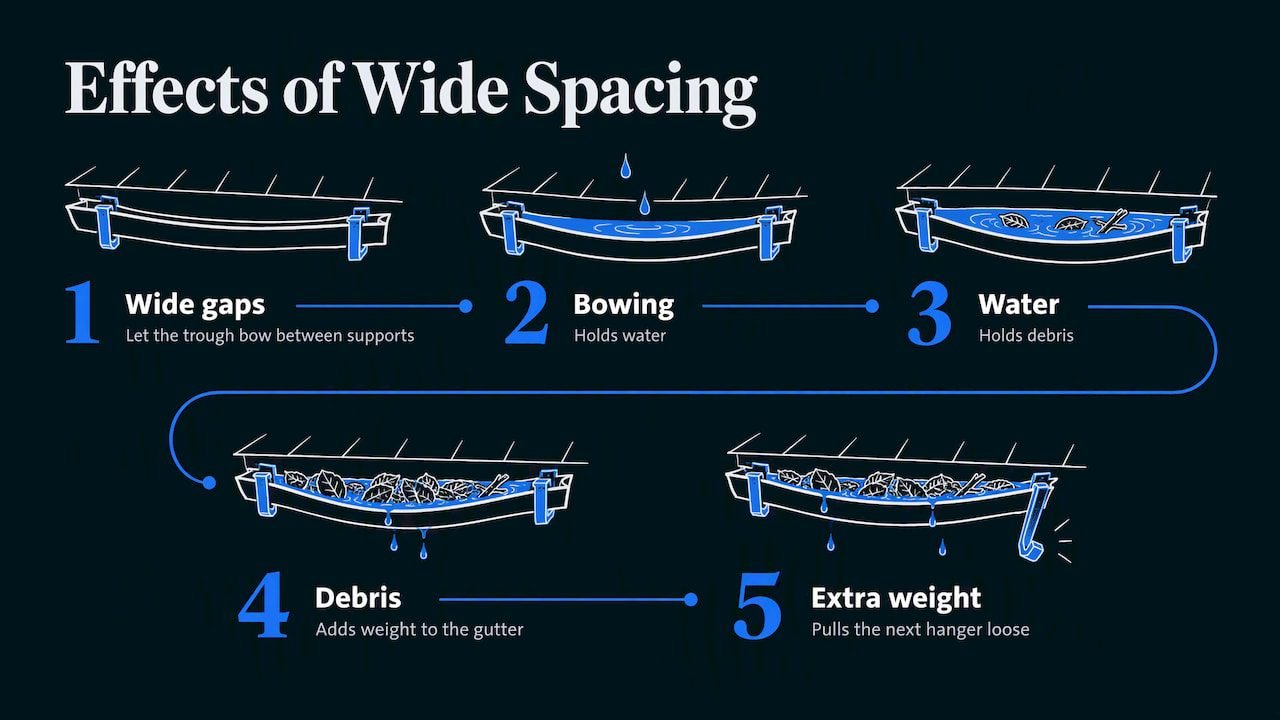
A gutter is light when it is empty. Fill a 40-foot run with rainwater, pine needles and wet oak leaves and it becomes heavy, and every pound pulls on the hangers and the fascia behind them. Wide gaps let the trough bow between supports. Bowing holds water, water holds debris, and the extra weight pulls the next hanger loose.
The cost side is real too. Angi’s guidance describes spacing as a trade-off: closer hangers cost more in labor and materials up front, but they reduce the long-term risk of sagging, fascia rot and foundation damage. On a house that sees summer downpours several times a week, we think the closer spacing is the cheaper choice over the life of the system.
Sagging also does not stay in the gutter. When water spills over the back edge, it runs down the fascia and into the soffit. If you have already seen stains on an interior ceiling, a drywall ceiling repair guide explains what the repair involves once the water source is fixed. Fix the gutter first, or the stain comes back.
24 inches or 18 inches: how to choose
Use these questions to decide.
- Is the home near the coast or exposed to open wind? Choose 18 inches. The copper system instructions cited above call for tighter spacing in high-wind areas, and coastal Florida qualifies.
- Are the gutters 6 inches or larger? Larger profiles carry more water, so they carry more weight. Closer hangers are sensible.
- Do oak, pine or palm trees overhang the roof? Debris adds load. Choose 18 inches or add gutter guards to cut the load.
- Is the roofline long and unbroken? Long runs flex more. Tighter spacing keeps the line straight.
- Is it a small, sheltered run on a low roof? 24 inches is fine.
Gutter style matters as well. If you are deciding between profiles, our comparison of K-style and half-round gutters covers capacity and cost.
Where the first and last hangers go
Spacing is only half the layout. The ends of a run are the weakest points, especially where a downspout adds weight. Angi recommends placing hangers at least 4 inches from each end of the gutter, and the Poligon guide uses the same 4 inches. Here is a layout method that works.
- Mark the fascia 4 inches in from each end of the run.
- Snap or string a line for the slope, which is usually a small drop toward the downspout.
- Mark hanger positions every 24 inches (or 18) starting from one end.
- If the last gap comes out short or long, spread the difference across several gaps rather than leaving one wide span.
- Add a hanger beside every outlet, corner and seam.
Corners deserve their own attention because they are where leaks begin. Our guide to seamless gutter corner methods explains the options.
How many hangers do you need?
The math is simple. Divide the run length in inches by the spacing, then add one.
| Run length | At 24 in. | At 18 in. |
|---|---|---|
| 10 ft (120 in.) | 6 | 8 |
| 20 ft (240 in.) | 11 | 14 |
| 30 ft (360 in.) | 16 | 21 |
| 40 ft (480 in.) | 21 | 27 |
These counts round up and assume hangers at both ends. Add extras at corners and outlets, and buy a few spares. So a 10-foot section needs about 6 hangers at the standard spacing, and about 8 at the tighter one.
Hanger type matters as much as spacing
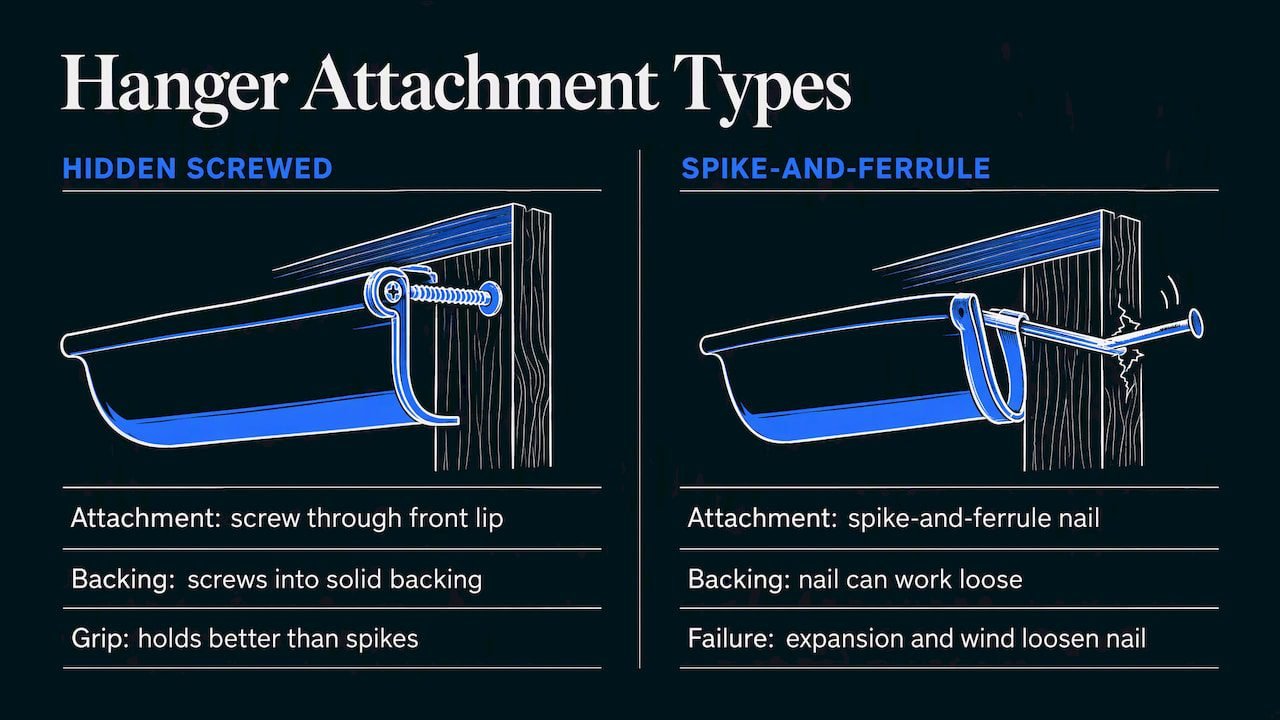
A perfectly spaced row of weak hangers still fails. Hidden hangers that screw through the front lip of the gutter into solid backing hold better than old spike-and-ferrule setups, where the nail can work loose from the wood over years of expansion and wind. We prefer screwed hangers on every Florida job for that reason.
The fastener matters too. Standard steel screws corrode in salt air, and a rusted screw loses its grip long before the aluminum gutter itself wears out. Choose corrosion-resistant fasteners rated for coastal use.
Fascia condition comes first
Hangers are only as strong as what they grip. Angi’s guidance and our own experience agree here: sagging is often blamed on spacing when the real problem is wood rot behind the gutter. The screwdriver test is simple. Press a screwdriver tip into the fascia board behind an existing hanger. If it sinks in easily, the wood is soft, and adding more hangers will only create more holes in rotten material.
In that case the fascia needs repair or replacement before new gutters go up. Our pages on fascia board material groups and soffit and fascia replacement costs help you plan, and soffit vs fascia explains how the two parts differ and why moisture in one affects the other.
Downspout spacing and placement
Hangers hold water up. Downspouts get it out. If you have too few, the best-spaced gutters still overflow.
The usual rule of thumb is about one downspout for every 20 feet of gutter, and manufacturer guidance is slightly looser: the Poligon guide calls for one downspout per 24 feet of gutter, and two once a run exceeds 24 feet. Your roof size, gutter profile and local rainfall change the answer, so treat these as starting points.
Where to put them
- At the low end of the slope. Water travels toward the outlet, so the outlet belongs where the gutter pitches down.
- Near corners where water collects. Valleys and inside corners send concentrated runoff into the gutter.
- Away from doors and walkways. A downspout that discharges onto a patio or entry is a nuisance and a slip hazard.
- With an extension or splash block. Water should land well away from the foundation, and many contractors target at least 6 feet.
A long run with one downspout in the middle can work if the gutter is large and the roof pitch is modest. But if your gutters overflow in a heavy rain, test before you assume the hangers are at fault. Our hose test for gutter overflow tells you whether the cause is slope, clogging or too few downspouts. If you need another outlet, see our downspout installation service.
Our perspective: treat the hanger as a storm part
After more than 20 years working on Florida homes, we look at hangers differently from a catalog. In a hurricane or a tropical downpour, the hanger is where the system lets go first. A gutter that is full of water and gets hit by wind transfers all of that force into a few screws and a strip of wood.
So we do not think of spacing as one number. It is a combination of hanger style, fastener material, gutter size and fascia condition. On the Gulf Coast, we favor 24 inches as the ceiling and go tighter when the home is exposed, the trees are heavy or the run is long. We would rather spend a few extra dollars on hardware than return after the first big storm.
The other half is honesty about the wood. If the fascia is soft, we say so before we quote gutters, because hanging new aluminum on rotten boards is money wasted. Fix the structure, space the hangers properly, use corrosion-resistant screws and keep the troughs clear. That is what holds up.
— Brian
How to check your hangers before storm season
A quick inspection once or twice a year catches problems early. A pre-hurricane gutter checklist recommends tightening loose hangers and replacing any that show rust, because one failed hanger can take the rest of the run with it. For a wider seasonal routine, see this guide on caring for a metal building, which covers inspection habits that also apply to the metal gutters on a house.
From the ground and a safe ladder, look for these signs:
- Gutter lines that dip or wave between supports
- Gaps between the gutter and the fascia
- Rust streaks below screw heads
- Water marks on the fascia or soffit after rain
- Hangers that move when you press gently on the gutter
Stay off the roof edge and never lean a ladder on a gutter itself. If you find sagging at several points, the system likely needs more than a tweak. Our guide to signs your gutters need replacing helps you judge repair versus replacement, and our seamless gutter maintenance tips keep a good system in shape. For cleaning timing, use our seasonal gutter checklist.
Let us handle the layout
If you own a home in Sarasota or a nearby county and want hangers set the right way the first time, we install seamless gutters built for Florida’s climate, with salt-air-resistant aluminum and a Lifetime No-Clog Guarantee. We also handle gutter repair and storm damage restoration and soffit and fascia repair, so a rotted board and a sagging run get fixed in one visit. We do not leave a job site until you are satisfied, and if you are not, you do not pay. Contact us through fivestaraluminum.com to schedule an estimate.
FAQ
How far apart should gutter hangers be?
Place them 24 inches apart on center for a typical home. In high-wind or heavy-load situations, use 18 inches. Never exceed 36 inches, which is widely seen as the outer limit.
How many hangers do I need for a 10-foot gutter?
About 6 at 24-inch spacing, or about 8 at 18-inch spacing. That counts one at each end, set roughly 4 inches in. Add more at corners and downspout outlets.
How many downspouts does my house need?
A common starting point is one for every 20 to 24 feet of gutter. Large roofs, heavy rainfall and small-profile gutters may need more. A contractor can size this from your roof area and pitch.
Where should downspouts go?
Put them at the low end of each run, near corners where water collects, and away from entries and walkways. Extend the discharge several feet from the foundation so water drains away from the house.
Can I fix sagging gutters by adding hangers?
Sometimes, but check the fascia first. If a screwdriver sinks into the board, the wood is rotted and new hangers will not hold. Repair the fascia, then re-hang the gutter at the proper spacing.
Sources
- Euracraft copper gutter system installation instructions
- Installing metal gutter systems, installation guide
- Gutter installation guide, Poligon
- How Far Apart Should Gutter Hangers Be, Alsco Metals
- 6 Gutter Hanger Spacing Tips, Angi
- Storm-Proof Gutters: Pre-Hurricane Season Checklist, My Home Quote
- How to Care for Your Metal Building