

Most homeowners do best with K-style gutters because they handle more water per nominal size and cost less to install, while half-round gutters remain the better pick for historic or architecturally formal homes that call for a traditional silhouette. The Building America Solution Center treats gutter profile as mainly an aesthetic choice, so we help you weigh looks against capacity and budget before you decide.
TL;DR:
- NRCS design tables tie capacity to gutter size, slope, and downspout count; a larger half round or extra downspout can offset its lower capacity.
- At slopes of 1/32 or 1/64 inch per foot, capacity margins narrow, so check roof area and drainage design before choosing dimensions.
- Aluminum K style systems formed on site usually cost less to install than shop formed half round sections and have fewer joints that can leak.
- If gutters are only a few years old, repair may be more sensible; recurring damage, sagging, or clogs point toward replacement.
Table of Contents
- K-style vs. half-round at a glance
- What is a K-style gutter?
- Advantages and drawbacks of K-style gutters
- What is a half-round gutter?
- Advantages and drawbacks of half-round gutters
- How profile affects water capacity and downspout planning
- Cost and installation: what drives your budget
- Maintenance and durability: what to expect over time
- Which style is right for your house?
- An installer’s take on choosing between the two
- Let us install the gutter style that fits your home
- FAQ
- Sources
K-style vs. half-round at a glance
K-style gutters fit most homes because they combine a decorative, crown-molding profile with a trough shape that carries more water in the same nominal width. They install as seamless runs, which cuts down on leak points, and they tend to cost less to buy and install than half-round systems of comparable size.
Half-round gutters suit homes where appearance carries real weight, like Victorians, Craftsman bungalows, or properties with historic designation. Their smooth, semicircular interior is easier to scoop clean by hand, and premium materials like copper give them a finished look that ages well.
K-style:
- Higher nominal water capacity for the same size
- Lower typical material and labor cost
- Widely available in seamless aluminum runs
Half-round:
- Smooth trough simplifies manual debris removal
- Traditional, architectural appearance
- Available in premium finishes like copper
If you’re not restoring a historic property, K-style is usually the practical default.
What is a K-style gutter?
A K-style gutter gets its name from a cross-section that resembles crown molding on the front face, with a flat bottom and back wall that give it more volume than a curved trough of the same width. That shape is why a 5-inch K-style gutter typically moves more water than a 5-inch half-round one, according to Building America guidance on sizing and style.
K-style comes in aluminum, vinyl, and galvanized steel, with nominal widths of 4, 5, and 6 inches. Most residential installs use seamless aluminum formed on-site, and the profile works well with hidden hangers for a clean look from the ground.
Advantages and drawbacks of K-style gutters
K-style gutters work for the majority of homes because they balance performance and price well.
- Pros: higher water capacity per nominal size, generally lower material and labor cost, available as seamless runs with fewer joints, and a clean fit on modern rooflines.
- Cons: the flat-bottomed profile can trap leaves and grit in the corners, the look reads more contemporary than traditional, and sectional installs show seams and repair patches more visibly than seamless runs.
Pro Tip: Ask your installer to confirm seamless aluminum is used on your run, since factory-sealed seams cut down on the leak points that sectional K-style systems are prone to.
What is a half-round gutter?
A half-round gutter is a simple semicircular trough, open at the top, usually sized at 5 or 6 inches. The rounded interior has no corners for debris to catch, which is part of why these systems carry a reputation for being easier to clean by hand.
Aluminum half-round gutters are common, but copper and steel versions show up on higher-end or historic projects where a premium finish matters. Installation typically uses round hangers or straps rather than the hidden brackets common on K-style, and half-round is more often shop-formed and installed in sections rather than run seamless on-site.
Advantages and drawbacks of half-round gutters
Half-round gutters earn their place on certain homes, but the trade-offs are real.
- Pros: the smooth trough makes manual cleaning faster, the rounded profile reads as traditional and architecturally appropriate on period homes, and copper or heavy-gauge aluminum options hold up well over time.
- Cons: a half-round gutter typically carries less water than a K-style gutter of the same nominal size, and both materials and installation labor usually cost more, especially with shop-formed sections and specialized hangers.
If your home’s style calls for half-round, budget for the premium rather than treating it as a drop-in swap for K-style.
How profile affects water capacity and downspout planning
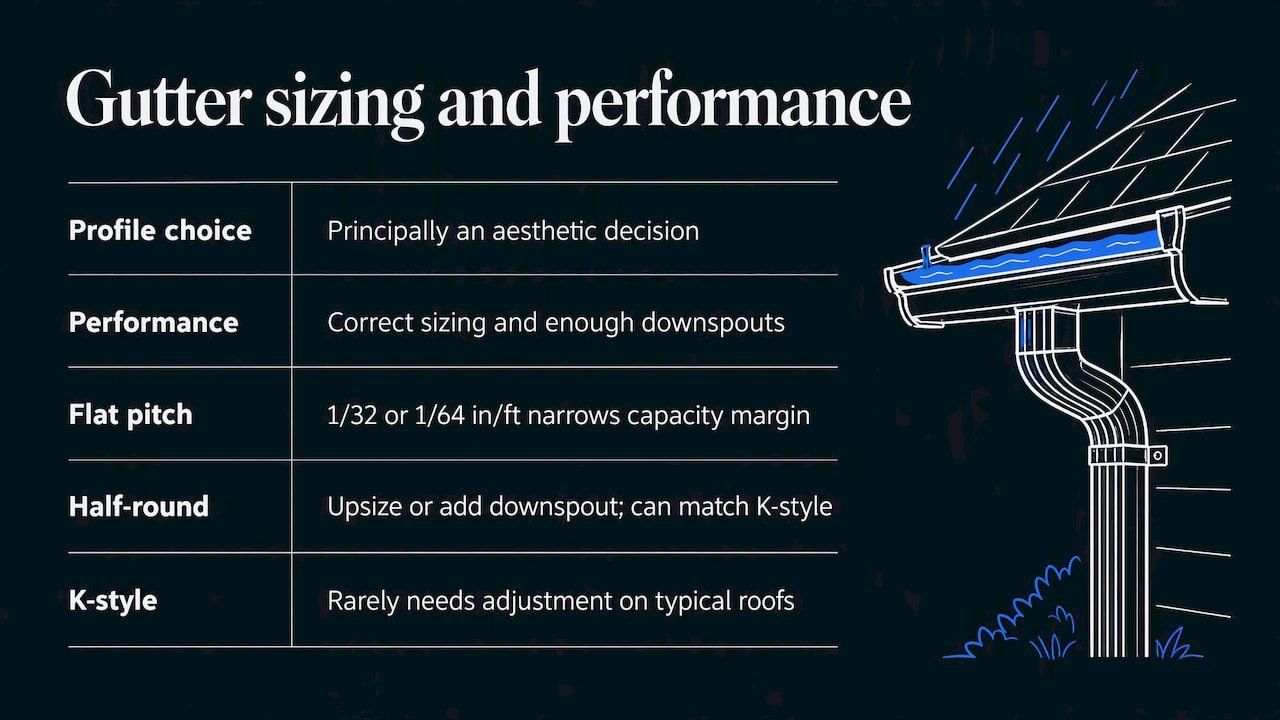
Profile shape matters less than most homeowners assume. Building America guidance states that gutter style is principally an aesthetic decision, and that correct sizing paired with enough downspouts is what actually determines how well a system performs in a storm.
NRCS/USDA design tables map gutter size, slope, and downspout count to the maximum roof area each configuration can handle, and the NRCS design guidance advises caution when planning very flat slopes, since a 1/32 or 1/64 inch per foot pitch narrows your capacity margin. In practice, that means a half-round system can often match a K-style system’s performance if you upsize it or add an extra downspout, and a correctly sized K-style run rarely needs adjustment on a typical residential roof. Getting the slope and downspout count right matters more than the profile you pick.
Cost and installation: what drives your budget
Material and labor costs move in predictable directions once you know the profile and finish you want.
- Aluminum and vinyl K-style gutters are generally the most budget-friendly option for a standard home.
- Copper half-round carries a premium price for both material and the skilled labor needed to form and hang it.
- Seamless K-style, formed on-site from a single aluminum coil, usually costs less to install than shop-formed half-round sections because it requires fewer joints and less specialized fitting.
- Projects that pair new gutters with gutter guard installation add to the upfront cost but reduce the cleaning work ahead.
When your existing gutters are only a few years old, a repair often makes more sense than full replacement. If damage, sagging, or persistent clogging keeps recurring, that is a sign it is time to replace rather than patch again.
Maintenance and durability: what to expect over time
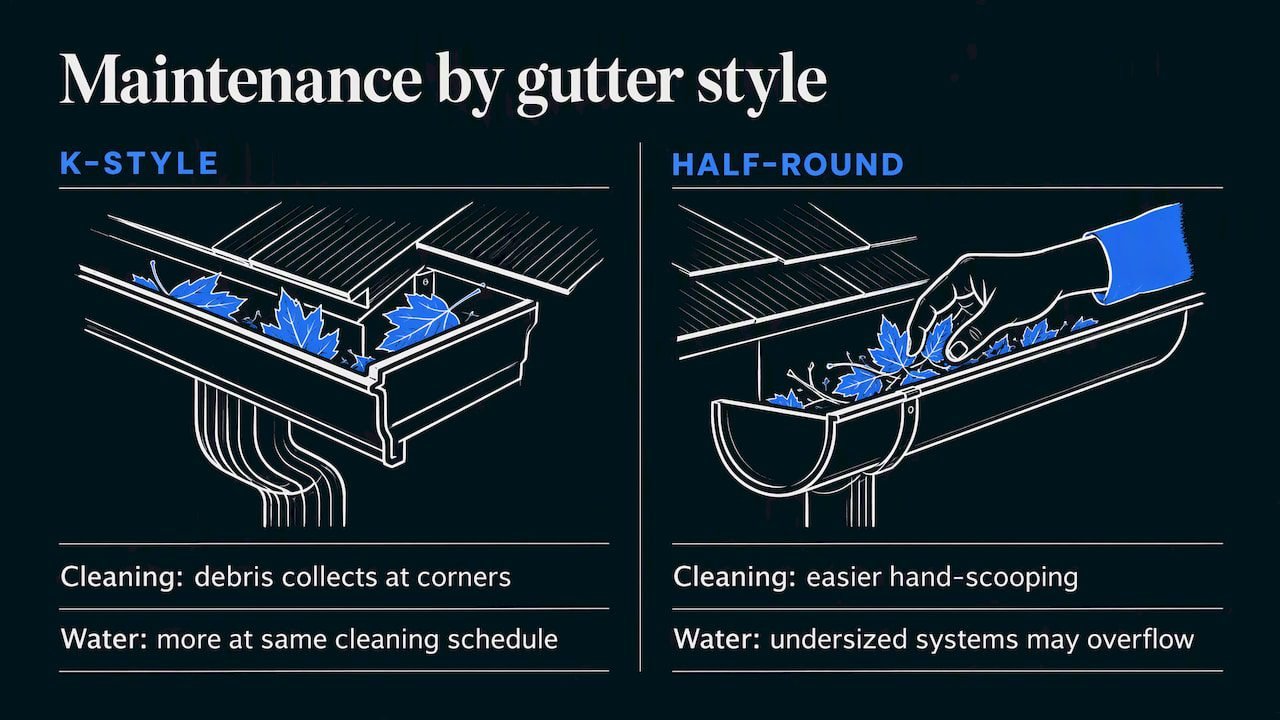
Half-round gutters are genuinely easier to scoop out by hand, but an undersized half-round system can still overflow in a heavy downpour regardless of how clean it is. K-style gutters need slightly more attention to their corners, where debris tends to collect, but they handle more water for the same cleaning schedule.
Material lifespan depends heavily on exposure. Coastal homes see faster wear from salt air, which is why we build with salt-air-resistant aluminum designed for Florida’s climate. Pairing either style with gutter guards cuts down on cleaning frequency.
Pro Tip: Check your gutters after the first few storms each season, since a quick look catches sagging or pooling before it turns into fascia damage.
Which style is right for your house?
Work through these steps before you commit to a profile.
- Look at your roofline and eaves. Steep, modern rooflines generally pair well with K-style.
- Consider your home’s architectural style. Historic, Craftsman, or formal designs often call for half-round.
- Factor in your local rainfall patterns and storm intensity, and size accordingly using NRCS design tables.
- Set your budget, since K-style typically costs less for comparable performance.
- Think about resale and curb appeal goals, especially if neighboring homes share a consistent gutter style.
A mid-century ranch or contemporary build usually looks right with seamless K-style aluminum. A restored bungalow or a home with decorative trim often looks better, and holds its value better, with half-round.
An installer’s take on choosing between the two
After more than 20 years installing gutters across Florida, we have seen homeowners pick a profile based on looks alone and end up with a system that cannot keep up with a hard summer storm. Flow calculation, hanger spacing, and pitch matter more than which shape looks better in a photo. We back every installation with a Lifetime No-Clog Guarantee because getting the sizing right the first time saves you a callback later.
— Brian
Let us install the gutter style that fits your home
Whether you want the practical capacity of seamless K-style or the classic lines of half-round, we handle gutter installation with materials built for Florida’s salt air and heat. Our team also handles gutter guard installation, downspout placement, and full replacements when an older system has run its course.

Every install comes backed by a Lifetime No-Clog Guarantee, with experienced professionals fitting gutters to Florida homes. If you want roofline details like drip edges checked before your gutters go on, roof edge guidance from our roofing partner is worth a look too. Ready to move forward? Get your gutter installation started and we will help you pick the profile, size, and finish that fits your home.
FAQ
What are the downsides of half-round gutters?
Half-round gutters typically carry less water than a K-style gutter of the same nominal size, and they usually cost more to buy and install because of shop-forming and specialized hangers. They can also be harder to source in certain premium materials like copper, depending on your region.
Are half-round gutters worth it?
Half-round gutters are worth the added cost on historic or architecturally formal homes where the traditional look matters, and their smooth trough does make manual cleaning easier. For a typical modern home focused on performance and budget, K-style usually delivers better value.
What shape of guttering is best?
Neither shape is universally best. The Building America Solution Center notes that gutter style is mainly an aesthetic choice, so the right shape depends on your home’s architecture, your budget, and whether the system is sized correctly for your roof.
How long do K-style gutters typically last?
Lifespan depends on material and exposure, with aluminum K-style gutters generally holding up well for many years when properly maintained, especially in coastal climates where salt-air-resistant finishes help. Regular cleaning and prompt repair of small issues extend that lifespan further.
Sources
- Gutters and Downspouts | Building America Solution Center
- Roof gutter and downspout design (NRCS/USDA)