

Seamless aluminum gutters typically last 20 years or more, and a professional chart rates aluminum gutters, downspouts, soffit and fascia at 20 to 40+ years. Where you land in that range depends on the installation, the aluminum, the roof and how well the system is maintained. In Florida, salt air, heavy rain and falling debris make those factors matter even more.
TL;DR
- Aluminum gutters, downspouts, soffit and fascia are rated at 20 to 40+ years by InterNACHI’s life expectancy chart.
- Seamless runs have no joints along the length, so the leak points sit at the corners, end caps and downspout outlets. That is where aging usually shows first.
- Coastal air, storms and debris can pull a system toward the short end of the range. Good installation and regular cleaning push it toward the long end.
- Repair suits isolated problems. Replacement makes sense when damage is widespread, the fascia behind the gutter is rotting, or water keeps overflowing.
- Not sure which side of that line you are on? A trained eye can tell you in one visit.
Table of Contents
- How long seamless gutters really last
- Why seamless gutters tend to outlast sectional ones
- What shortens a gutter’s life in Florida
- How often do gutters need replacing?
- Signs you need new gutters
- Repair or replace: how to decide
- How to extend the life of your gutters
- Our perspective
- Ready for a straight answer on your gutters?
- FAQ
- Sources
How long seamless gutters really last
The honest answer is a range, not a single number. Aluminum is the most common seamless gutter material, and the published life expectancy for aluminum gutters, downspouts, soffit and fascia runs from 20 to 40+ years. That spread is wide because a gutter is not just a material. It is a material, a roof, a climate and a set of habits.
Here is how the common materials generally compare:
| Material | Typical character | What to expect |
|---|---|---|
| Seamless aluminum | Light, rust-resistant, formed to length on site | Long service life when installed and maintained well |
| Vinyl | Inexpensive, can turn brittle in sun | Shorter life in strong UV and heat |
| Copper | Premium look, develops a patina | Longest life, highest cost |
If you are weighing materials, our guides on aluminum vs. vinyl gutters and aluminum vs. copper gutters go through cost, lifespan and Florida fit in more detail.
One point surprises many homeowners: thicker is not automatically longer-lived. Heavier aluminum mostly resists dents from ladders, branches and hail better. Lifespan is driven far more by how the gutter is pitched, hung and kept clear.
Why seamless gutters tend to outlast sectional ones
Sectional gutters arrive in short pieces, usually 10 feet long, and are joined every few feet. Each joint is sealed with a bead of sealant, and sealant eventually dries out, cracks and lets go. That is the most common way a sectional system starts to leak.

Seamless gutters are formed from a single coil of aluminum at your home, cut to the exact length of each run. With no joints along the straight sections, there is far less to fail. Our comparison of seamless gutters vs. regular gutters covers the differences side by side.
Seamless does not mean joint-free. Corners, end caps and downspout outlets still have connections. How those are made is a big part of whether a system lasts. We explain the options in four seamless gutter corner methods.
What shortens a gutter’s life in Florida
A gutter in Sarasota, Parrish or Bradenton works harder than one in a dry, mild climate. These are the factors we see most often.
Salt air and humidity
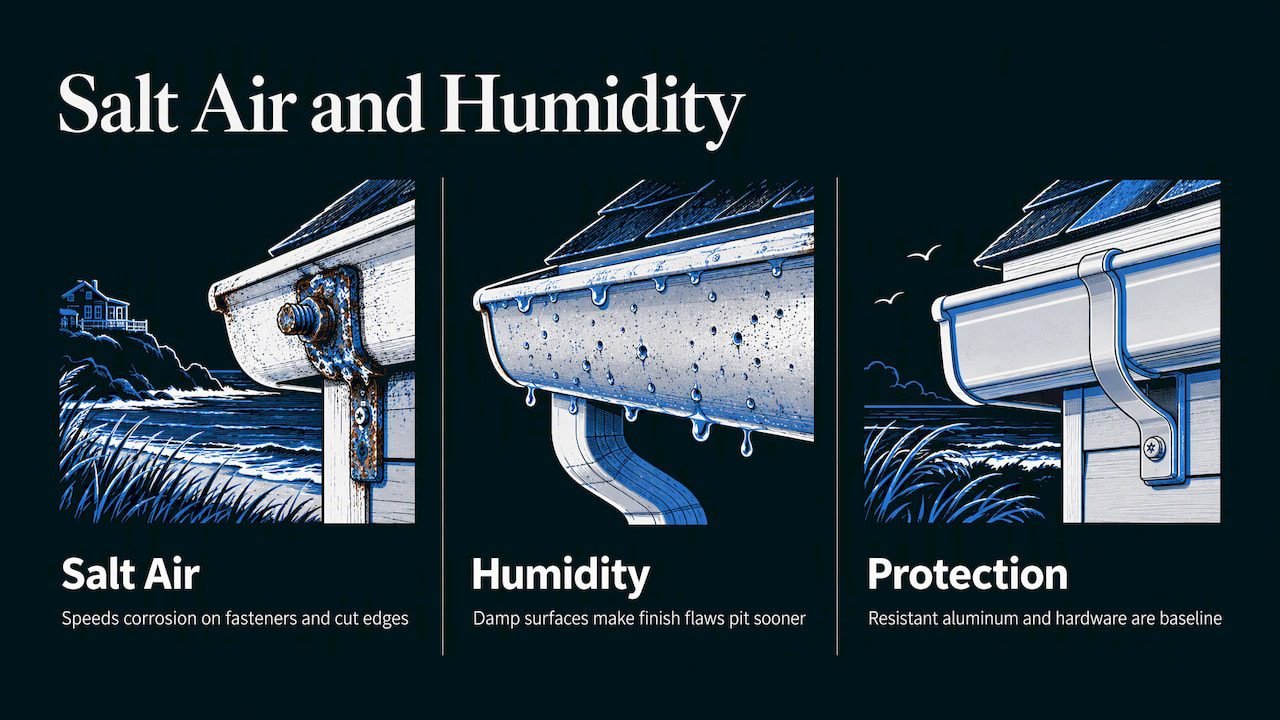
Homes near the Gulf and the bays live with salt in the air. Salt speeds corrosion on fasteners, hangers and any exposed cut edge. Humidity keeps surfaces damp longer, so small flaws in the finish turn into pitting sooner. Salt-air-resistant aluminum and corrosion-resistant hardware are not extras here. They are the baseline.
Heavy rain and storm seasons
Florida summers deliver rain in short, intense bursts. A gutter that is slightly undersized, poorly pitched or too lightly fastened will overflow or pull away from the fascia under that load. Wind-driven debris and fallen limbs from storms also bend, dent and loosen gutters that were fine before the season began.
Debris and standing water
Oak leaves, palm fronds, pine needles and shingle grit settle in the trough. Wet debris holds moisture against the metal and adds weight. Water that stands in a gutter instead of draining is what eventually wears through the finish and stresses the seams and hangers.
Installation quality
A gutter needs a steady slope toward the downspouts, hangers at the right spacing, and solid wood behind it to hold the fasteners. Skip any of those and even the best aluminum will sag, pool water and fail early. This is why the person hanging the gutter matters as much as the metal.
Roof type
Some roofs shed water in ways that stress a gutter more than others. Tile roofs, for instance, can throw water past a standard setup. We cover that in gutters for tile roofs.
How often do gutters need replacing?
There is no calendar date that tells you it is time. A well-installed seamless aluminum system that is cleaned regularly can serve for decades. A neglected one can start failing much earlier. Think of the published range as a guide, then let the condition of your own gutters decide.
A practical rule: once your gutters pass the 15-to-20-year mark, look at them closely every season. Before that, look after every major storm.
Signs you need new gutters
These are the signs that point toward replacement rather than another patch. Our page on signs your gutters need replacing goes deeper.
- Gutters pulling away from the house. A visible gap between the gutter and the fascia means the fasteners or the wood behind them have given way.
- Sagging runs. Dips hold water, and the weight keeps making the dip worse.
- Rust, pitting or flaking finish. Small spots can be treated. Widespread corrosion means the metal is failing.
- Cracks and splits along the trough. If you find several, the system is aging out, not just unlucky.
- Leaks at multiple corners or end caps. One leaky corner is a repair. Many suggest the whole system has run its course. See why corner leaks happen and what to do about leaking end caps.
- Overflow in heavy rain even when the gutters are clean. That can mean wrong pitch, undersized gutters or too few downspouts. A simple hose test helps you tell the difference.
- Water stains, peeling paint or soft spots on fascia and soffit. Moisture has already reached the wood. These are also signs to check soffit and fascia.
- Water pooling at the foundation or damaged landscaping beneath the eaves. Water is landing where it should not.
- Peeling or fading paint. Cosmetic fading alone is not a reason to replace. If you are unsure, read paint gutters or replace them.
Repair or replace: how to decide
The decision comes down to how much of the system is affected and what is happening behind it.
| Situation | Usually points to |
|---|---|
| One leaking corner or end cap | Repair and reseal |
| A single loose hanger or short sagging section | Repair, re-hang |
| Clogged downspout | Clear or replace the downspout |
| A section dented by a fallen limb | Repair or replace that section |
| Leaks at many corners and joints | Replacement |
| Rusted or pitted metal in several places | Replacement |
| Rotted fascia behind the gutter | Fix the wood, then replace or re-hang the gutter |
| Chronic overflow with proper cleaning | Replacement with a better-sized system |
A useful test is the “second repair” test. If you have already fixed the same gutter once and a new problem appears somewhere else, you are probably paying for patches on a system at the end of its life. If the problem is isolated and the rest of the run is sound, a repair makes sense and keeps the system going for years.
Also check what is behind the gutter. Gutters hang from the fascia, and the fascia sits under the roof edge. If the board is soft, any new gutter will fail in turn. Repairing or replacing the fascia first is the right order. You can see how we approach that in our soffit and fascia repair service and in our guide to soffit and fascia replacement.
How to extend the life of your gutters
Maintenance is the cheapest way to add years to a gutter system. Here is what makes the biggest difference.
- Clean them on a schedule. In Florida, with year-round leaf and needle drop, many homes benefit from cleaning more than twice a year. Our seasonal gutter checklist explains what to do yourself and when to call a pro.
- Check after storms. Look for bent sections, loose hangers, and debris jammed in downspouts.
- Flush the downspouts. Water should run freely from the outlet. If it backs up, there is a clog somewhere in the line.
- Look at the corners and end caps once a year. Small leaks caught early are quick to reseal.
- Trim overhanging branches. Less debris in means fewer clogs and less storm damage.
- Consider gutter guards. They keep most large debris out of the trough. We explain when gutter guards work and how much cleaning they can save.
- Keep the right habits for the long term. For a practical routine, see our maintenance tips for seamless gutters. For what a cleaning visit involves, this professional gutter cleaning guide walks through what to expect.
Working on a ladder is a real fall risk. If your home has two stories, a steep roof or tile, hiring a licensed, insured contractor is the safer choice.
Our perspective
We have spent more than 20 years putting up and fixing gutters in Sarasota and the surrounding counties. The pattern is consistent: a gutter rarely fails because the metal ran out of years. It fails because water sat in it, a corner was never sealed well, or the wood behind it quietly rotted.
That is why we build seamless runs on site, measured to your roofline, from salt-air-resistant aluminum. It is also why we pay attention to pitch, hanger spacing and the fascia before we hang anything. Done that way, a seamless system is designed to protect your home for a long time.
Our Lifetime No-Clog Guarantee is part of the same thinking. We would rather fit a system that keeps working than one that sends you back up a ladder every few months. And we do not leave a job site until you are satisfied.
Brian
Ready for a straight answer on your gutters?
If you are seeing any of the signs above, we can look at your gutters, your fascia and your roofline and tell you whether a repair will do or a replacement is the better course. We handle seamless gutter installation, replacement, repair, downspouts, gutter guards, and soffit and fascia work for homes across Sarasota and nearby counties. We stand behind it with a satisfaction-or-no-payment promise.

See our gutter installation options, our gutter repair and storm damage services, or contact us to schedule a visit.
FAQ
How long do aluminum gutters last?
Aluminum gutters, downspouts, soffit and fascia are rated at 20 to 40+ years in InterNACHI’s life expectancy chart. Real-world results depend on installation quality, climate and upkeep. In coastal Florida, salt-air-resistant aluminum and regular cleaning help a system reach the long end of that range.
Do seamless gutters last longer than regular gutters?
In general, yes, because seamless runs have no joints along their length where sealant can fail. Corners, end caps and outlets still need to be made and sealed well. Our comparison of seamless and regular gutters covers the details.
Should I repair or replace my gutters?
Repair isolated problems such as one leaking corner, a loose hanger or a single damaged section. Replace when damage is widespread, the metal is rusting through, or the fascia behind it is rotted. If you have already patched the same system more than once, replacement usually costs less over time.
Can I make my gutters last longer?
Yes. Keep them clear of debris, flush the downspouts, check corners and end caps each year, and inspect after storms. Gutter guards can also reduce how much debris gets in.
Sources
- InterNACHI’s Standard Estimated Life Expectancy Chart for Homes
- Gutter cleaning guide for homeowners