

For most homes, 6-inch seamless gutters are the right size. A 7-inch gutter makes sense when your roof sends a lot of water to one downspout, when the roof is steep, or when your house sits in a high-rainfall or coastal area like ours on Florida’s Gulf Coast. The difference is real but modest: about 40 percent more capacity, which matters most where one afternoon thunderstorm can dump a lot of water on a single roof section.
Below, we explain how the two sizes compare, how to tell which one your roof needs, and what to pair with each so the system works.
6 Inch VS 7 Inch Gutters
-
A 6-inch K-style gutter holds about 2.00 gallons per linear foot. A 7-inch holds about 2.80, roughly 40 percent more.
-
Six inches suits most single-family roofs. Seven inches is worth considering for roofs that send 3,000 or more square feet to one downspout, steep roofs, and coastal or high-rainfall sites.
-
A bigger gutter does not fix a bad layout. Downspout size, spacing and slope decide whether it actually works.
-
Florida’s building code requires downspouts to discharge at least 1 foot from the foundation, whatever gutter size you pick.
-
If you are unsure, a roof-by-roof assessment beats a rule of thumb. We can do that for homes in Sarasota and nearby counties.
Table of Contents
What actually differs between 6-inch and 7-inch gutters
The number names the width of the gutter’s opening, the part that catches water coming off the roof edge. Both sizes are usually K-style, the profile with a flat back and a decorative front that resembles crown molding. A wider opening and deeper trough means a bigger cross-section, and a bigger cross-section moves more water before it spills over.
Here is how the two compare on the numbers we can verify:
| 6-inch K-style | 7-inch K-style | |
|---|---|---|
| Capacity per linear foot | About 2.00 gallons | About 2.80 gallons |
| Capacity premium | Baseline | About 40 percent more |
| Typical roof area per downspout | Up to about 2,000 sq ft | Considered at 3,000+ sq ft |
| Typical downspout pairing | 3×4 inch | 4×5 inch |
| Best fit | Most single-family homes | Large roofs, steep pitches, coastal and high-rainfall sites |
The capacity figures and roof-area guidance come from a gutter capacity comparison. The downspout pairing comes from a K-style gutter size calculator, which also lists flow per downspout of 130 gallons per minute for 6-inch and 195 for 7-inch at a standard slope of 1/4 inch per 10 feet.
Notice what the table does not say. Seven inches is not “better” in every case. It is a different tool for a different roof. A 7-inch gutter on a small, low-slope roof with two short runs adds weight and material cost and changes how the trim looks, without solving a problem you actually have.
Why gutter size matters at all
Gutters exist to move roof runoff away from your house. According to InterNACHI’s gutter inspection guidance, the purpose is to channel water away from the foundation, because saturated soil can lead to moisture intrusion, mold and wood rot. An undersized gutter overflows in a heavy downpour and dumps that water exactly where you do not want it: along the foundation, over your entry, or onto a planting bed.
The Building America Solution Center frames it as a system: gutters should be sized for the anticipated water load, and downspouts should be spaced 20 to 50 feet apart. That second point is where many size debates go wrong. People argue about 6 versus 7 inches when the real problem is one downspout serving a 60-foot run.
How to decide: four things to check on your roof
1. How much roof drains to each downspout
This is the biggest factor. Per the capacity comparison, a 6-inch K-style gutter handles up to about 2,000 square feet of roof per downspout. Seven inches comes into play when a downspout serves 3,000 square feet or more. In between, you can often stay with 6-inch and add a downspout.
A practical way to think about it: measure the roof section that drains to a given gutter run, then count the outlets on that run. Many Florida homes have long, simple eaves that are easy to fix with one more downspout. Homes with large, complex roofs and few places to hide a downspout are where 7-inch earns its keep.
2. Roof pitch
Steep roofs shed water faster, so the gutter gets hit with a heavier surge. The same guidance says a roof at 9/12 or steeper calls for more capacity. Water coming fast off a steep slope can also overshoot a gutter that would handle the same volume from a gentler roof. If you have a steep section above a patio or front door, that run is a candidate for 7-inch even when the rest of the house is fine with 6.
3. Rainfall intensity and location
The sizing guidance singles out coastal and Gulf Coast properties where storm intensity can exceed what a 6-inch gutter handles. That is our market. Sarasota is rainy, with a distinct wet season, and summer storms deliver rain in short, heavy bursts. A gutter does not care about your annual total. It cares about how much arrives in ten minutes.
If you want to see whether your current gutters are the problem, test them with a hose before you spend anything. Where the water spills tells you whether you have a capacity problem, a clog, a slope problem or a missing downspout.
4. Reserve capacity
Gutters do not run at 100 percent. Leaves, granules and pollen collect, a section sags, and a storm exceeds the design rainfall. The calculator we referenced recommends keeping at least 15 percent reserve capacity. If your roof is close to the limit for 6-inch, that reserve is the argument for going to 7.
One caution on measuring: roof drainage design often starts from the plan area of the roof, then adjusts for pitch. Guidance such as this manufacturer’s installation document notes that using the true sloped area can lead to oversizing. It is one reason a quick online calculator and a professional estimate can disagree.
When to choose 7-inch gutters
Seven-inch gutters are the better call in these situations:
-
Large roof sections with few downspout locations. If one downspout has to serve 3,000 square feet or more, the larger trough gives you the margin.
-
Steep roofs. A 9/12 pitch or steeper sends water down quickly.
-
Long valleys. Where two roof planes meet, flow concentrates and dumps into one spot on the gutter.
-
Spots where overflow would do damage. Above an entry, a pool deck, a walkway or a garage door, a little extra capacity is cheap protection.
-
Coastal exposure and storm-heavy sites. If you have had overflow in past storms with 6-inch gutters, upsizing is a reasonable fix, as long as the downspouts are upsized with it.
Gutters are also one piece of getting a house ready for storm season. If you are building that plan, this hurricane home prep checklist walks through what to do in the 48 and 36 hours before a storm arrives.
When 6-inch is the smarter choice
Six-inch is our default recommendation for many homes, and not as a compromise. It is the right answer when:
-
Your roof is moderate in size and pitch, with a downspout at least every 30 to 40 feet.
-
No single roof section drains more than about 2,000 square feet to one outlet.
-
Your current gutters overflow only because of clogs or missing outlets, not capacity.
-
You want to match a profile that is easier to source and replace. A 1986 USDA technical note says 7-inch gutter is a standard size but can require a special order in many regions, and while that is an older document, it is a good reason to ask any installer how they source the material.
Most important, remember that a properly installed 6-inch system with enough downspouts can outperform a poorly pitched 7-inch system. If you are choosing between the two, ask first whether adding an outlet solves the problem.
Match the downspouts to the gutter
A 7-inch gutter feeding a small downspout is a bottleneck. The calculator guidance pairs 6-inch K-style gutters with 3×4-inch downspouts and 7-inch K-style gutters with 4×5-inch downspouts. For single-pitch runs over 40 feet, it suggests stepping up one gutter size or adding a downspout.
Three practical points:
-
Count outlets before you count inches. Adding a downspout is often cheaper than upsizing the whole gutter run.
-
Place outlets where water naturally concentrates. Valleys, the low corner of a long run and the ends of large roof planes are the usual spots.
-
Do not skip the discharge. The Florida Building Code section on downspouts requires discharge at least 1 foot from the foundation, per the code text (the version we reference is the 2007 edition, so confirm the current edition and your local rules). In practice, extensions or splash blocks should carry water further than that. Our downspout installation page covers what we install.
What the Florida code says (and does not say)
The Florida Building Code does not set 6-inch or 7-inch as a required gutter size for a typical house. What the code text we reviewed does address is where the water goes: downspouts must discharge at least 1 foot from the structure, and gutters are called for on buildings whose eaves project less than 6 inches. Beyond that, sizing generally falls to local municipal drainage standards and the plumbing code.
So you will not fail an inspection for choosing 6-inch over 7-inch. You are choosing based on performance. If you are in an HOA, check its exterior guidelines on gutter color and profile before you order.
Appearance, materials and upkeep
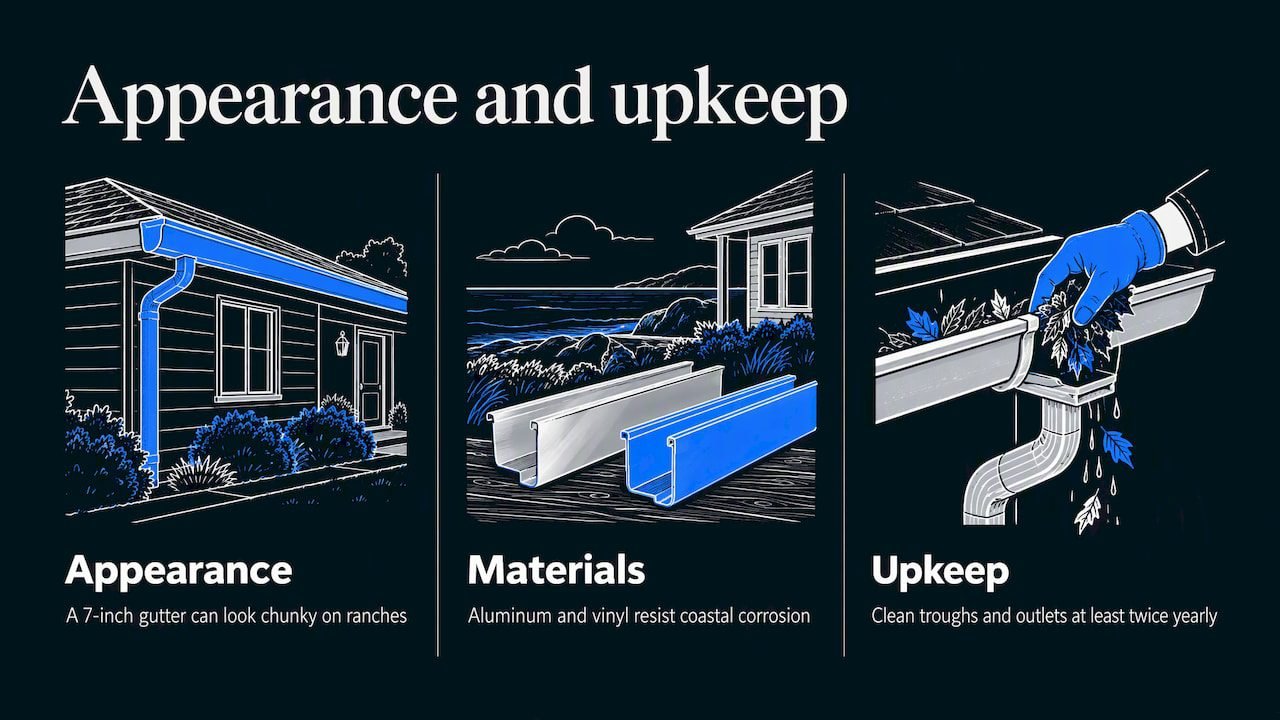
A 7-inch gutter is visibly deeper and sits a little heavier on the fascia. On a single-story ranch, that can look chunky. On a two-story stucco house with a large roof, it often looks proportionate. Color and profile matter more to curb appeal than the extra inch, and seamless runs look cleaner than sectional ones. If you are comparing profiles, our guide to K-style versus half-round gutters explains why K-style tends to move more water for less money, and seamless versus regular gutters covers why fewer seams means fewer leaks.
Material matters in salt air. We install aluminum and vinyl materials chosen for Florida’s climate, designed to resist the corrosion that coastal humidity brings.
Size also does not replace maintenance. Clean troughs and downspout outlets at least twice a year, and check hangers for sagging, which creates standing water and can lead to rot, as one field guide explains. A bigger gutter still clogs. Our seasonal cleaning checklist helps you decide what to do yourself and when to call a pro, and gutter guards can reduce how often you need to.
Our perspective: size the system, not just the gutter
After more than 20 years working on Gulf Coast homes, we see the same pattern. Homeowners ask whether they need 7-inch gutters because a neighbor told them to, or because a gutter overflowed once. When we get on the roof, the cause is rarely the gutter’s width.
More often it is a clogged outlet, a run pitched the wrong way, a downspout too small or too far away, or a valley dumping a lot of water in one spot. Fix those and 6-inch seamless gutters handle most homes beautifully. When a roof truly is large, steep or exposed, we recommend 7-inch with 4×5 downspouts, and we explain why, so you are not just buying a bigger number.
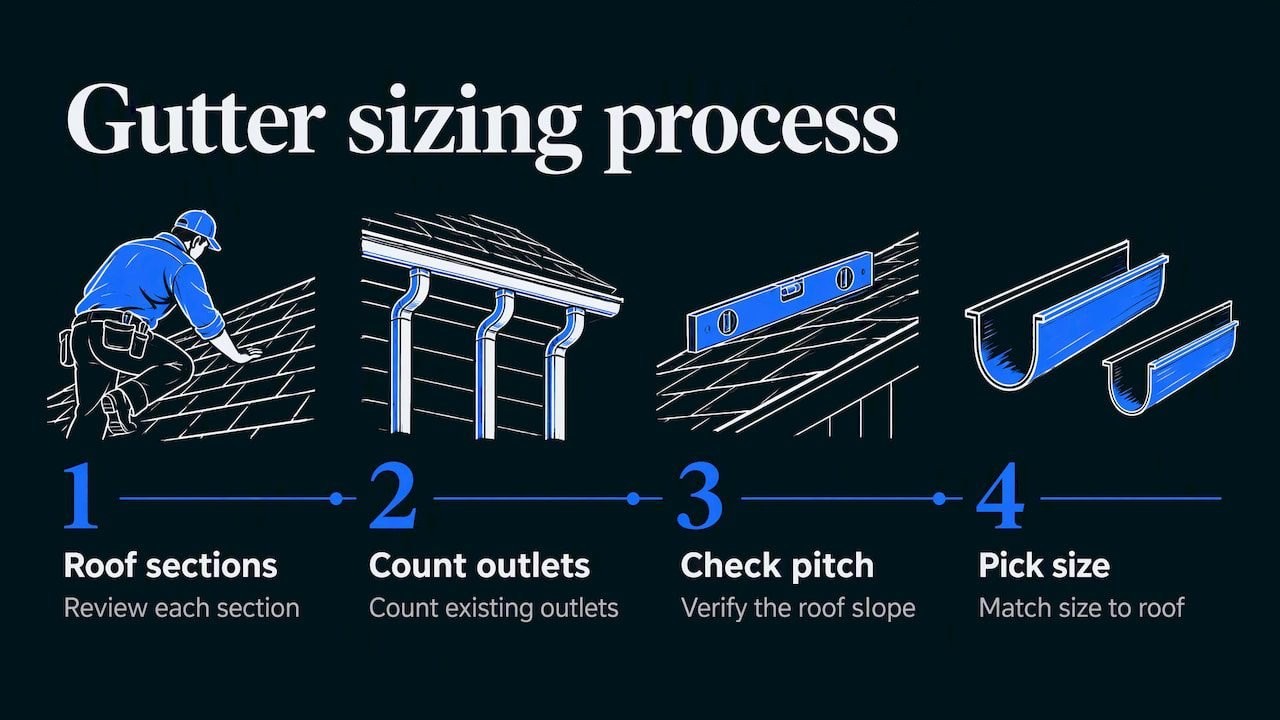
Our approach is simple: look at the roof sections, count the outlets, check the pitch, then pick the size that fits. We would rather tell you 6-inch is enough than sell you something you do not need. That is also why we stand behind our work with a Lifetime No-Clog Guarantee and do not leave a job site until you are satisfied.
— Brian
Get a size recommendation for your home
If you are replacing gutters or fixing overflow in Sarasota or a nearby county, we will look at your roof layout, pitch and drainage and tell you plainly whether 6-inch or 7-inch fits. We install seamless gutters, downspouts and gutter guards, and we repair what you already have.

See our gutter installation services or visit Five Star Aluminum to request an estimate. If your gutters are failing, our guide to signs your gutters need replacing is a good place to start. We offer satisfaction or no payment, so you can ask your questions with confidence.
FAQ
Is a 7-inch gutter always better than a 6-inch?
No. It carries about 40 percent more water per linear foot, but you only benefit when your roof actually needs the capacity. On a moderate roof with enough downspouts, 6-inch performs well and costs less in material.
Can I switch from 6-inch to 7-inch without changing downspouts?
You can, but you should not. A 7-inch gutter is typically paired with 4×5-inch downspouts, and a smaller outlet becomes the bottleneck. Plan on changing gutters, outlets and downspouts as one system.
Do Florida codes require a specific gutter size?
The Florida Building Code text we reviewed does not name a required width for ordinary homes. It does require downspouts to discharge at least 1 foot from the foundation. Local drainage standards and HOA rules may add requirements, so check yours.
Would adding a downspout be enough instead of upsizing?
Often, yes. If a long run overflows, the cheapest fix may be another outlet or a better pitch. Guidance suggests stepping up a gutter size or adding a downspout when a single-pitch run passes 40 feet.