

A gutter corner leaks for one of two reasons: the seam has failed, or water is backing up and forcing its way out of the weakest point in the run. The first calls for a proper reseal or a new corner. The second calls for clearing a clog or fixing the slope. This guide shows you how to tell which one you have, what you can safely do from the ground, and when it is time to call a professional.
TL;DR
- Corners and end caps are the joints in a seamless system, so they are where leaks start. Straight runs are continuous metal. (The Roofing Brief)
- Aging sealant, thermal movement, debris, poor pitch and clogged downspouts are the usual culprits.
- Sealant only works on clean, dry metal with the old material removed. Caulk over failed caulk fails again.
- Standing water, overflow and slow downspouts point to a clog or slope problem, not just a bad seam.
- A professional gutter repair averages about $390, with a typical range of $120 to $900 (Angi).
Table of Contents
- What the corner of a gutter is, and why it leaks
- Is it the seam or a clog? A 10-minute check
- Gutters not draining: how to clear the blockage
- How to seal a leaking gutter corner
- When to replace the corner instead of resealing
- What water behind a leaking corner does to your home
- Send the water away from the house
- What does it cost to fix a leaking gutter?
- Our perspective: fix the cause, not the drip
- Keep corner leaks from coming back
- Need a leaking corner fixed properly?
- FAQ
- Sources
What the corner of a gutter is, and why it leaks
The corner piece is usually called a miter, or an inside or outside corner. On a seamless system, the long straight runs are formed from one piece of metal. The joints exist only where the gutter turns a corner or ends, which means at the miters and the end caps (The Roofing Brief).
That is why a corner leak is such a common complaint, even on high-quality gutters. Every joint is held together by fasteners and sealant, and sealant has a limited life. The usual causes of a leaking corner are:
- Aging sealant. It dries, shrinks and pulls away from the metal.
- Thermal movement. Aluminum expands and contracts with temperature, and that flexing works on the joint every day.
- Debris buildup. Leaves, shingle grit and pine needles collect in corners, hold moisture and add weight.
- Poor pitch. If the run slopes the wrong way, water pools at a joint instead of heading to the downspout.
- Clogged downspouts. Water backs up the run and finds the seam.
The last three are drainage problems that show up as a leak. Resealing a corner will not help if the water is only leaking because it has nowhere to go (The Roofing Brief).
In Florida, add heavy summer downpours and sun that bakes sealant year-round. A gutter corner that holds up in a mild climate can open up quickly here. We cover how corner construction affects durability in our guide to seamless gutter corner methods.
Is it the seam or a clog? A 10-minute check
Before you buy a tube of sealant, work out where the water is really coming from. Do this from the ground or a stable ladder, and only in dry weather.
Look at when and where it drips
- Drips only during heavy rain usually mean the gutter is overflowing or backing up. The corner is where the extra water escapes.
- Drips in light rain, or minutes after it stops, point to a failed seam that leaks whenever water passes over it.
- Staining or streaks below the corner show the leak is long-running.
- Peeling paint or soft fascia behind the corner mean water has been getting in for a while.
Check the signs of a clogged gutter
Home improvement guidance lists three things to look for: downspouts that flow slowly or not at all, gutters that overflow or sag, and debris visible in the gutter or downspout (Better Homes & Gardens). If you see any of them, you probably have a drainage problem as well as, or instead of, a seam problem.
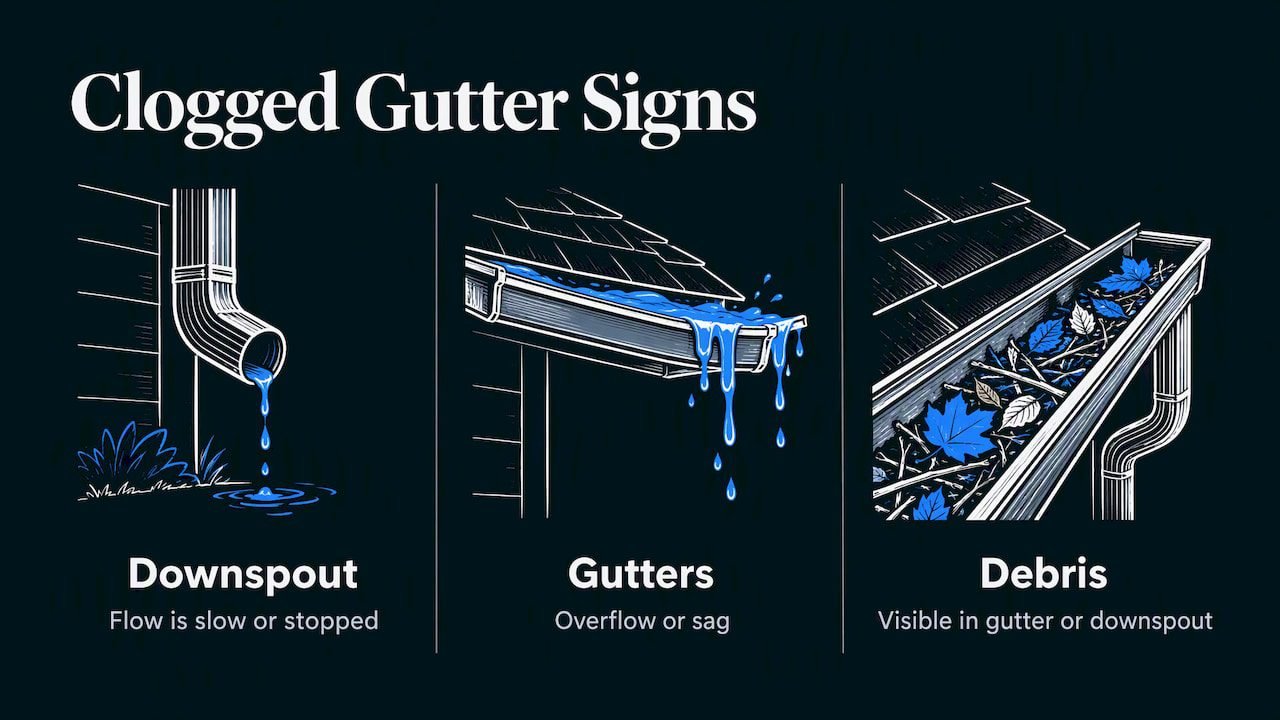
Standing water in a gutter is the clearest sign. Water should drain within minutes of rain stopping. A pool that lingers means a clog, a low spot or a pitch problem.
Run a hose test
Run water into the gutter at the high end and watch it travel. Watch the corner, the downspout outlet and any sagging section. If water leaks at the joint while the flow is light and steady, the seam is the problem. If it only leaks once the gutter fills, you have a flow problem. Our walkthrough on testing gutter overflow with a hose covers this step by step.
One caution: water on a wall or ceiling is not always the gutter. A leaking outdoor spigot can look just like a gutter leak, and fixing a leaking hose bib is a different job entirely. Trace the water to its source before you start repairs.
Gutters not draining: how to clear the blockage
If the gutters are not draining, start with the clog. Clean out debris by hand with gloves. Then flush the system. If water still does not flow freely after cleaning, a blockage remains. West Virginia University Extension advises clearing it with full-pressure hose water or a plumber’s snake (WVU Extension). It also recommends a pistol-grip nozzle to control the pressure, with goggles and gloves for protection.
Stay safe on the ladder
Most gutter injuries come from the ladder, not the gutter. The same WVU guidance recommends heavy gloves, safety goggles and a sturdy ladder on level, flat ground, and it warns that climbing onto the roof is extremely dangerous (WVU Extension). Set the ladder base one-quarter of its working length out from the wall. An extension ladder used to reach a higher surface should extend at least 3 feet above the support point (Douglas County).
If your gutters are on a second story, or the corner is over a porch roof or hard to reach, hire a professional. A leaking corner is not worth a fall.
How to seal a leaking gutter corner
If the metal is sound and the seam has simply opened up, a reseal can buy you real time. The order matters more than the product.
- Clean the area. Remove debris and scrub the joint so you see bare metal.
- Remove the old sealant. New sealant applied over old, failing material bonds to that layer rather than the metal, so it fails when the old layer does (The Roofing Brief). Scrape or cut away every loose bit.
- Dry the joint fully. Sealant needs a clean, dry surface to grip. Check the product’s data sheet for cure time and temperature limits (The Roofing Brief).
- Apply a gutter-rated sealant along the inside seam, covering the joint and the fastener heads.
- Let it cure before the next rain. Then re-run the hose test.
Two habits cause most failed repairs. People smear sealant over wet or dirty metal, and they patch a corner that is really leaking because water is backing up. If you reseal and the corner leaks again within a season, the joint is likely moving too much, the metal is worn, or the real problem is pitch.
Why spray and tape fixes often disappoint
Spray-on and peel-and-stick products are tempting because they promise a quick fix. A seam that flexes with every temperature swing tends to pull away from a rigid or thin coating. They also hide the problem. If the patch seems to hold but water is still pooling behind it, you can damage the fascia without noticing.
When to replace the corner instead of resealing
Resealing is fine for a joint that is basically healthy. Replace the corner, or the section, when:
- You have already resealed once or twice and it keeps leaking.
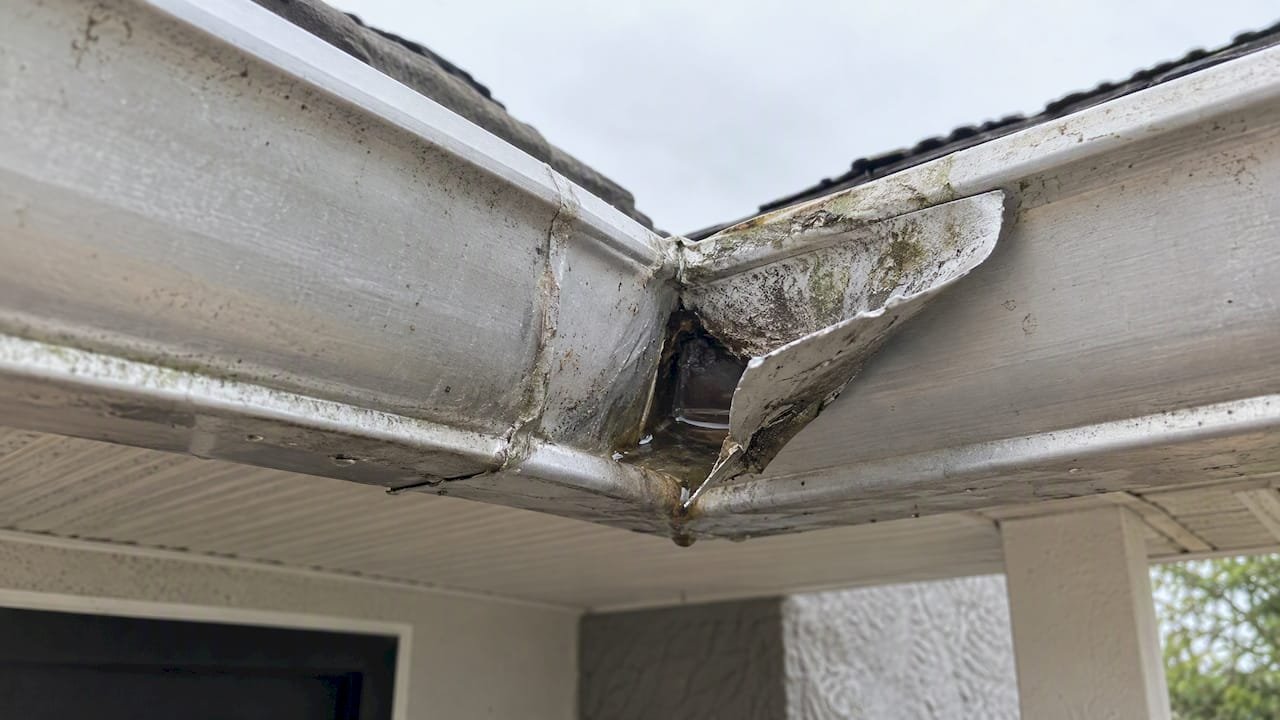
- The metal is cracked, dented, corroded or pulling apart at the joint.
- Rivets or fasteners are loose, rusted or missing, and the corner shifts when you touch it.
- The gutter near the corner sags, so water pools no matter how well it is sealed.
- Fascia or soffit behind the joint is stained, soft or rotting.
Housing regulators treat this as more than cosmetic. HUD’s 2023 NSPIRE roof standard classes damaged, missing or unfixed gutter components as a moderate health and safety deficiency that must be corrected within 30 days (HUD NSPIRE). That standard applies to HUD-assisted housing, but it shows how seriously the industry takes a gutter that cannot carry water away.
If several corners fail, or the gutters are old, a full replacement often makes more sense than repeated patching. Our guide to the signs your gutters need replacing explains how to decide. You can also see how seamless gutters compare with regular sectional gutters when it comes to joints.
What water behind a leaking corner does to your home
A small drip is easy to ignore. Do not. Water that escapes at a corner runs down the fascia and soffit, and along the foundation line. Over time it can cause:
- Paint failure and soft, rotting fascia boards
- Stained or sagging soffit, and moisture in the attic
- Mold on soffits, which needs the moisture fixed first
- Erosion and pooling near the foundation
If you already see damage behind the corner, read our notes on soffit and fascia replacement costs and on mold on soffits. Fixing the gutter alone will not undo wood that has already rotted.
Send the water away from the house
Even a perfect corner cannot help if the downspout empties beside the foundation. NC State Extension advises conducting gutter water to a suitable release point at least 10 feet downhill and away from the house (NC State Extension).
If the ground near the downspout is flat or slopes toward the house, extend the discharge with a buried pipe or an above-ground extension. Surface channels can also help; driveway drainage channels show how a shallow channel carries water across a paved area. If you need a new or relocated outlet, see our downspout installation service.
What does it cost to fix a leaking gutter?
National figures give you a rough frame. Angi reports that a professional gutter repair averages about $390, with a range from $120 to $900 depending on damage type and material (Angi). Several things move the price:
- Number of corners and seams. One corner is a small job. A whole house of tired seams is not.
- Home height. Two-story work needs more equipment and time.
- Gutter material. Aluminum is generally less costly to work with than copper.
- Hidden damage. Rotted fascia or a sagging run adds carpentry to the bill.
- Access. Roof lines with dormers, porches or tight spaces take longer.
We do not publish set prices, because the cost depends on what we find when we look at the gutters in person. After an inspection, you receive a quote for the actual job.
Our perspective: fix the cause, not the drip
We have installed and repaired gutters in Sarasota and nearby counties for over 20 years. The pattern we see most is simple. Homeowners reseal a corner, it holds for a few weeks, and then it leaks again. Nine times out of ten, the sealant was not the problem. Either there was old material under the new, the run was clogged downstream, or the gutter was no longer pitched correctly.
So we start by finding out why the water is escaping. We check the slope, the downspouts and the fascia before touching the seam. When a corner is truly done, we replace it rather than layering on another patch.
In Florida, salt air and strong sun are hard on cheap materials, which is why we use salt-air-resistant aluminum and vinyl. For homeowners whose gutters keep filling with oak leaves and pine needles, we also install gutter guards, and we stand behind them with a Lifetime No-Clog Guarantee. Fewer clogs mean less standing water, and less strain on every joint.
A good repair should leave you with dry fascia and no mystery drips, not a tube of caulk to reapply next year.
— Brian
Keep corner leaks from coming back
Prevention is mostly routine. WVU Extension recommends clearing debris at least twice a year to protect against water damage and flooding (WVU Extension). In Florida, where trees drop debris year-round, many homes need more frequent attention, especially after storms.
- Clear the gutters and corners before and after the heaviest rain months.
- Run a hose through the system and check the downspout outlets.
- Look at the corners for cracked sealant, gaps or rust streaks.
- Trim branches that overhang the roof.
- Check that the discharge points move water well away from the house.
- Consider gutter guards if you are cleaning more than a couple of times a year.
Our seasonal gutter checklist helps you decide what to do yourself and what to leave to a pro. For more routine care, see our maintenance tips for seamless gutters.
Need a leaking corner fixed properly?
If the corner keeps leaking, the metal is worn, or you have standing water and don’t know why, we can find the cause and fix it. Our team handles gutter repair, cleaning and storm damage restoration, and we replace full runs when patching no longer makes sense. We promise not to leave the job site until you are satisfied, and we guarantee satisfaction or no payment. Contact Five Star Aluminum through our website to schedule an inspection.
FAQ
What is the best way to seal a leaking gutter corner?
Remove the old sealant completely, clean the joint to bare metal, let it dry, then apply a gutter-rated sealant to the inside seam. New sealant over old failing sealant bonds to the old layer, so it fails with it. If the corner leaks again after a proper reseal, the joint is likely worn or water is backing up.
Why is there standing water in my gutters?
Standing water usually means a clog, a downspout blockage or a gutter that is not pitched toward the outlet. Clear debris, then flush with a hose. If water still pools, the slope may have shifted and the run needs to be re-hung.
How can I tell if my gutters are clogged?
Look for overflow during rain, sagging sections, slow-flowing downspouts and visible debris in the gutter or downspout (Better Homes & Gardens). Water trickling out of a corner instead of reaching the downspout is another clue.
How much does it cost to fix a leaking gutter?
Professional repairs average about $390 nationally, with a range from $120 to $900 (Angi). The number of leaking corners, the height of your home and any rotted fascia behind the gutter decide where yours lands.
Sources
- The Roofing Brief: Seamless Gutter Corners
- Better Homes & Gardens: How to Clean Gutters
- WVU Extension: Gutter Safety
- Douglas County: Asphalt Shingle Roofing Checklist
- HUD: NSPIRE Standard, Roof Assembly
- NC State Extension: Gutter Management
- Angi: Gutter Repair Cost
- Paradigm Services: Leaking Outdoor Hose Bib
- GL Driveways: Driveway Drainage Channels