

The clearest signs of poor attic ventilation are an attic that bakes in summer, damp or dark-stained wood on the underside of the roof, rusty nails, a musty smell, warped soffits, and ice dams in cold climates. In Florida, add upstairs rooms that never cool down and shingles that age faster than they should. Most of these signs come down to one thing: heat and moisture have nowhere to go.
Below, we walk through each sign, what it usually means, how to check your own attic without taking risks, and when it is time to bring in someone who can fix it.
TL;DR
- Look for heat, moisture and mold in the attic itself: wet or stained wood, water-stained insulation, rusty nails and a musty smell.
- Check the outside too: warped or rotting soffit panels, bubbled paint on fascia boards and curling shingles point to trouble above.
- Blocked soffit vents, mixed exhaust vent types and bathroom fans venting into the attic are the most common causes, and none of them need a new roof to fix.
- Seal ceiling air leaks first, then balance intake and exhaust vents. Adding vents alone rarely solves it.
- If you cannot pinpoint the problem, a professional inspection beats guessing which vent to add.
Table of Contents
- Why attic ventilation matters more than most people think
- Signs you can spot inside the attic
- Signs you can see from outside the house
- A quick table: symptom, likely cause, next step
- The hidden causes behind most ventilation problems
- How to check your attic ventilation, step by step
- What happens if you ignore it
- What fixing it usually involves
- Our perspective: start at the eaves
- When to call us
- FAQ
- Sources
Why attic ventilation matters more than most people think
Most homeowners assume attic ventilation is about letting summer heat escape. That is only half of it. According to the Department of Energy’s Consumer Guide to Durable Attics, the number one enemy of an attic is moisture, which can enter from above, below or the side and can warp the roof and render insulation useless. Steady airflow all year is your main defense against it.
As the Home Ventilating Institute explains, in cold weather, equalizing attic and outdoor temperatures keeps moist air from condensing on the underside of the roof and rafters, which can lead to mildew and rot. In hot weather, the same airflow takes pressure off your shingles and your air conditioner. ENERGY STAR notes that trapped heat makes cooling systems work harder, and that damp insulation loses some of its insulating value.
Florida homes sit in the middle of this. Long, humid summers, heavy rain and salt air mean your attic and the soffits that feed it are under stress most of the year. That is why we look at ventilation on almost every exterior job we do.
Signs you can spot inside the attic
Bring a flashlight, step only on joists or solid boards, and go in the cooler part of the morning. If your attic is already very hot, skip the climb and look from the hatch.
Wet, stained or warped wood
The Department of Energy’s guidance lists warped, rotted or discolored wood on rafters and joists among the common signs. Look at the underside of the roof sheathing in particular. Dark patches, old water rings or a damp feel suggest moisture has been sitting there. A home inspector’s checklist from the American Society of Home Inspectors treats a balanced system, with exhaust near the ridge and intake at the eaves, as a first thing to verify.
Rusty nails and fasteners
Roofing nails that poke through the sheathing should be dry and dull gray. Rust on nail tips and other fasteners points to condensation, because metal only rusts where moisture keeps returning. A frosty look on nails in winter is the same warning in colder climates.
Damp insulation
Press a handful of insulation. If it is clumped, compressed or water-stained, moisture is getting in from somewhere. Wet insulation does not insulate well, so it also shows up as higher energy bills. ENERGY STAR lists wet or damp insulation, along with moldy or rotted rafters and joists, among the problems you may need a contractor to correct.
Mold, mildew and a musty smell
Fuzzy or black spotting on wood, or a damp odor when you open the hatch, usually follows a long stretch of trapped moisture. Insurance-industry guidance from Liberty+ also lists musty odors and condensation among the key indicators. Treat visible mold as a symptom: the moisture source has to be found and corrected before any cleaning will last.
An attic that feels like an oven
An attic is always hotter than outdoors on a sunny day, so heat alone proves little. What matters is the pattern: upstairs rooms that stay warm long after sunset, an air conditioner that runs constantly, and attic air that feels stagnant. Trapped heat can also cook shingles from underneath, which brings us to the exterior signs.
Signs you can see from outside the house
You can learn a lot from the ground with a pair of binoculars.
- Warped or rotting soffit panels. The Department of Energy’s Guide to Durable Attics lists warped or rotted soffit panels and the fascia board behind them as signs of possible water intrusion.
- Bubbled or peeling paint on fascia and soffits. Moisture is pushing out from behind the paint.
- Worn, curling or warped shingles. Heat and moisture stress the roof from below as well as above.
- Ice dams (cold climates). These form when heat escapes from the living space into the attic and melts snow on the roof. It is rare in Sarasota, but common if you moved from the north or own a second home there.
- Stains on soffits or ceilings below. NDSU Extension notes that if you have spots on your ceiling, you already have a moisture problem.
Soffits do double duty: they are decorative trim and the main air intake for your attic. If you see damage there, read our guide on what to do when soffit vents are blocked, and if you see dark spotting on them, mold on soffits needs moisture fixed before it is cleaned.
A quick table: symptom, likely cause, next step
| What you see | Likely cause | Sensible next step |
|---|---|---|
| Rust on nail tips, damp sheathing | Condensation from poor airflow or an air leak below | Check intake vents, then seal ceiling leaks |
| Hot upstairs rooms, high cooling bills | Blocked intake, too little exhaust, or a leaky ceiling | Inspect soffit vents and baffles |
| Musty smell, visible mold | Long-term moisture, possibly a bathroom fan venting into the attic | Trace the moisture source before cleaning |
| Warped soffit panels, bubbled fascia paint | Water intrusion or trapped moisture at the eaves | Have the soffit and fascia evaluated |
| Curling shingles | Heat or moisture stress from below | Have the roof and ventilation assessed together |
| Rain or snow marks near a vent | Mixed exhaust vent types pulling weather in | Review the vent layout |
The hidden causes behind most ventilation problems
The vents on your roof may be fine. What goes wrong is usually what surrounds them.
Insulation covering the soffit vents
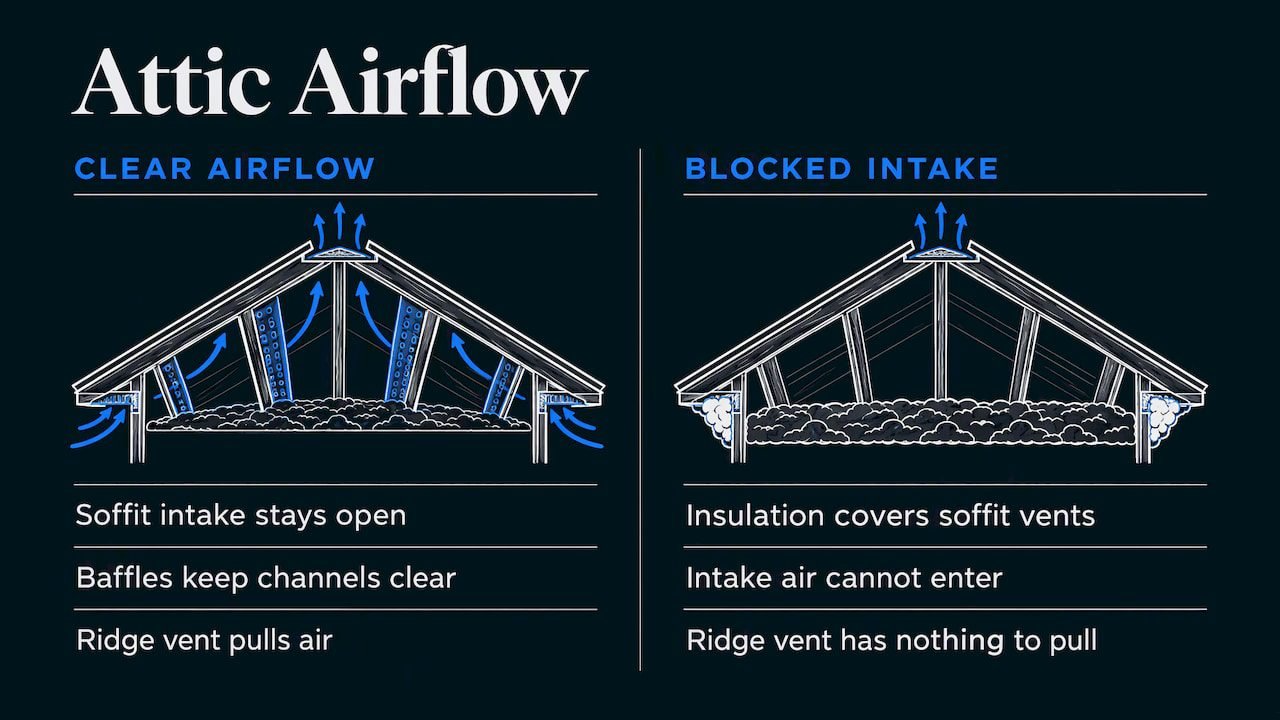
ENERGY STAR’s attic guidance calls blocking airflow at the eaves the most common mistake homeowners make when adding insulation. Its rule is plain: never cover attic soffit vents with insulation, and use rafter vents (baffles) to keep a channel open. Check every rafter bay, not just a few. If intake air cannot get in, your ridge vent has nothing to pull, and the attic turns into a pocket of dead air.
Mixing exhaust vent types
The home inspectors’ checklist flags a less obvious problem: ridge vents combined with power fans or gable louvers on the same roof. Air takes the path of least resistance, so one exhaust vent can start acting as an intake and draw rain or snow under the roof deck. If you see more than one kind of exhaust vent, it is worth a closer look.
Bathroom, kitchen and dryer ducts ending in the attic
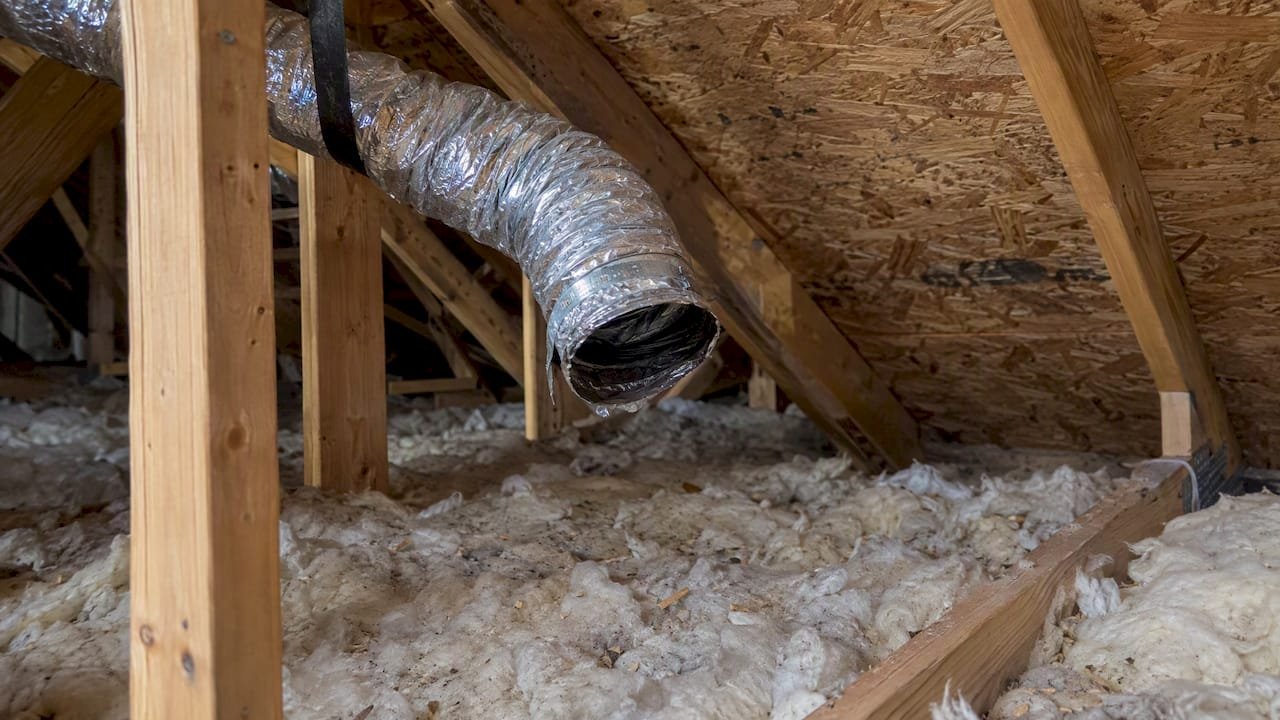
Exhaust ducts that dump into the attic instead of going outside add a steady stream of moisture. The Department of Energy guidance treats this as a serious problem that leads to mold and decay of rafters and joists. Many areas treat it as a code violation. If you find a duct ending in your attic, have it rerouted to the outdoors by a licensed professional.
Air leaks from the living space
You cannot ventilate your way out of a leaky ceiling. ENERGY STAR’s guide stresses sealing air leaks around recessed lights, plumbing penetrations and the attic hatch, because otherwise conditioned air pours into the attic and moisture follows. Seal the leaks first, then fine-tune the vents.
How to check your attic ventilation, step by step
- Count your vents. Note whether you have soffit (intake) vents, ridge or other exhaust vents, or both.
- Look for balance. The Department of Energy suggests roughly half the vent area high near the peak and half low at the eaves.
- Check the ratio. The same guidance gives a rule of thumb of 1 square foot of net free vent area for every 300 square feet of attic space when a ceiling vapor retarder is present, and 1 square foot per 150 square feet of ceiling area without one. Net free area is printed on the vent, not the same as its overall size.
- Inspect each rafter bay at the eaves. Make sure insulation is held back by baffles and you can see daylight or open airspace at the soffit.
- Trace every duct. Bathroom fans, range hoods and dryer vents should all exit the house.
- Photograph what you find. Dated photos help a contractor, and they matter if you ever file a claim.
That last point connects to insurance. Documented attic and roof-edge condition can matter at renewal, and this walkthrough of the home insurance inspection steps shows how inspectors look at a home’s exterior and structure, so you know what to tidy up first.
The Department of Energy guidance also points out that when you suspect a problem but cannot find it, a professional assessment is the most reliable next step. It recommends a contractor certified by the Building Performance Institute, who can pressure-test the home and show where air is bypassing the ceiling. That is often more useful than guessing which vent to add.
What happens if you ignore it
The damage builds slowly, which is why it gets ignored. Moisture rots rafters and sheathing, ruins insulation, and feeds mold. Heat shortens the life of shingles and raises cooling costs, according to ENERGY STAR. And damage at the eaves, where soffit and fascia sit, can let water and pests into the attic and shorten the life of your gutters’ mounting boards. Our soffit vs fascia checklist shows how the two parts work together to keep attic moisture in check.
Water management outside matters as well. Overflowing gutters soak the fascia and eaves, and that moisture ends up in the attic. If you notice overflow in heavy rain, try the hose test for gutter overflow before you call anyone.
What fixing it usually involves
The right fix depends on the cause. Common steps include:
- Clearing blocked soffit vents and installing baffles so insulation stays back from the eaves
- Replacing damaged or rotted soffit panels and fascia boards
- Adding or rebalancing intake and exhaust vents
- Rerouting fan and dryer ducts outdoors
- Sealing ceiling air leaks before changing the vent layout
Cost depends on the roof, the vent type and how much wood is damaged. Our guide to attic ventilation costs and the 1:300 rule breaks down what drives the price, and the soffit and fascia replacement guide covers the eaves side, including when DIY makes sense and when it does not. Building materials matter too: our page on fascia board materials explains why you should check local codes first.
Our perspective: start at the eaves
After more than 20 years working on Sarasota-area homes, we see the same pattern. Homeowners call about a stained soffit, a sagging gutter or a peeling fascia board, and the cause turns out to be airflow. The soffit panel that looks cosmetically tired is often the intake for the whole attic, and it has been painted over, crushed, or buried under insulation.
So we do not treat ventilation as a separate product to sell. We look at the roof edge as a system: gutters carry water away, fascia holds the gutters and closes the end of the rafters, and soffits let the attic breathe. If one fails, the others suffer. Salt air and constant humidity speed that up in Florida, which is why we install salt-air-resistant aluminum and vinyl materials.
Our advice is simple. Do not add vents until you know why the current ones are not working. Check the eaves first, fix leaks and blocked intake, and only then change the layout. And if you are not comfortable crawling around an attic in Florida heat, you do not have to. A good contractor can read the problem from the outside and a quick look inside.
— Brian
When to call us
If you see warped soffits, bubbled fascia paint, water stains at the roof edge or signs of blocked vents, we can inspect the exterior and tell you what we find. Five Star Aluminum handles soffit and fascia repair, soffit and fascia installation and attic ventilation improvement for homeowners in Sarasota and nearby counties. We back our work with a satisfaction-or-no-payment promise and do not leave a job site until you are satisfied.
To talk through what you are seeing, contact Five Star Aluminum today.
If your attic shows signs of active mold, wet insulation across a large area, or a roof leak, treat that as a repair job first. ENERGY STAR lists these as problems that call for a contractor. For suspected mold affecting your health, ask a qualified mold professional or your doctor, not a ventilation fix alone.
FAQ
How do you fix poor ventilation in an attic?
Find the cause first. Clear blocked soffit vents, add baffles so insulation does not cover them, reroute any ducts that end in the attic, and seal ceiling air leaks. Only then add or rebalance vents so intake and exhaust are roughly equal. A contractor can do this in one visit.
How much does it cost to improve attic ventilation?
It varies with the roof, vent type and amount of damage, so no single figure fits every home. Our cost guide for Florida attic ventilation explains the range and what pushes it up or down. For a firm number, ask for an on-site estimate.
How can I tell if my attic has moisture in it?
Look for dark or damp wood on the underside of the roof, rusty nail tips, clumped or stained insulation and a musty smell. Check ceilings below for stains too. If you cannot find the source, have a professional assess it.
What happens if your attic is not vented properly?
Moisture builds up and can lead to mold, rotted wood and damp insulation. Trapped heat makes your air conditioner work harder and stresses your shingles. Problems at the soffits and fascia often show up first.
Sources
- Consumer Guide to Durable Attics, U.S. Department of Energy
- Guide to Durable Attics, U.S. Department of Energy
- A Do-It-Yourself Guide to Sealing and Insulating with ENERGY STAR
- An Attic Ventilation Checklist for Home Inspectors, American Society of Home Inspectors
- Attic Ventilation, Home Ventilating Institute
- Attic Ventilation is Often Overlooked, NDSU Agriculture
- 5 signs your home has poor attic ventilation, Liberty+