The safest soffit and fascia colors are white, a soft neutral, or a dark bronze or black that echoes your windows or roof. Pick one lead feature on your house, such as the roof, the trim, or the windows, and build the roofline around it. Matching soffit and fascia gives a clean, unified look. Contrasting them works when the contrast ties back to something else on the house. In Florida, the finish matters as much as the shade, because sun, salt air and humidity are hard on anything that is painted.
TL;DR
- Soffit and fascia do not have to match. A matched pair looks tidy; a contrasting pair works when each color connects to another feature, like the roof, windows or doors.
- Start with one lead feature (roof, trim, or windows) and match undertones rather than chasing an exact shade.
- Gutters and downspouts usually look best in the fascia or trim color, though the roof or siding color can work with some palettes.
- Light soffits brighten an overhang, dark ones add depth, and on a wide, vented soffit a very dark color can look heavy.
- Before you repaint, check for moisture damage. Peeling paint and soft wood are a repair problem first and a color problem second.
Table of Contents
- What soffit and fascia are, and why color matters
- Should soffit and fascia be the same color?
- Start with a lead feature
- Light, dark or mid-tone: how each reads from the street
- Should gutters match the fascia, soffit, siding or roof?
- Perspective: what we see on Florida roofs
- Florida considerations: sun, salt air and humidity
- Check for moisture damage before you choose a color
- Painting soffit and fascia: what to know
- Common color mistakes
- Work with Five Star Aluminum on your roofline
- FAQ
- Sources
What soffit and fascia are, and why color matters
Fascia is the horizontal board or strip that covers the projecting end of a roof eave. Soffit is the material that encloses the underside of the overhang. Those are the definitions used by the National Association of Home Builders. If you want a deeper walk-through of how the two parts work together, our soffit vs fascia homeowner checklist covers it.
Together they form the frame between your roof and your walls. Fascia is seen head-on from the street, and the gutters usually mount to it. Soffit is seen from an angle, mostly when you stand near the house or look up at the porch. That difference drives most color decisions: the fascia is the more visible line, so it tends to carry the stronger color choice, while the soffit supports it.
Should soffit and fascia be the same color?
No, but matching is the easy default. A color consultant at The Color Concierge recommends that soffits and porch ceilings match the fascia when possible for a unified look. She notes that white soffits brighten the underside of the roof, and that a black fascia can be paired with a black soffit or with the body color of the house.
Here is how the choice plays out in practice.
Match them when:
- The house has a simple roofline and you want it to read as one clean band.
- Your overhangs are narrow, so the soffit is barely visible anyway.
- You are using prefinished aluminum or vinyl and want fewer colors to order and keep consistent.
Contrast them when:
- The house has detailed trim, and a stronger fascia sets off a quieter soffit.
- A dark fascia would make a wide soffit feel heavy. In that case, letting the soffit take the body color or a light shade keeps the eave from looking like a dark slab.
- You want a lighter underside over a porch, which reflects more light onto the ceiling.
The rule behind the rule: if you contrast, give the contrast an anchor. A dark fascia that echoes the window frames, the roof or the front door looks planned. A dark fascia with nothing else dark on the house looks like an accident.
Start with a lead feature
Most color regret comes from picking the soffit and fascia in isolation. A better method is to choose a lead feature first, then pull the roofline colors from it.
| Lead feature | Fascia and soffit approach | Result |
|---|---|---|
| Roof (dark shingle or metal) | Fascia in the roof color or one step lighter | Grounds the top of the house, strong and traditional |
| Siding (light or mid-tone) | Fascia in the siding color or a close neighbor | Softens the transition, makes the roofline look lighter |
| White or cream trim | White fascia, white or matching soffit | Crisp and classic, easy to coordinate |
| Black or bronze windows | Dark fascia, soffit in dark or body color | Modern, high contrast, ties windows to roof |
| Brick or stone | Pull a warm neutral from the masonry, such as tan, cream or dark brown | Looks built-in rather than added on |
The same logic applies to outdoor surfaces generally. If you like seeing how a leading exterior element guides a palette, this piece on choosing a color that lasts shows the same approach applied to hardscape.
Match undertones, not exact shades
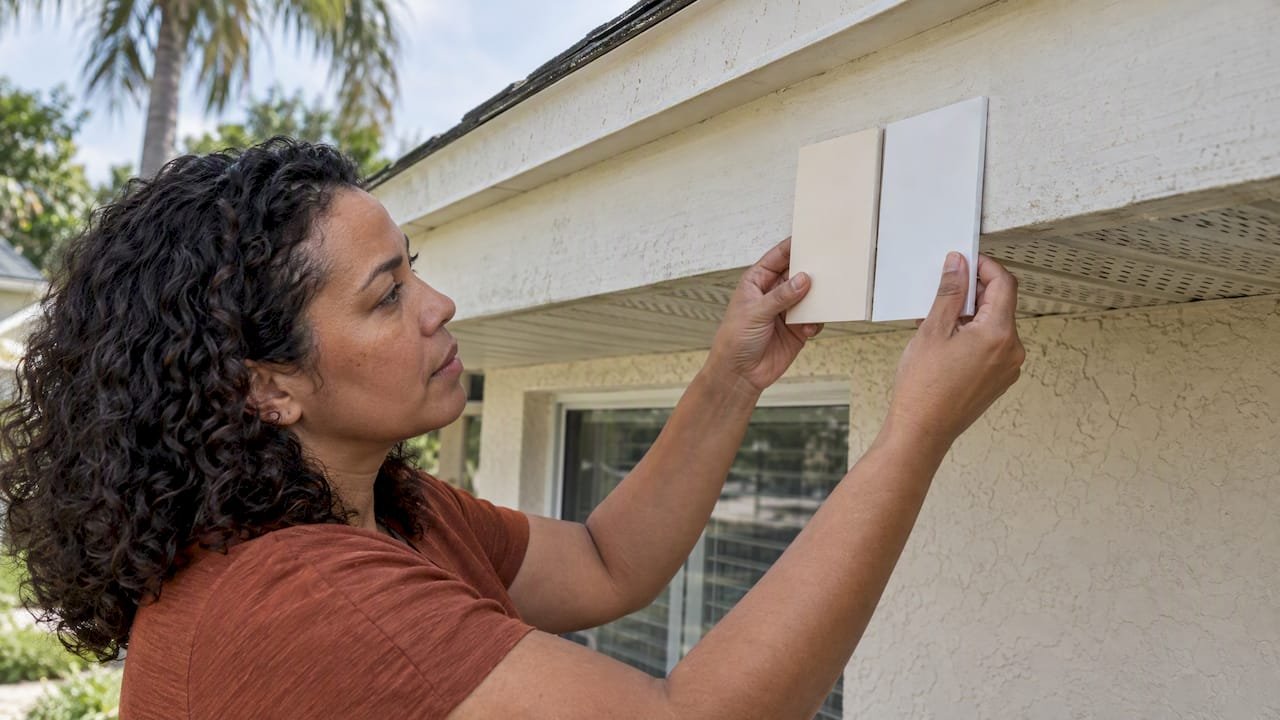
You will rarely get a perfect match between asphalt shingles, aluminum trim coil, vinyl soffit panels and painted wood. They are different materials with different sheens. Instead of chasing an identical shade, check undertones. A warm cream soffit next to a cool bright white fascia will look off, even though both are “white.” Hold samples against each other outdoors, in morning and afternoon light, before you commit.
Light, dark or mid-tone: how each reads from the street
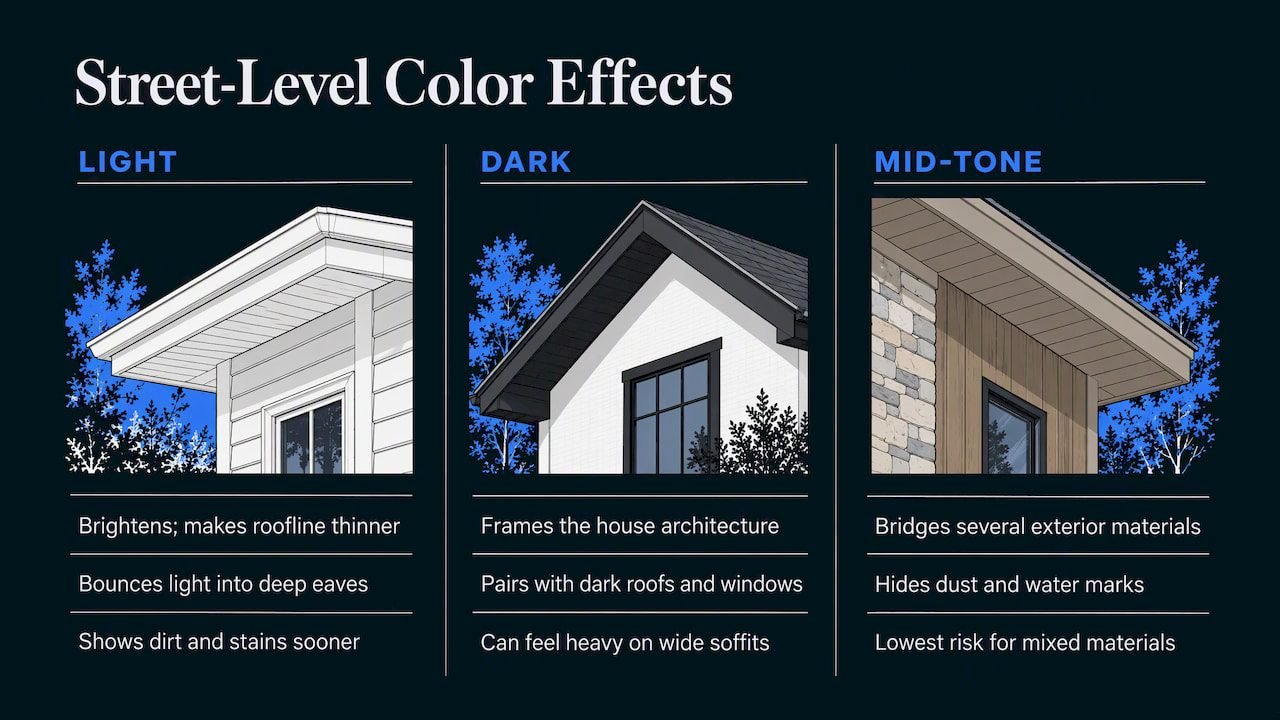
Light colors (white, cream, soft gray). They brighten the overhang and make the roofline look thinner. They are also the most forgiving on a house with deep eaves, because light bounces into the shadowed soffit. The tradeoff is that light colors show dirt, mildew streaks and rust stains from fasteners sooner.
Dark colors (black, bronze, charcoal, deep brown). They frame the house and outline its architecture. They pair naturally with dark roofs and window frames. On a house with a lot of white siding the effect is striking. On a wide soffit, though, very dark can feel heavy, which is why many designers let the soffit stay lighter than the fascia.
Mid-tones (tan, gray, sandstone, taupe). These bridge between siding, masonry, roofing and metal. They hide dust and water marks well and are the lowest-risk option when your house mixes several materials.
A quick gut check: stand across the street, squint, and ask where your eye goes first. If it lands on the roofline when it should land on the front door or the architecture, soften the fascia contrast.
Should gutters match the fascia, soffit, siding or roof?
In most cases, match the gutters to the fascia or trim. One design guide puts it this way: your best bet is usually matching gutters, soffits and downspouts to the trim color, with exceptions depending on roof and window color. Matching gutters to the roof or the siding is less common.
A few practical pairings:
- White fascia and trim: white gutters and downspouts. The gutter disappears into the roofline.
- Dark fascia, dark windows: black or bronze gutters that continue the frame.
- Brown, tan or beige roofs with white trim: white gutters keep it crisp. Brown works if your trim is also brown.
- Downspouts: match the wall color if you want them to vanish, or match the gutter and fascia for a continuous line.
If you are replacing gutters at the same time, it is the cheapest moment to settle the whole roofline palette, since the crew is already on ladders. See our guide on whether to paint gutters or replace them if yours are older but structurally fine, and how K-style and half round profiles change the look.
Perspective: what we see on Florida roofs
We have worked on roofs across Sarasota and nearby counties for more than 20 years, and the color conversation almost always starts the same way: a homeowner holding a paint chip. Our advice is to start somewhere else. Start with the material and the finish, because in this climate they decide how the color will look in five years, not just on installation day.
Three things we tell homeowners:
- Pick a prefinished color you can live with. Prefinished aluminum carries its color through sun and salt air without the repainting cycle that wood needs. That is why we install durable, salt-air-resistant aluminum and vinyl on the soffit, fascia and gutter line.
- Keep the palette small. Two colors on the roofline is usually plenty: one for the fascia, gutters and downspouts, and one for the soffit. Three is where houses start to look busy.
- Do not paint over a problem. If a soffit is sagging, stained or soft, a new color only hides it for a season. Fix the moisture first, then choose the color.
White and bronze are the two colors we are asked for most, and both are safe choices. Bring us your roof and window colors and we will tell you honestly what will look right and what will be a headache to keep clean.
— Brian
Florida considerations: sun, salt air and humidity
A color that looks great in a showroom has to survive years of UV, heavy rain and damp air. A few things to weigh in a hot, humid climate:
- Material first. Wood fascia and soffit need regular repainting to keep water out. By contrast, prefinished aluminum and vinyl keep their color without it. Even fiber cement, which holds its shape and color better than vinyl, has been noted by the NAHB as resistant to salt spray and ultraviolet rays. Our fascia board material guide walks through the four material groups and the code questions to check first.
- Dark colors and heat. Dark trim absorbs more heat than white. On aluminum and vinyl this is usually fine, but it is another reason to choose a quality prefinished product rather than a bargain paint.
- Mildew shows on light colors. In humid weather, green or black streaks appear first on white and cream soffits. If you see them, read our guide to mold on soffits before you scrub or paint, because the cause is often moisture.
- Venting is part of the design. Vented soffit panels have perforations, and the color you choose applies to those too. The U.S. Department of Energy says that proper attic ventilation, such as replacing soffit panels with vented ones, helps control moisture and protect the attic. Do not choose a color or a finish that leads to blocked vents. Our pages on blocked soffit vents and soffit vent spacing explain what to check.
Check for moisture damage before you choose a color
The same Department of Energy guide lists the signs of moisture intrusion: warped or rotted wood soffits, damaged fascia boards, or bubbled paint. If you see any of these, a fresh coat is the wrong first step.
Walk the perimeter of the house and look for:
- Peeling or bubbling paint along the fascia
- Soft spots you can press a screwdriver tip into
- Dark stains or sagging on the soffit panels
- Gutters pulling away from the fascia
- Wasp nests, bird entry points, or gaps at the corners
If the answer is yes to any of them, the fix is repair or replacement, and that is also your best opportunity to change colors. Our soffit and fascia replacement guide explains when to repair, when to replace, and whether the job is realistic for a homeowner. Poor airflow in the attic can contribute, so also see the signs of poor attic ventilation and Florida attic ventilation requirements.
Painting soffit and fascia: what to know
If your soffit and fascia are wood and structurally sound, painting is a normal option. Exterior architectural paints include latex, acrylic and oil-based enamel coatings, and a product made for exterior use is the only kind that belongs on a roofline.
Some practical points:
- Clean and dry first. Remove mildew and let the wood dry fully. Paint over damp wood will peel.
- Repair before you coat. Replace rotted sections. Fill and sand minor damage.
- Prime bare wood and use an exterior paint rated for your climate.
- Be careful with prefinished panels. Painting raw or factory-finished materials is possible, but the NAHB notes it is often not recommended by manufacturers and may affect the warranty. Check with the manufacturer before you buy paint.
- Never paint over vent openings. Clogged perforations cut airflow.
Working at the roofline means ladders and sometimes a second story. For anything beyond a single-story eave, hiring a professional is the safer choice.
Common color mistakes
- Choosing from a tiny chip. A color looks different at a large scale and in direct sun. Test a bigger sample outdoors.
- Forgetting the roof. The roof is the largest color on the roofline and cannot be changed easily. Choose around it.
- Pure white against a cream house. A cooler white fascia can make warm siding look dingy.
- Too many colors. Fascia, soffit, gutters, downspouts, shutters and doors each in a different shade is hard to pull off.
- Ignoring the neighbors and the HOA. Many Florida communities have approved color lists. Check yours before you order materials.
- Painting over damage. See the moisture section above.
Work with Five Star Aluminum on your roofline
If your soffit and fascia are due for replacement, we install them with durable, salt-air-resistant aluminum and vinyl, and we can coordinate gutters and downspouts so the whole roofline reads as one design. We back our gutter work with a Lifetime No-Clog Guarantee and we do not leave a job site until you are satisfied.

See our soffit and fascia installation service or our soffit and fascia repair service, or contact us for a quote in Sarasota and nearby counties.
FAQ
What is the most popular soffit and fascia color?
White is the long-standing default because it pairs with nearly any siding and roof and brightens the overhang. Black and dark bronze are popular on modern or high-contrast homes. For a safe choice, take your cue from your window frames and trim.
Can the soffit be a different color than the fascia?
Yes. Many homes use a stronger fascia with a lighter or body-colored soffit, especially where the eave is wide and a dark soffit would feel heavy. The key is that both colors relate to something else on the house.
What color should gutters be with white fascia?
White gutters are the usual pick, since they blend into the fascia and the roofline stays clean. If your windows or doors are black or bronze, matching gutters to them can also look intentional.
Do I need to repaint aluminum or vinyl soffit and fascia?
Usually not. Prefinished aluminum and vinyl are made to hold their color, so you choose the shade at installation. Painting them may not be recommended by the manufacturer, so check before you try.
Sources
- Retrofit Improvements: Wind Resistant Exterior Cladding (NAHB)
- Choosing Paint Colors for a Home’s Exterior (The Color Concierge)
- Exterior House Details: Gutters, Soffits, & Downspouts
- Concrete Homes Technology Brief No. 15 (NAHB)
- Consumer Guide to Durable Attics (U.S. Department of Energy)
- Definition of Architectural Paint Products (PaintCare)